We use cookies and other tracking technologies to improve your browsing experience on our website, to show you personalized content and targeted ads, to analyze our website traffic, and to understand where our visitors are coming from.
⚠️
GDPR & Cookie Policy Notice
In accordance with data protection regulations; the use of mandatory cookies is required for the core functions of our website to operate, ensure data security, and perform analytics. If you reject the use of cookies, it is not possible to benefit from the services on our website due to technical limitations and data synchronization interruptions. You must consent to the use of cookies to access the content on our site.
Interface Segregation: Reducing Client Dependencies by Splitting 'Fat' Interfaces
Sustainability and flexibility in software architecture are directly related to how precisely the dependencies (coupling) between components are managed. The Interface Segregation Principle (ISP), the fourth pillar of the SOLID principles defined by Robert C. Martin, is one of the most critical tools for cleaning up the technical debt created by “fat” (bloated) interfaces.
The fundamental motto of ISP is: “No client should be forced to depend on methods it does not use.”
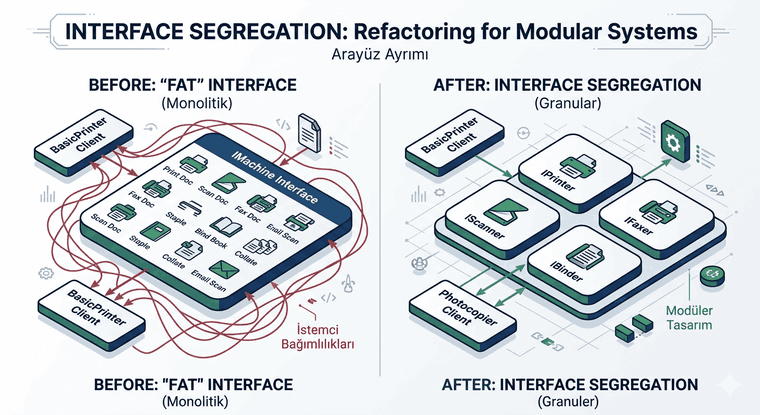
An interface becomes “fat” when it consolidates multiple responsibilities under a single umbrella. This situation causes classes that implement that interface to leave methods unrelated to their business logic empty or to throw a NotImplementedException.
Why Is It Dangerous?
Unnecessary Re-compilation: A small change in the interface leads to the re-compilation of dozens of classes that do not even use that method, along with their dependent modules.
Fragility: The client is affected by side effects in the system due to a dependency it does not actually need.
Code Pollution: Empty methods within a class reduce the readability of the code and complicate unit testing processes.
2. Technical Analysis: Transition from Monolithic to Granular Structure
To understand ISP, let’s consider a classic smart printer scenario. Assume we have a massive IMachine interface that can send faxes, perform scans, and print.
Incorrect Design (Violation of ISP)
publicinterfaceIMachine{
void Print(Document d);
void Scan(Document d);
void Fax(Document d);
}
// A standard printer cannot send a fax but is forced to implement this method.publicclassBasicPrinter : IMachine
{
publicvoid Print(Document d) { /* Printing logic */ }
publicvoid Scan(Document d) { /* Scanning logic */ }
publicvoid Fax(Document d)
{
thrownew NotImplementedException("This device does not support faxing!");
}
}
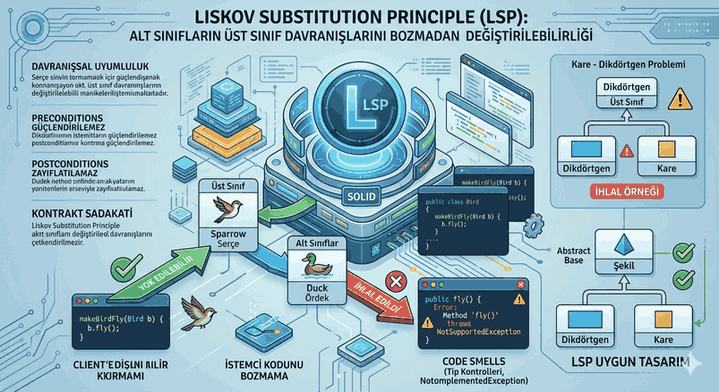
In this design, BasicPrinter becomes dependent on the Fax method despite not having faxing capability. This also opens the door to a violation of the Liskov Substitution Principle (LSP); because if you provide a BasicPrinter to a client expecting an IMachine, the program may crash at runtime.
3. ISP Implementation: Role-Based Interfaces
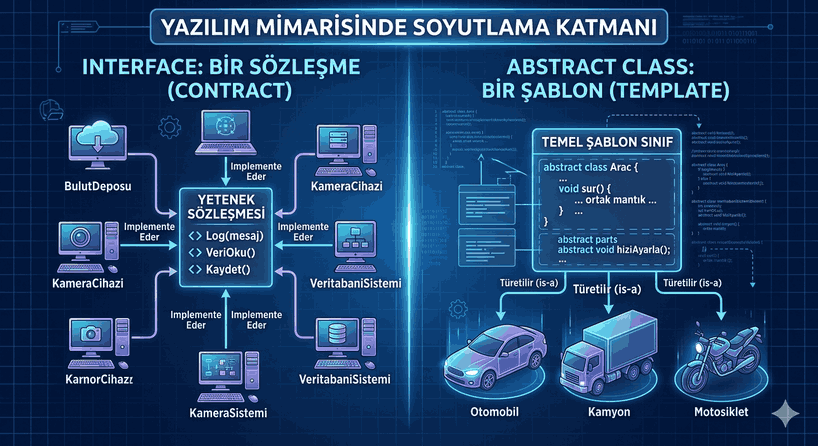
The solution is to break the massive interface into atomic (indivisible) capabilities. This approach is called Interface Factoring.
4. ISP in Software Resources and Library Architectures
When examining modern libraries, one can see how meticulously ISP is applied. This structure is standard, especially in system-level languages and popular frameworks.
.NET and Java Collection Architecture
The IEnumerable, ICollection, IList hierarchy in .NET is an excellent example of ISP.
A method that only wants to iterate over data receives IEnumerable.
If the ability to add/remove data is required, ICollection is used.
If index-based access is required, IList is preferred.
If there were a single IFullCollection interface, even a read-only list would be forced to carry Add() or Remove() methods.
C++ Header Files and V-Table Management
In the C++ world, ISP is critical to keep v-table (virtual table) sizes under control. A class with too many virtual methods increases its memory footprint. Breaking down interfaces ensures that only the necessary function pointers are loaded.
5. Integration with Adapter Pattern
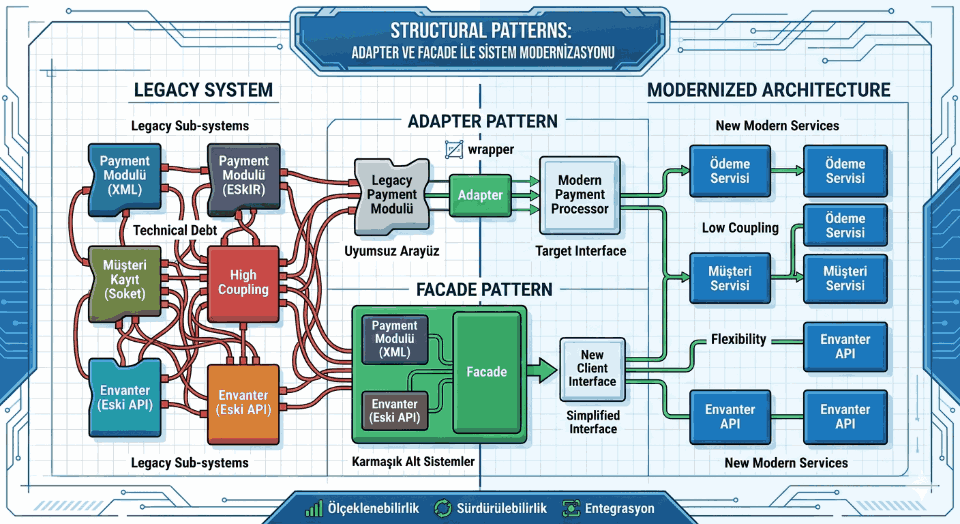
Sometimes you cannot change “fat” classes coming from third-party libraries. In this case, Adapter or Facade patterns come into play to protect ISP. You define small, specific interfaces for your own system and write adapters that connect these interfaces to the massive classes in the outside world. Thus, your domain logic is protected from the dirty design of the external library.
6. Algorithmic and Performance Effects of ISP
The compile-time speed of software is directly related to the dependency graph.
Header Pollution: In C++ and similar languages, changing a massive interface can cause the entire project to be recompiled. ISP increases development velocity by isolating this dependency.
Interface Polluting: A class harboring too many interface methods also pollutes the IntelliSense/Auto-complete features of IDEs. The developer is forced to choose the correct one among dozens of irrelevant options when using the object.
7. Advanced Notes and Implementation Strategies
A. The Risk of Interface Explosion
Applying ISP to the extreme can lead to the creation of hundreds of small interfaces in the system. To maintain this balance, Interface Composition should be used.
Method Usage Analysis: Identify the intensity with which an interface’s methods are used by clients.
Clustering: Group methods that are logically linked to each other.
Hierarchical Transition: Derive the old “fat” interface from new small interfaces to transition without breaking backward compatibility.
C. Microservices and API Design
ISP is valid not only at the code level but also at the API level. Creating specialized BFF (Backend for Frontend) layers for different client types (Mobile, Web, Admin) instead of a massive “God API” offered by a microservice is, in a way, Interface Segregation at the architectural level.
8. Conclusion: Fine-Tuning for Clean Code
The Interface Segregation Principle does not just make software more modular; it also guarantees the evolution capability of the system. Breaking down fat interfaces requires more effort initially, but in the long run, it maximizes the testability and extensibility of the project.
Important Note: ISP is not just about “separating methods”; it is also about transforming the fabric of the system into a network of expertise where each component knows only its own business. When you reduce your dependencies to an atomic level, the fragility of your code decreases and its resistance to change increases.
Summary List for Technical Requirements:
Interfaces should be designed as client-focused, not provider-focused.
Instead of multi-purpose interfaces, interfaces serving a single purpose (consistent with Single Responsibility) should be preferred.
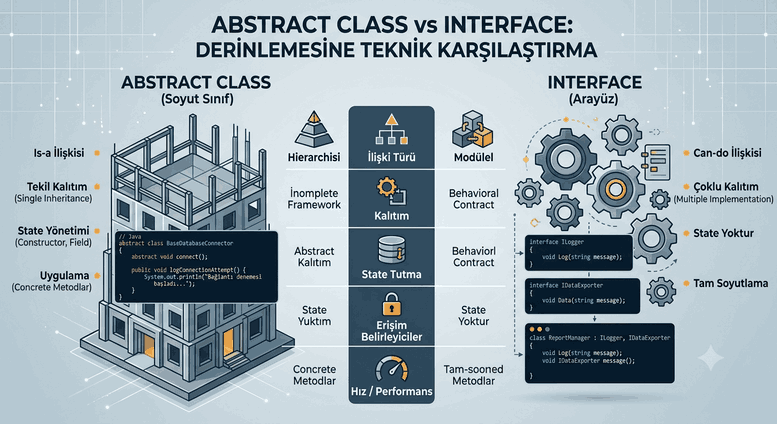
Instead of inheritance, composition and multiple interface implementation should be used.