We use cookies and other tracking technologies to improve your browsing experience on our website, to show you personalized content and targeted ads, to analyze our website traffic, and to understand where our visitors are coming from.
⚠️
GDPR & Cookie Policy Notice
In accordance with data protection regulations; the use of mandatory cookies is required for the core functions of our website to operate, ensure data security, and perform analytics. If you reject the use of cookies, it is not possible to benefit from the services on our website due to technical limitations and data synchronization interruptions. You must consent to the use of cookies to access the content on our site.
OOP Fundamentals: Encapsulation, Inheritance, Polymorphism, and Abstraction
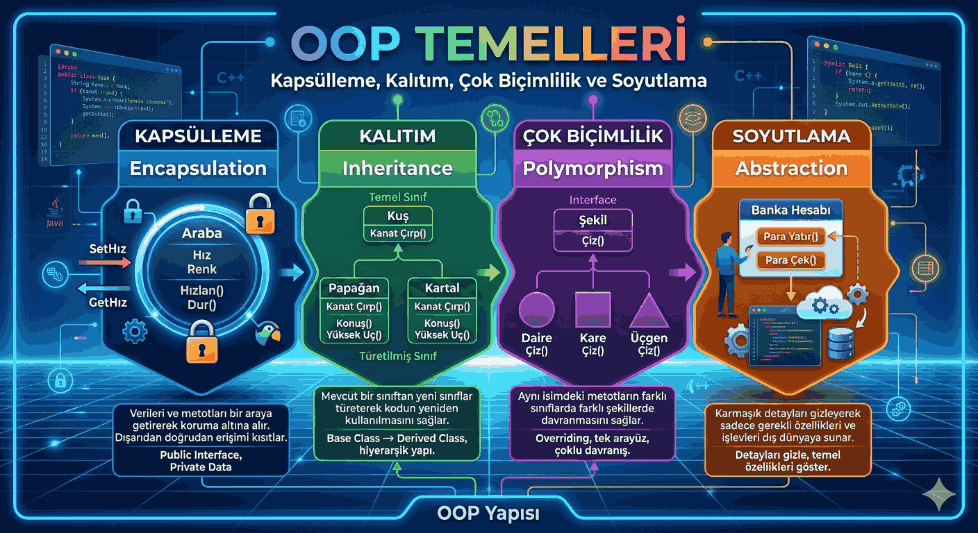
Object-Oriented Programming (OOP) is the most fundamental paradigm used to break down complex software systems into manageable, sustainable, and extensible components. In modern system design, these four core principles—Encapsulation, Inheritance, Polymorphism, and Abstraction—form the backbone of software.
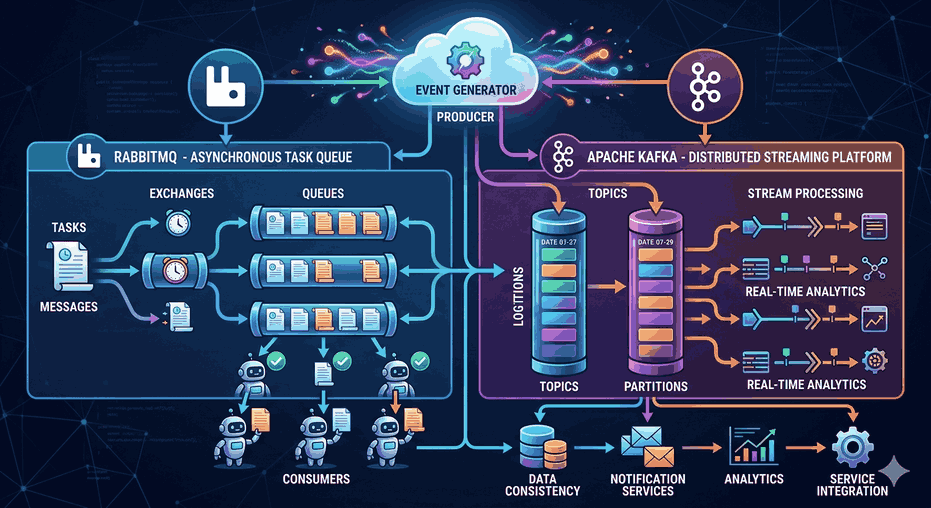
Figure 1: OOP Fundamentals: Encapsulation, Inheritance, Polymorphism, and Abstraction.
1. Abstraction: Hiding System Complexity
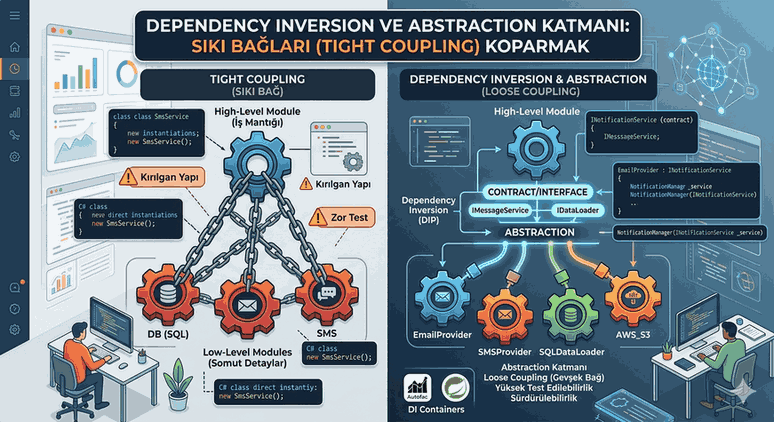
Abstraction focuses on the functionality an object presents to the outside world, hiding the internal details of “how” the object performs that task. In system design, abstraction is the most critical tool for reducing coupling.
Technical Detail and Architectural Role
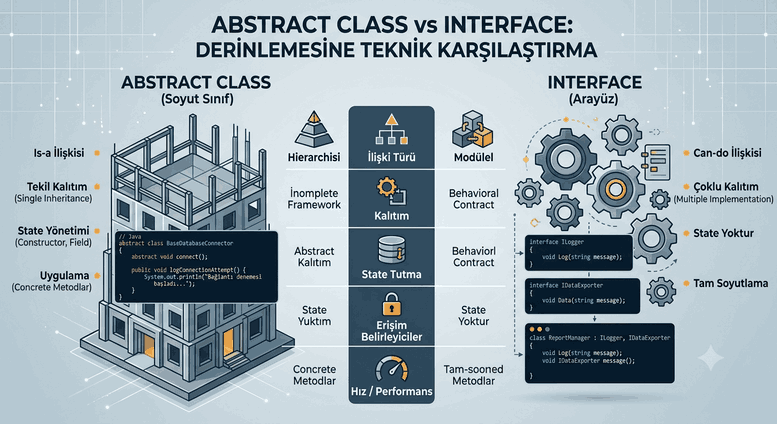
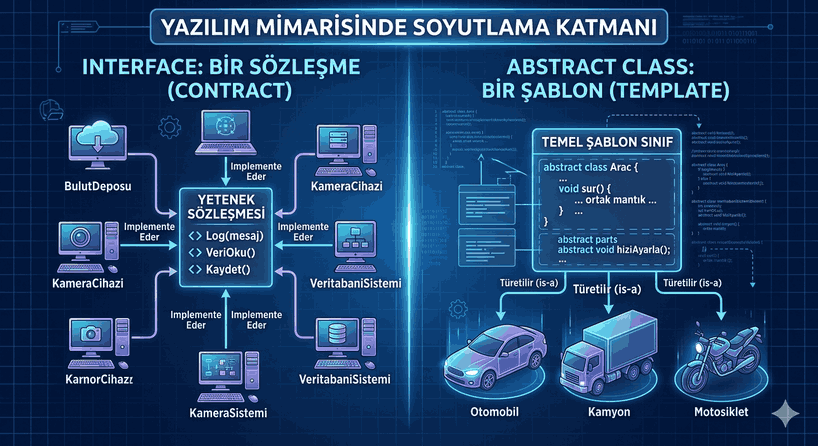
Abstraction is generally implemented through Abstract Class and Interface structures. Thanks to abstraction, high-level modules do not need to know how low-level details work. This prevents the rest of the system from being affected when a part of the software is changed.
Interface: A contract that defines “what” an object can do.
Abstract Class: A template that includes both incomplete (abstract) methods and common behaviors.
Code Implementation: Python and Abstract Base Classes (ABC)
from abc import ABC, abstractmethod
classDatabase(ABC):
"""An abstraction layer for database operations."""@abstractmethoddefconnect(self):
pass@abstractmethoddefexecute_query(self, query: str):
passclassPostgreSQL(Database):
defconnect(self):
return"Connected to PostgreSQL database."defexecute_query(self, query: str):
returnf"Executed '{query}' on PostgreSQL."classMongoDB(Database):
defconnect(self):
return"Connected to MongoDB (NoSQL) cluster."defexecute_query(self, query: str):
returnf"Processed query '{query}' in BSON format."
Note: Abstraction reduces “cognitive load” by presenting the user with only the necessary interface. A car driver using only the steering wheel and pedals without knowing the piston movements inside the engine is the most fundamental example of abstraction.
2. Encapsulation: Data Security and State Management
Encapsulation is the bundling of data (attributes) and the methods that operate on that data into a single unit (class). The primary goal here is to prevent uncontrolled external access to the object’s internal state and to ensure data consistency.
Technical Mechanisms: Access Modifiers
Encapsulation is managed through access modifiers:
Public: Accessible from anywhere.
Private: Accessible only within the class where it is defined.
Protected: Accessible within the class and derived classes.
Architectural Benefits
Encapsulation implements the Data Hiding principle. This ensures that the object’s internal logic (business logic) is protected from external interference. For example, preventing direct modification of the balance in a bank account class and instead forcing the use of deposit() or withdraw() methods increases system security.
Inheritance is the mechanism by which a class (child/subclass) inherits the properties and methods of another class (parent/superclass). It is used in software to prevent code duplication and to establish a logical hierarchy.
“Is-A” Relationship and Design Strategies
Inheritance establishes an “is-a” relationship between classes. For example, “A truck is a Vehicle.” However, the use of uncontrolled inheritance can lead to tight coupling between classes. At this point, the “Composition over Inheritance” principle is frequently debated in the modern software world.
Code Implementation: Hierarchical Structure in Java
Critical Note: To avoid multiple inheritance complications such as the Diamond Problem, languages like Java and C# manage multiple inheritance through Interfaces.
4. Polymorphism: Flexibility and Dynamic Behavior
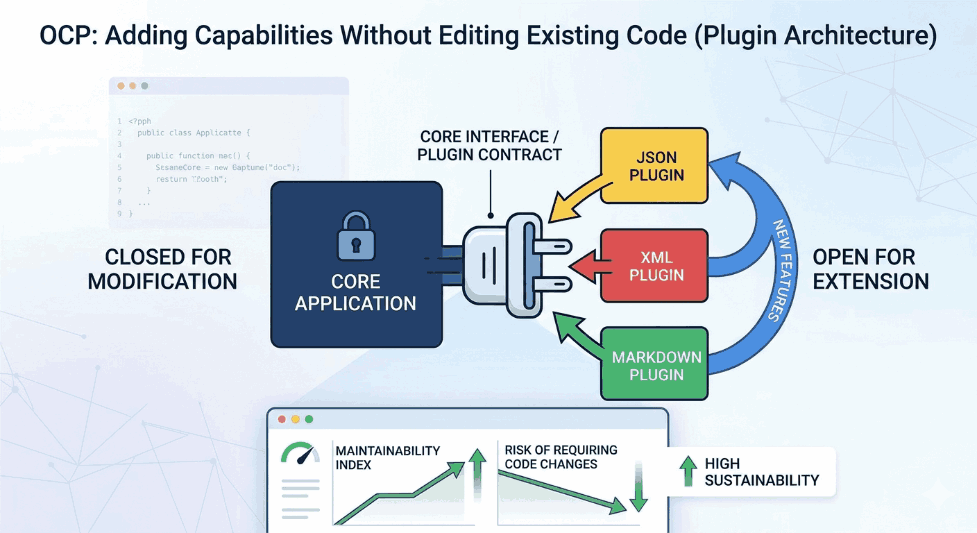
Polymorphism is the ability of a method with the same name to be implemented in different ways by different classes. This allows the system to work in a type-independent manner and makes adding new features to the system incredibly easy.
Static vs. Dynamic Polymorphism
Static Polymorphism (Compile-time): Method Overloading (defining a method with the same name but different parameters).
Dynamic Polymorphism (Runtime): Method Overriding (rewriting an inherited method in a subclass).
Place in Design Patterns
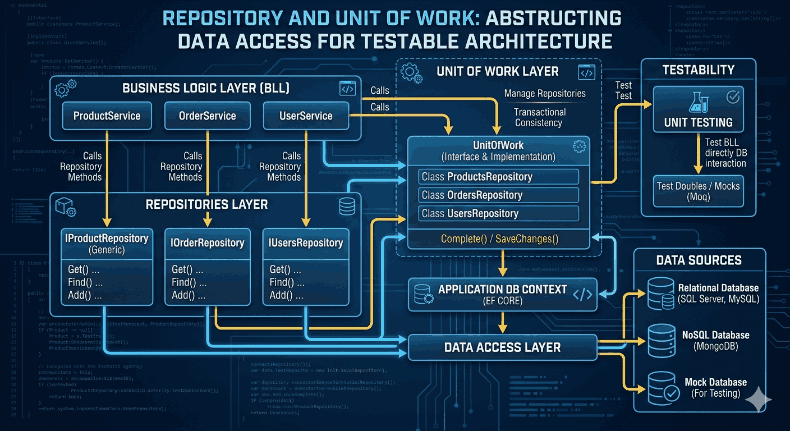
Design patterns such as Strategy and Factory are entirely built on polymorphism. Rendering different types of objects in a list within the same loop is the most powerful use case for polymorphism.
Code Implementation: C# Polymorphism and Virtual Methods
OOP Integration and Library Approaches in System Design
In modern software development processes, OOP is not just a language feature but the heart of library and framework structures.
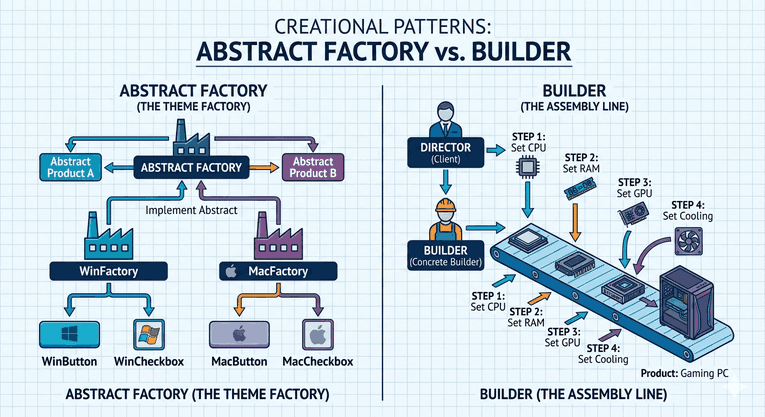
1. Design Patterns
When OOP principles are combined with SOLID principles, industry-standard solutions emerge:
Single Responsibility
Open/Closed
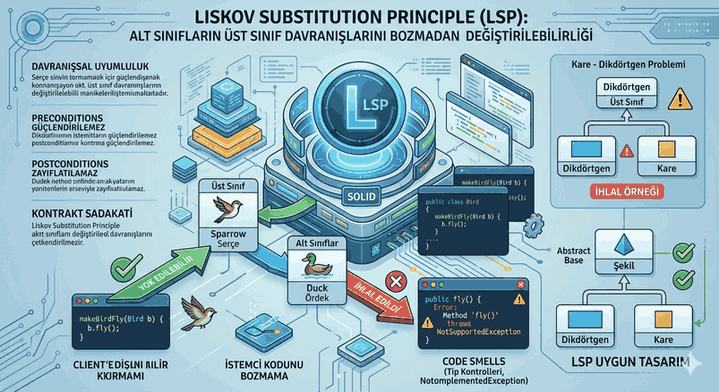
Liskov Substitution
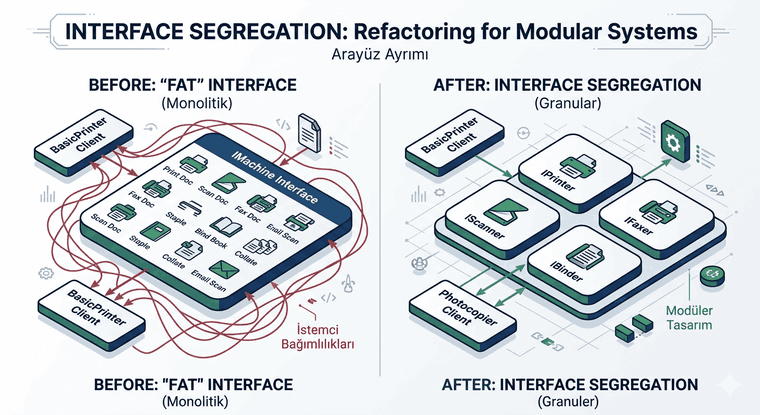
Interface Segregation
Dependency Inversion
2. Examples from Frameworks and Libraries
Django (Python): Database schemas are created by inheriting from the models.Model class (Inheritance & Abstraction).
React (JavaScript/TypeScript): Component-based architecture offers an OOP-like structure with encapsulation and props/state management.
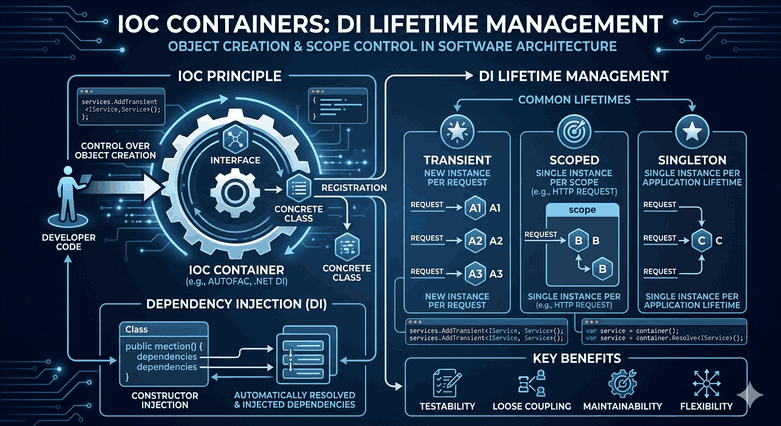
Spring Boot (Java): Uses Abstraction and Polymorphism at the extreme level with the Dependency Injection mechanism.
In-depth Technical Comparison Table
Concept
Primary Goal
Technical Tool
Architectural Impact
Abstraction
Reduce complexity
Interface, Abstract Class
Minimizes dependencies.
Encapsulation
Protect data
Access Modifiers (Private, etc.)
Ensures data integrity.
Inheritance
Prevent code duplication
Extends, Implements
Establishes hierarchical structure.
Polymorphism
Provide flexibility
Override, Virtual Methods
Increases system extensibility.
Conclusion and Advanced Notes
The four horsemen of OOP are not mechanisms that operate independently, but an ecosystem that is constantly interacting with each other in modern system design. A good software architect:
Plans the system with Abstraction,
Draws boundaries with Encapsulation,
Finds common denominators with Inheritance,
Adds dynamism to the system with Polymorphism.
However, it should be noted that over-engineering can make the system complex, and unnecessary inheritance depth can lead to the “fragile base class” problem. Each principle should be applied in a balanced way according to the project’s needs.
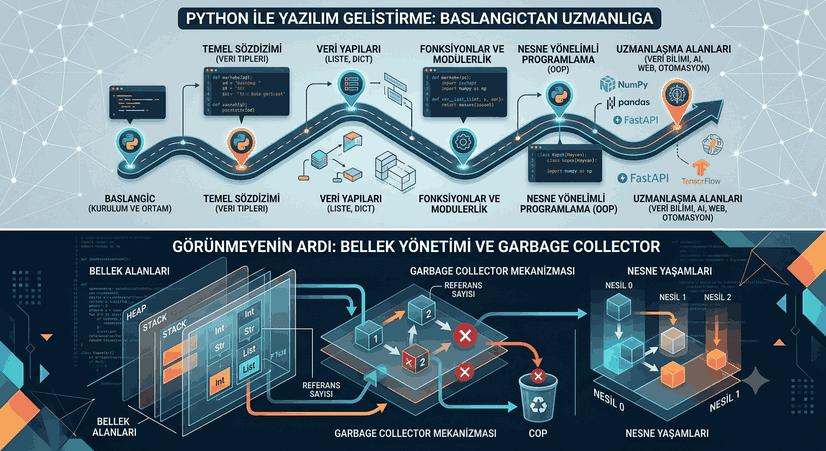
Technical Note: From a Memory Management perspective, the use of Polymorphism and Inheritance can introduce runtime costs such as “Virtual Table” (VTable). In performance-critical systems (such as embedded systems or game engines), design should be carried out by considering these costs.