We use cookies and other tracking technologies to improve your browsing experience on our website, to show you personalized content and targeted ads, to analyze our website traffic, and to understand where our visitors are coming from.
⚠️
GDPR & Cookie Policy Notice
In accordance with data protection regulations; the use of mandatory cookies is required for the core functions of our website to operate, ensure data security, and perform analytics. If you reject the use of cookies, it is not possible to benefit from the services on our website due to technical limitations and data synchronization interruptions. You must consent to the use of cookies to access the content on our site.
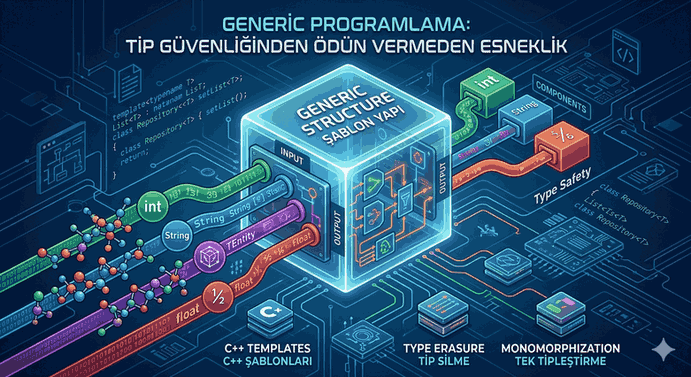
Generic Programming: Building Flexible and Reusable Structures Without Compromising Type Safety
Generic programming is one of the cornerstones of modern software engineering. Subjecting code to logical abstraction independent of data types not only reduces development costs but also increases system stability by bringing runtime errors to compile-time.
Figure 1: Generic Programming: Building Flexible and Reusable Structures Without Compromising Type Safety.
1. Theoretical Foundations of Generic Programming
Generic programming is based on the principle that algorithms and data structures take the data types they will operate on as “parameters.” This approach is called Templates in the C++ world and Generics in the Java and C# worlds. The main goal is to avoid rewriting the same logic for different types, applying the “Don’t Repeat Yourself” (DRY) principle at the highest level.
Type Safety and Type Erasure vs. Monomorphization
The operating mechanism of generic structures varies from language to language:
Monomorphization (C++, Rust): The compiler creates a specific copy of the code for each different type used. This results in no runtime performance loss (zero-cost abstraction), but can cause the binary file size to grow (binary bloat).
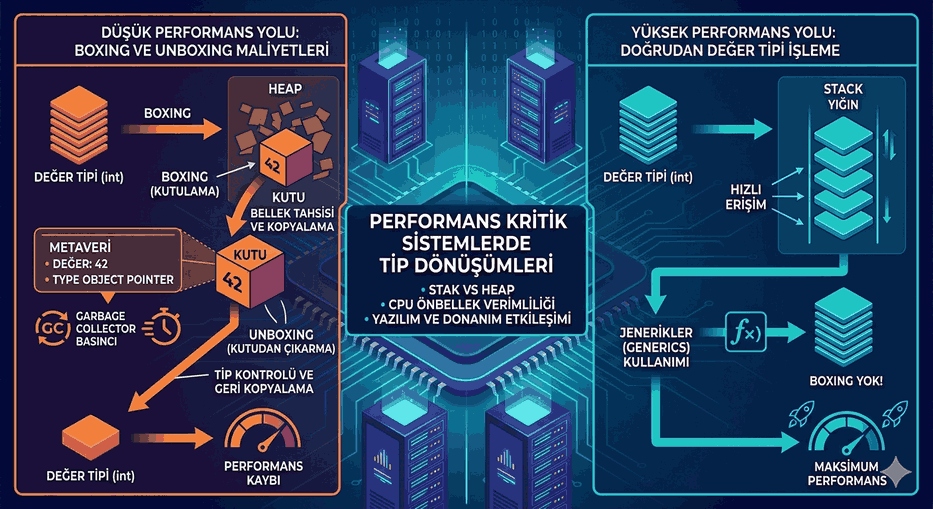
Type Erasure (Java): Generic types are converted to the Object type during the compilation phase. Type information is not preserved at runtime. This ensures backward compatibility but leads to “boxing/unboxing” costs when working with primitive types.
2. Flexibility in Collections and Algorithmic Abstraction
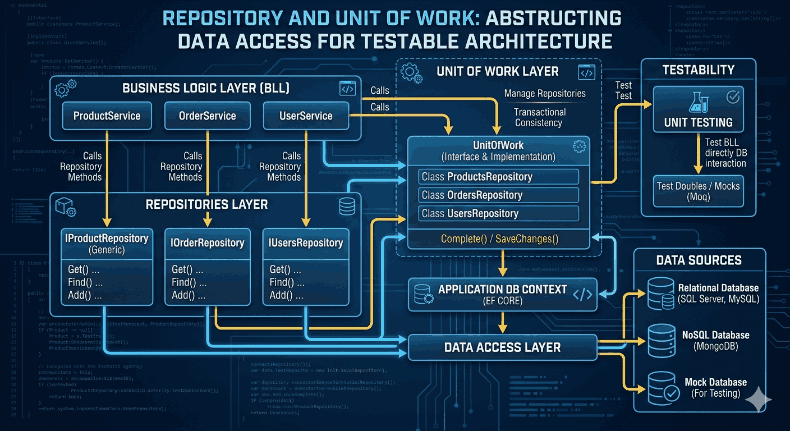
Designing data structures to be generic is a necessity for library developers. For example, specifying that only an Integer can be put into a Stack data structure restricts the structure.
Technical Example: Generic Class with Type Constraints in C#
The following example shows an advanced repository structure that works only with types that are reference types and can have a new instance created:
publicclassRepository<T> where T : class, new()
{
privatereadonly List<T> _entities = new List<T>();
publicvoid Add(T entity)
{
_entities.Add(entity);
}
public T GetDefault()
{
returnnew T(); // possible thanks to the new() constraint }
public IEnumerable<T> Find(Func<T, bool> predicate)
{
return _entities.Where(predicate);
}
}
This structure makes the generic structure safer and more predictable by introducing type constraints with the where expression.
3. C++ Templates and Meta-Programming
C++ is the language that takes generic programming to the extreme. Thanks to Template Metaprogramming (TMP), calculations are performed at compile-time, not runtime.
Variadic Templates
Introduced with C++11, Variadic Templates allow for writing generic functions that accept an indefinite number of arguments. This has revolutionized logging systems or tuple structures in particular.
This technique can process a variable number of arguments without breaking type safety.
4. Advanced Concepts: Covariance and Contravariance
In generic programming, hierarchies between types can lead to unexpected errors. The question of whether a List<Cat> object can be assigned to a List<Animal> object gives rise to the concept of variance.
Covariance: The ability to use a more derived type in place of a more general type. It is generally safe only in “read-only” (out) operations.
Contravariance: The ability to use a more general type in place of a more specific type. It is generally used in “write-only” (in) operations, for example, in delegate structures such as Action<T>.
Java Example: Wildcards
// Covariance: Can read from the list but cannot addList<?extends Animal> animals =new ArrayList<Cat>();
// Contravariance: Can add to the listList<?super Cat> catList =new ArrayList<Animal>();
5. Integration with Software Architecture and Design Patterns
Generic structures play a central role in the implementation of Design Patterns.
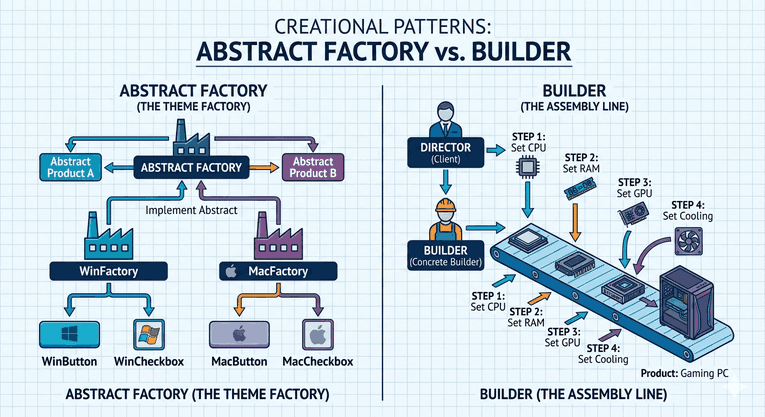
Factory Pattern and Generics
Below is a generic Factory example that automates object creation:
This approach minimizes the dependencies of the code and eliminates the need to modify the factory class when new product types are added.
6. Performance Analysis and Memory Management
Generic programming is not always “free.” Especially how languages manage memory has a direct impact on performance.
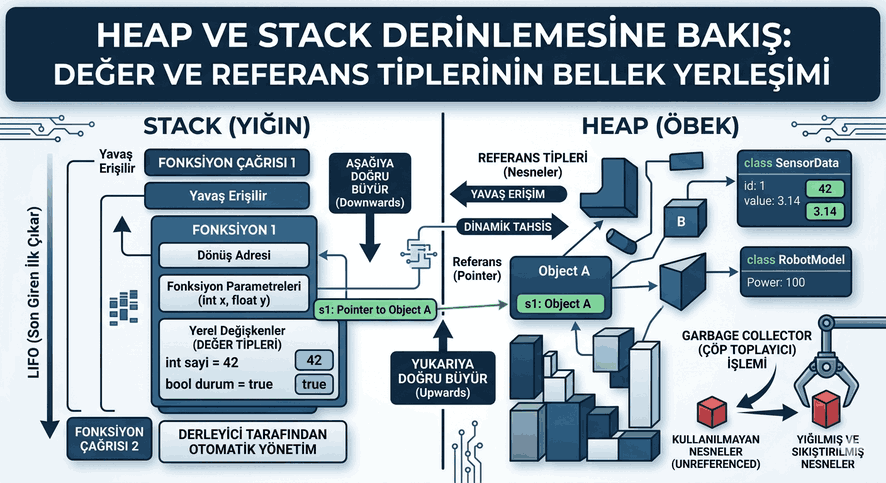
Boxing/Unboxing: In languages like C# and Java, when an int value is added to a generic collection, this value may need to be converted to an object. This creates extra overhead on the heap and increases Garbage Collector (GC) pressure.
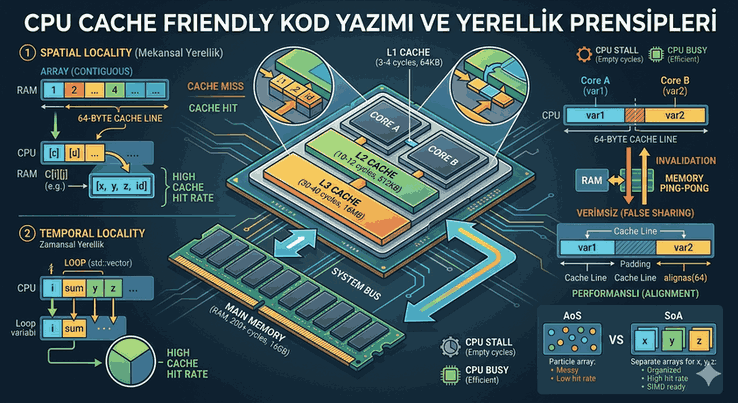
Code Bloating: In C++, generating new machine code for each different template parameter can lead to inefficient use of the processor cache (L1/L2 cache).
7. Use of Generics in Modern Libraries and Frameworks
Current software ecosystems use generic structures at the core level:
STL (Standard Template Library - C++): Structures like vector, map, and sort are all generic.
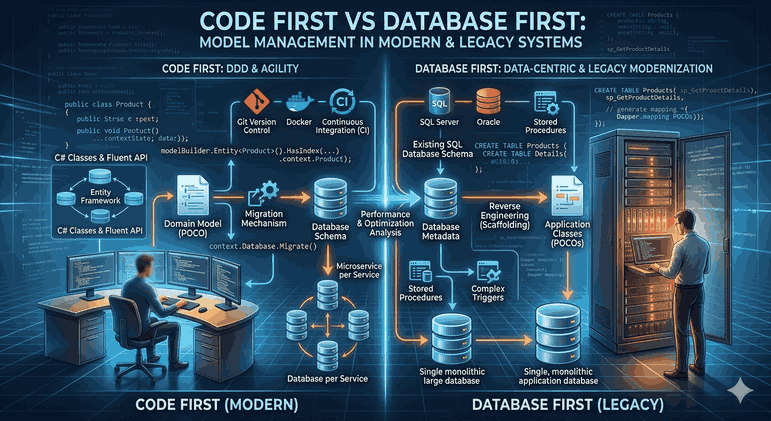
Entity Framework Core (C#): The DbSet<TEntity> structure uses a generic architecture to map database tables to object models.
React (TypeScript): Structures such as useState<T> and Component<P, S> allow UI components to manage data in a type-safe manner.
Standard Library (Rust):Option<T> and Result<T, E> structures aim to completely eliminate null errors by moving error management to a generic plane.
8. Technical Notes and Best Practices
Meaningful Naming: Instead of just using T, descriptive names such as TKey, TValue, TRequest, and TResponse should be preferred for multiple parameters.
Use Constraints: Definitely specify what kind of properties the generic type should have (IComparable, IDisposable, etc.). This eliminates the need for type casting within the method.
Isolate Algorithms: Separate business logic from data. If an algorithm only works with numerical values, make it generic with a Numeric constraint.
Generics Instead of Reflection: Prefer generic structures that provide compile-time checking over reflection that performs type checking at runtime. This can increase performance by approximately 10 to 100 times.
Conclusion
Generic programming allows a software developer to design “code that writes code.” This flexibility, provided without sacrificing type safety, is vital for the sustainability of large-scale projects. Whether it is C++’s template meta-programming or TypeScript’s advanced type system, deeply understanding generic structures not only prevents code duplication but also enables the construction of a safer, more performant, and more readable architecture.