We use cookies and other tracking technologies to improve your browsing experience on our website, to show you personalized content and targeted ads, to analyze our website traffic, and to understand where our visitors are coming from.
⚠️
GDPR & Cookie Policy Notice
In accordance with data protection regulations; the use of mandatory cookies is required for the core functions of our website to operate, ensure data security, and perform analytics. If you reject the use of cookies, it is not possible to benefit from the services on our website due to technical limitations and data synchronization interruptions. You must consent to the use of cookies to access the content on our site.
Code First vs. Database First: Model Management in Modern and Legacy Systems
In software architecture, the design of the Data Access Layer plays a decisive role in the project’s sustainability, scalability, and team workflows. Especially with the evolution of Object-Relational Mapping (ORM) tools, model management has been shaped around two main paradigms: Code First and Database First. This article examines both approaches in technical depth and covers implementation strategies across a wide spectrum, from modern microservice architectures to legacy monolithic systems.
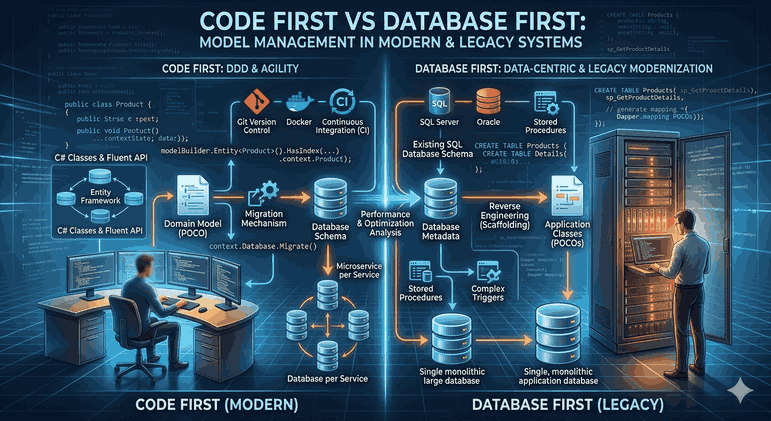
Figure 1: Code First vs. Database First: Model Management in Modern and Legacy Systems.
1. Code First Approach: Domain-Driven Design (DDD) and Architectural Flexibility
Code First is an approach in the application development process where class structures (POCO - Plain Old CLR Objects) that represent business logic are prioritized over the database schema. In this model, the database schema is derived from the classes and configurations (Fluent API or Data Annotations) within the code.
Technical Mechanisms and Migrations
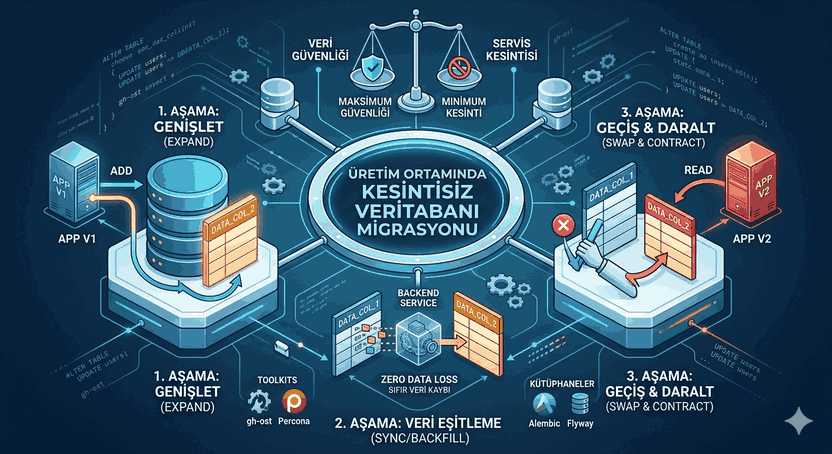
At the heart of the Code First model lies the Migration mechanism. Migration tracks changes made to classes (adding a new property, changing a data type, etc.) and converts these changes into SQL scripts that reflect them in the database schema.
Advantage: Provides independence from the Relational Database Management System (RDBMS). Schemas can be generated on SQL Server, PostgreSQL, or MySQL using the same code structure.
Version Control: Since every change in the database schema is saved as a C# or Java class, it can be tracked in version control systems like Git.
Sample Application: Entity Framework Core (C#)
Below is the definition of the relationship between Product and Category in an e-commerce system using Code First:
2. Database First Approach: Data-Centric Design and Legacy Systems
Database First is based on the principle of automatically generating application classes (Scaffolding) based on an existing database schema. It is generally preferred in corporate structures where Database Administrators (DBAs) have high authority and in projects built on top of “legacy” databases that have been in use for years.
Reverse Engineering Process
In this approach, the ORM tool reads the database metadata and converts tables into classes, columns into properties, and constraints (Foreign Key, Unique) into relationships within the code.
Data Integrity: Complex triggers, stored procedures, and views defined at the database level can be used directly.
Speed: If there is a massive existing schema, a model layer can be created in minutes instead of writing the classes manually one by one.
Technical Libraries and Tools
Java/Hibernate: POJO generation from schema with hbm2java tools.
EF Core Power Tools: Converting schema to code structure with a visual interface.
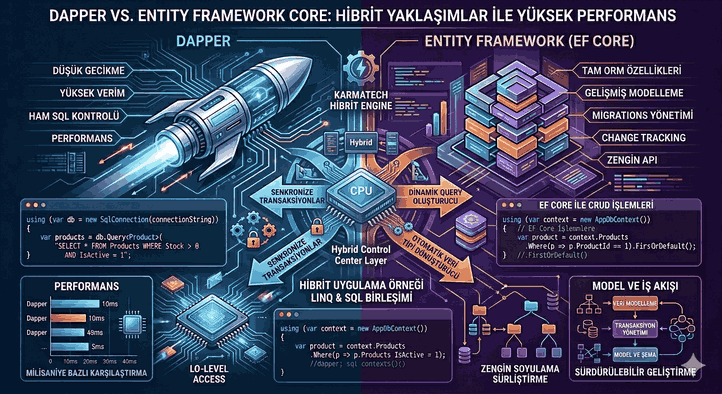
Dapper: A Micro-ORM generally preferred in Database First scenarios to maintain full control over the schema and minimize performance loss.
3. Model Management in Modern Microservices
In modern systems, every microservice has its own database due to the “Database per Service” principle. In this context, Code First has become the standard for microservice ecosystems.
Why Code First in Microservices?
Rapid Prototyping: Business logic can be developed without the need for an external SQL editor for database design.
Containerization (Docker): As the application container starts, the target database can be automatically updated to the latest version with the context.Database.Migrate() command.
Clean Architecture Compatibility: Ensures the domain layer remains independent of the outside world (the database).
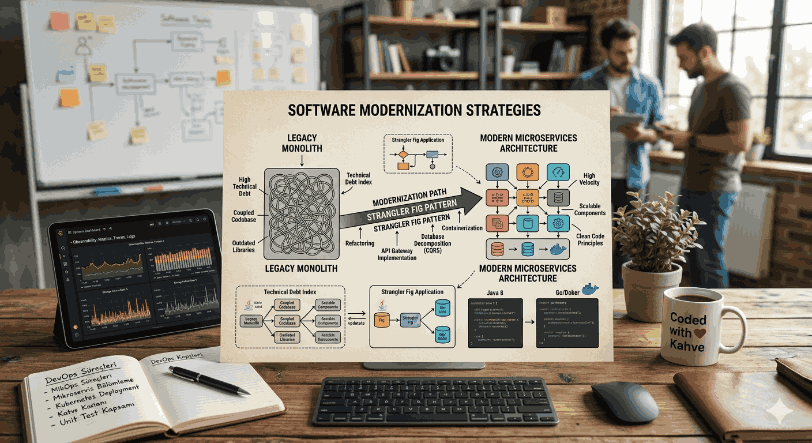
4. Modernization Strategies for Legacy Systems
Migrating or modernizing an existing Database First project to Code First is a risky process. The techniques applied at this stage are:
Mapping to Existing Database: Even though Code First is used, instead of creating the schema, HasTableName and HasColumnName configurations are written to comply with the existing schema.
Shadow Properties: Management of fields that exist in the database but are not intended to be visible in domain models (such as audit info like CreatedAt, UpdatedBy).
5. Performance and Optimization Comparison
From a technical standpoint, both methods perform similarly at runtime because the ORM generates SQL queries in both cases. However, the differences in design-time and operational costs are significant.
Criteria
Code First
Database First
Control Focus
Software Developer (Code-centric)
Database Administrator (Data-centric)
Migration Management
Automatic / Versionable
Manual SQL Scripts
Complex Relationships
Flexible management with Fluent API
Restrictions in SQL Schema
Stored Procedure
Difficult to use (requires mapping)
Direct integration
Deployment
Continuous Integration (CI) friendly
May require manual schema synchronization
6. Critical Notes and Technical Advice
Note 1: Data Loss Risk: When using Code First Migrations, operations such as DropColumn can cause data loss. In production environments, migrations should always be converted to Idempotent SQL scripts and reviewed before being applied.
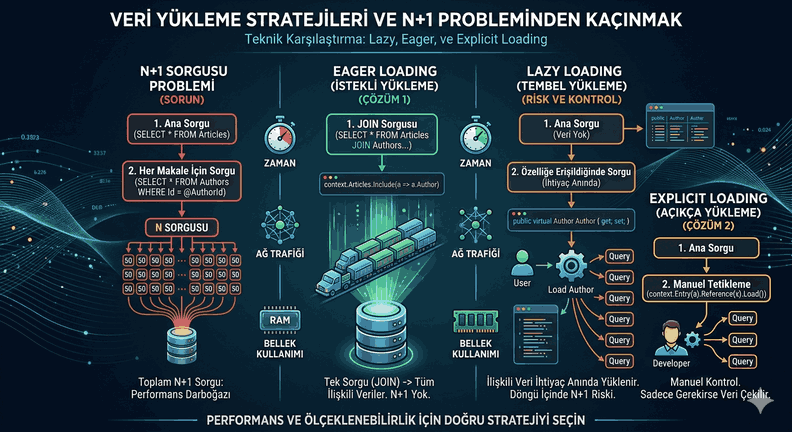
Note 2: Index Management: Index structures created by default in Code First are not always optimized. To improve query performance, HasIndex definitions via Fluent API and Include (Eager Loading) strategies should be chosen carefully.
Note 3: DbContext Separation: In very large systems, using small contexts broken down into a modular structure (Bounded Context) instead of a single massive DbContext facilitates model management and improves application startup time (cold start).
7. Conclusion: Which Approach Should Be Chosen?
The decision-making process depends on the current state of the project and the competence of the team:
Choose Code First if: Starting from scratch (Greenfield), DDD principles are adopted, a microservices architecture is being built, and the team wants to manage the database schema through code.
Choose Database First if: There is an existing, complex, and data-intensive database (Brownfield), different applications share the same database, or the database design is entirely under the control of the DBA team.
Although modern software development practices are evolving towards Code First due to testability and automation capabilities, Database First continues to exist as an indispensable technique in the corporate world where data consistency and legacy systems prevail. It is critical for the developer to have an in-depth understanding of the mapping techniques and schema synchronization tools in both approaches for the long-term health of the system.