We use cookies and other tracking technologies to improve your browsing experience on our website, to show you personalized content and targeted ads, to analyze our website traffic, and to understand where our visitors are coming from.
⚠️
GDPR & Cookie Policy Notice
In accordance with data protection regulations; the use of mandatory cookies is required for the core functions of our website to operate, ensure data security, and perform analytics. If you reject the use of cookies, it is not possible to benefit from the services on our website due to technical limitations and data synchronization interruptions. You must consent to the use of cookies to access the content on our site.
Deep Dive into Creational Patterns: Complex Object Construction with Abstract Factory and Builder
In software architecture, object creation processes are a critical threshold for system flexibility and extensibility. “Creational Patterns” abstract the object creation process, making the system independent of how objects are created, composed, and represented. In this context, the Abstract Factory and Builder patterns stand out as some of the most powerful tools for managing complexity and object hierarchies.
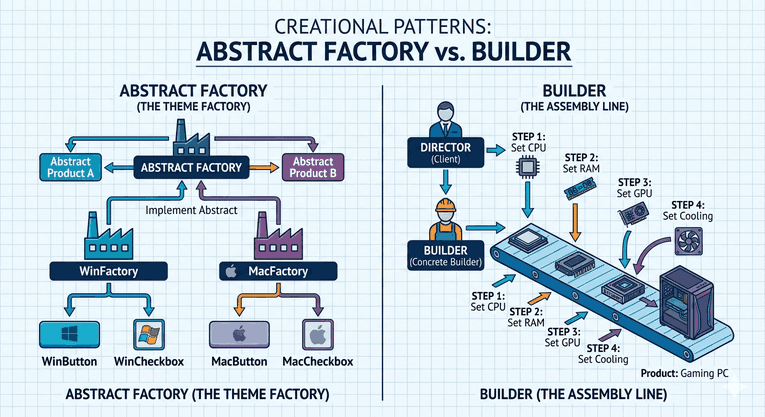
Figure 1: Deep Dive into Creational Patterns: Complex Object Construction with Abstract Factory and Builder.
1. Abstract Factory: Abstraction of Families and Themes
The Abstract Factory pattern provides an interface for creating families of related or dependent objects without specifying their concrete classes. This pattern comes into play when there are multiple product families that the system needs to be structured around.
1.1. Architectural Structure and Components
The Abstract Factory architecture consists of four main components:
Abstract Factory: Defines an interface for product creation operations.
Concrete Factory: Concrete classes that create products belonging to a specific product family.
Abstract Product: Declares a general interface for a product type.
Concrete Product: The actual object variations created by the corresponding factory.
1.2. In-depth Technical Analysis
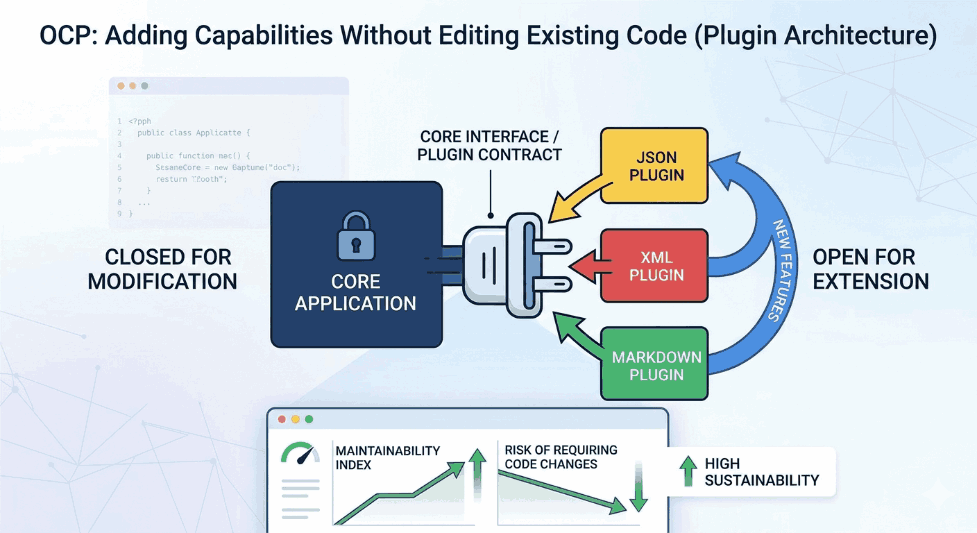
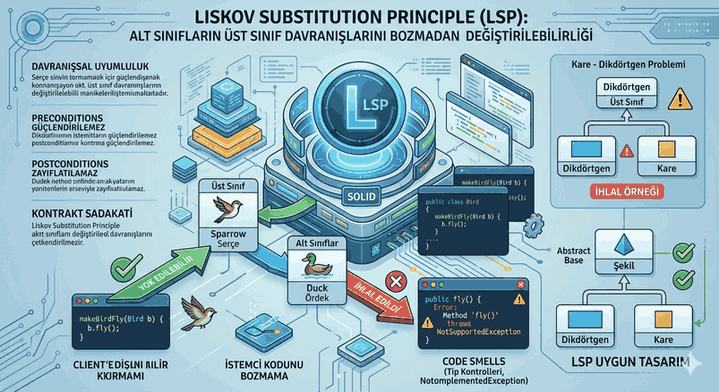
Abstract Factory implements the Dependency Inversion principle (DIP) in its purest form. The Client code depends on abstract interfaces, not concrete types. This supports the “Open/Closed” principle; to add a new product family to the system, there is no need to change existing client code, only new factory and product classes are added.
1.3. Application Example via C++
Let’s consider the basis of a modern GUI library (with Windows and macOS support):
2. Builder: Step-by-Step Construction and Fine-Tuning
The Builder pattern separates the representation of a complex object from its construction process. This allows the same construction process to create different representations. While Abstract Factory is concerned with “what” is created, Builder is concerned with “how” it is created, that is, the algorithm of the process.
2.1. The Necessity of Builder: “Telescoping Constructor” Problem
In software development, having a class with a large number of optional parameters (e.g., an HTTPConfig object with 10-15 parameters) reduces readability and makes it error-prone. The Builder converts this complexity into a flowchart.
2.2. Core Roles
Director: Manages the construction process. It knows which steps to call and in what order.
Builder: Defines abstract steps to create parts of the product.
Concrete Builder: Implements the Builder interface and holds the constructed object (Product).
Product: The complex object being built.
2.3. Java (Lombok Style) and Fluent Interface
In modern libraries (Spring, Hibernate, etc.), the Builder pattern is frequently combined with a “Fluent Interface”.
Although these two patterns are often confused, their architectural focus points are different:
Feature
Abstract Factory
Builder
Focus
Product Families
Complex object construction (Step-by-step)
Product Type
Returned immediately (One step)
Returned after steps are finished
Structure
Usually Polymorphism-based
Usually Composition-based
Result
Different types of but related objects
A single complex object
Technical Note: If your system produces components specific to different platforms (iOS, Android, Web), Abstract Factory should be preferred; if you are producing an output consisting of many parts and variations such as an SQL query or a PDF report, Builder should be preferred.
4. Advanced Scenario: Using Both Patterns Together
In large-scale projects, these two patterns can be used in a hybrid structure. For example, while a Builder is used to construct a Level object in a game engine, an Abstract Factory can come into play to create the Enemy or Obstacle types (under themes such as Orc, Human, Robot) within this level.
4.1. Modern Library Approaches
Java’s StringBuilder class: It is a classic example of Builder. It is used to efficiently construct structures that require immutability, like String.
Guice and Dagger (Dependency Injection Frameworks): They automate the Abstract Factory concept with the “Binding” mechanism.
Python marshmallow or pydantic: They run the Builder principles in the background while validating and constructing data models.
5. “Anti-Patterns” to Watch Out For During Implementation
Over-Engineering: If the object being created does not have more than 3-4 parameters or if the product family does not have expansion potential, using these patterns increases code complexity unnecessarily.
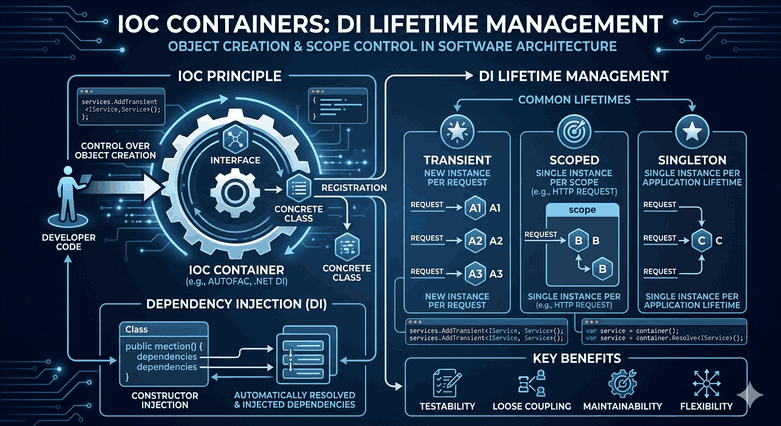
Static Factory Dependency: Creating factory classes entirely from static methods makes “mocking” operations difficult when writing unit tests. It is healthier to manage the factory object via a Singleton or DI container instead.
Mutable Product in Builder: The object (Product) being constructed should not be allowed to be modified from the outside while the Builder process is ongoing. The object should only be accessible after the build() method is called.
6. Conclusion and Architectural Perspective
Object creation is not just about a new keyword. Abstract Factory maintains the thematic consistency of the system, while Builder maximizes configurational flexibility. In microservice architectures, using these patterns when creating clients for different protocols (gRPC, REST, GraphQL) can reduce the maintenance cost of the code by up to 40%.
From hardware abstraction (HAL) to high-level UI libraries, the correct use of creational patterns is the only element that ensures software remains sustainable throughout its lifecycle. The developer’s task is to position these patterns not as a template, but as a problem-solving tool suited to the nature of the problem.