We use cookies and other tracking technologies to improve your browsing experience on our website, to show you personalized content and targeted ads, to analyze our website traffic, and to understand where our visitors are coming from.
⚠️
GDPR & Cookie Policy Notice
In accordance with data protection regulations; the use of mandatory cookies is required for the core functions of our website to operate, ensure data security, and perform analytics. If you reject the use of cookies, it is not possible to benefit from the services on our website due to technical limitations and data synchronization interruptions. You must consent to the use of cookies to access the content on our site.
Open-Closed Principle: Adding New Capabilities Without Touching Existing Code (Plugin Architecture)
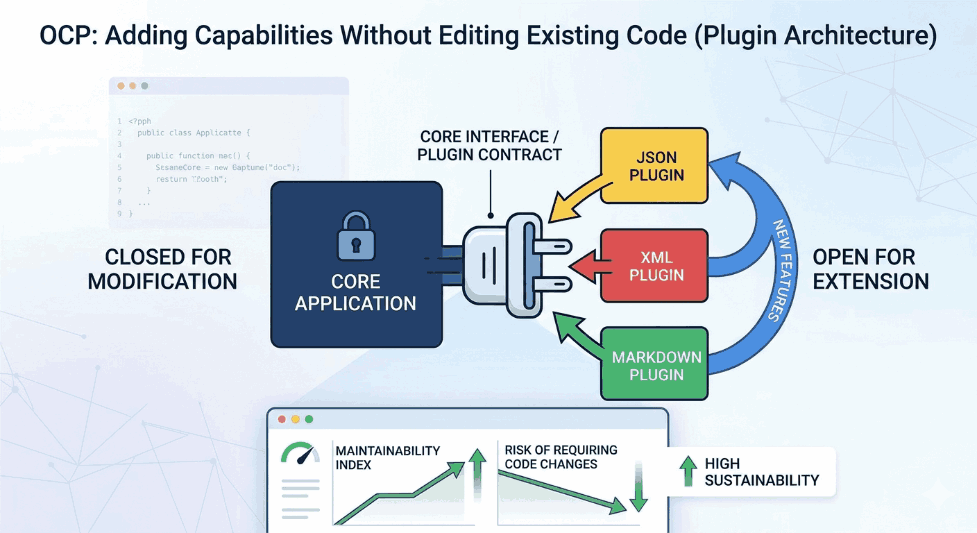
One of the cornerstones of building sustainable architecture in software engineering is the Open-Closed Principle (OCP), which dictates that a system should be open for extension but closed for modification. Popularized by Robert C. Martin, this concept aims to integrate every new feature into the codebase without risking the integrity of already functioning and tested code blocks.
Figure 1: Open-Closed Principle: Adding New Capabilities Without Touching Existing Code (Plugin Architecture).
1. Open-Closed Principle: Conceptual and Technical Foundations
OCP states that the behavior of a software unit (class, module, function, etc.) should be extendable without modifying its source code. This is usually achieved using abstraction and polymorphism.
Static vs. Dynamic Extension
Static Extension: Extending the code by adding new classes at compile-time.
Dynamic Extension (Plugin Architecture): Enabling an application to gain capabilities at runtime via externally loaded modules (DLL, .so, .jar).
2. Abstraction Layers and Interface Design
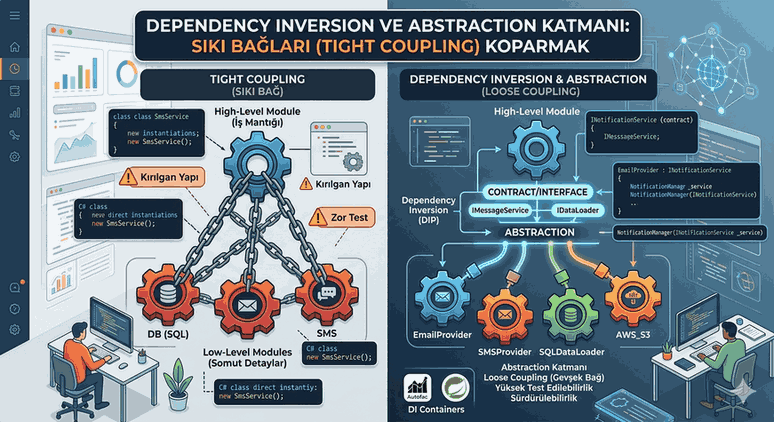
At the heart of OCP lies the principle “program to an interface, not an implementation.” If a class is directly dependent on a concrete class, you must modify that class to add new behavior. This violates OCP.
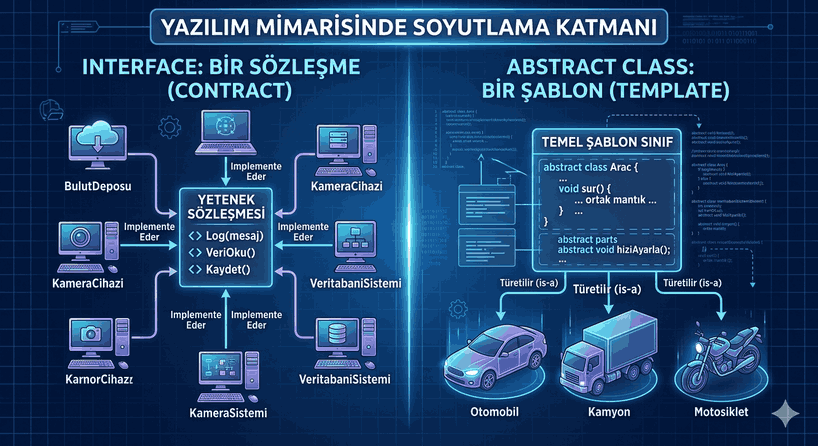
Abstraction Techniques
Technically, there are two main approaches:
Interface-Based: Based entirely on a contract. Method signatures are defined.
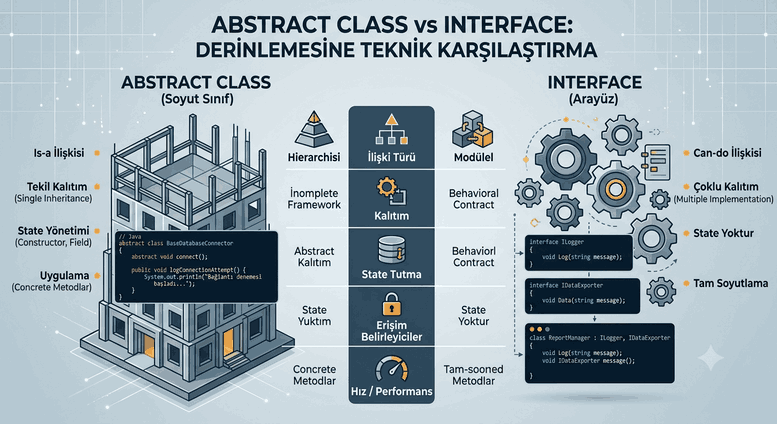
Abstract Class-Based: A structure where common behaviors (template method) are shared, but specialized parts are left to subclasses.
3. Plugin Architecture: The Pinnacle of Modular Extension
Plugin architecture is the most advanced implementation of OCP. The main application (Host) does not know what the plugins will do; it only knows which interface they follow.
Architectural Components:
Core Logic: The main engine of the application. It remains unchanged.
Plugin Contract: The common interface library that plugins must adhere to.
Plugin Loader: The module that scans libraries in a specific folder and loads them into memory at runtime.
4. Technical Implementation: Plugin Example with C# and .NET
In the following scenario, let’s design a text processing engine. This engine should be able to output in new formats (JSON, XML, Markdown) without touching its existing code.
Step 1: Contract Design (Closed for Modification)
This library is referenced by both the main application and the plugins.
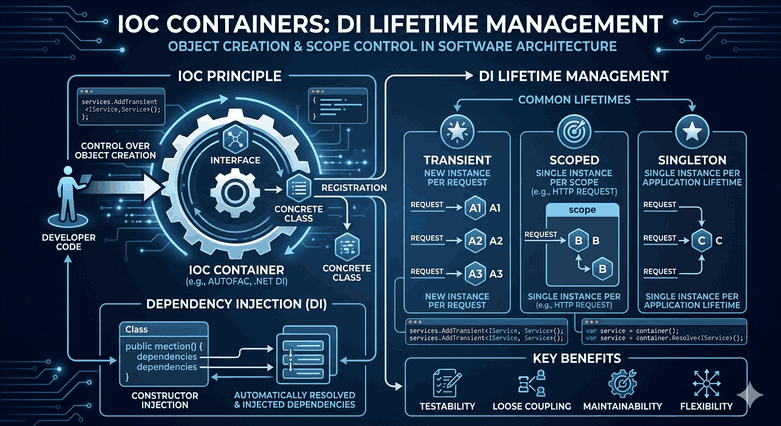
5. Dependency Injection (DI) and Inversion of Control (IoC)
To effectively implement OCP, dependencies must be managed externally. DI containers are used in modern frameworks (Spring Boot, .NET Core, NestJS).
Service Registration: All concrete classes are registered via their interfaces when the application starts.
Reflection: In plugin architectures, Reflection libraries are used to scan all .dll files in a specific folder, and classes implementing the IOutputFormatter interface are injected automatically.
6. OCP and Design Patterns
There are many design patterns that bring OCP to life:
Strategy Pattern: Makes different algorithms interchangeable. Provides behavior modification at runtime.
Decorator Pattern: Adds new responsibilities to an existing object without altering its structure.
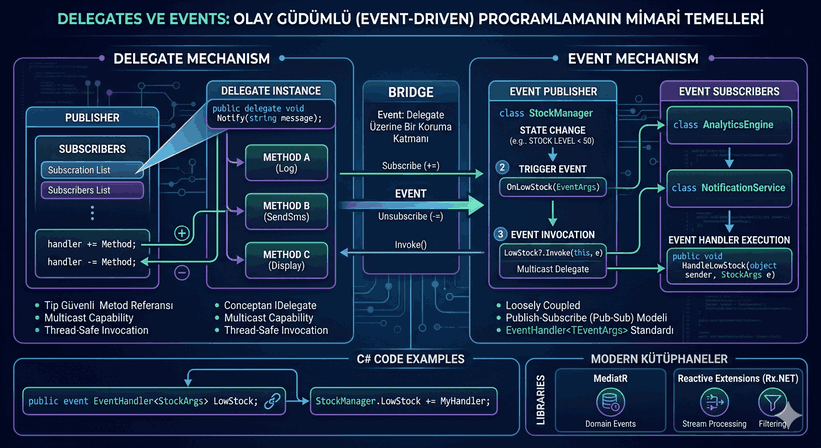
Observer Pattern: Allows adding new listeners to the system, extending reactions without modifying the main object.
Template Method Pattern: Preserves the skeleton of an algorithm while leaving the implementation of steps to subclasses.
7. Dynamic Plugin Management with Python
In dynamic languages, OCP can be implemented more flexibly with libraries like importlib. The following example shows how a “Plugin Manager” works by scanning a folder.
import importlib
import os
classPluginManager:
def__init__(self, plugin_folder):
self.plugin_folder = plugin_folder
self.plugins = []
defload_plugins(self):
for filename in os.listdir(self.plugin_folder):
if filename.endswith(".py"):
module_name = filename[:-3]
module = importlib.import_module(f"plugins.{module_name}")
if hasattr(module, "Plugin"):
self.plugins.append(module.Plugin())
defexecute_all(self):
for plugin in self.plugins:
plugin.run()
8. Library and Framework Support
Modern ecosystems contain powerful tools that support OCP:
C# (.NET):Managed Extensibility Framework (MEF) and DependencyInjection libraries.
Java (Spring):@Component scanning and the Spring Boot Starters structure.
JavaScript/TypeScript: Webpack plugins, InversifyJS, or the NestJS module system.
C++: Dynamic library loading (dlopen / LoadLibrary) and polymorphic calls via vtable.
9. OCP and Modern Software Practices
Microservices and OCP
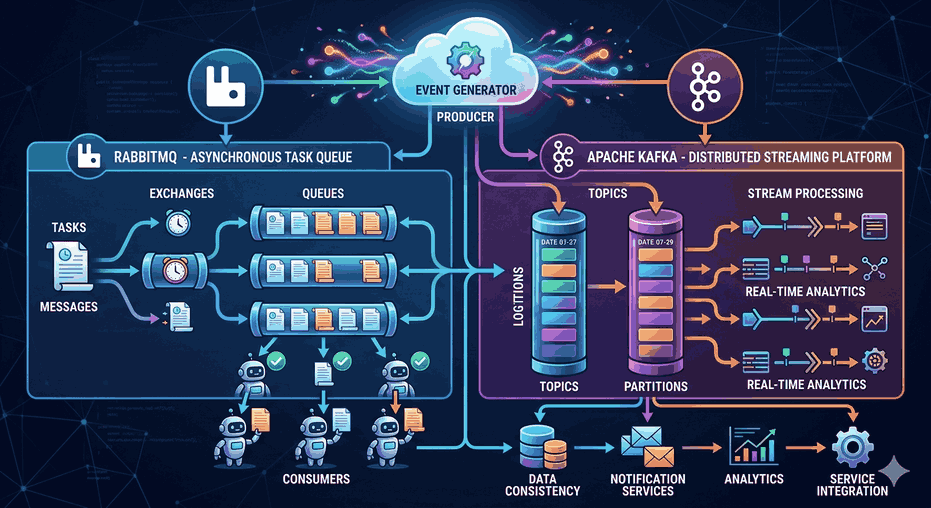
In microservice architecture, OCP manifests itself in inter-service communication (Event-Driven Architecture). When a new service is added, instead of changing the code of existing services, the new service subscribes to the existing message queue (RabbitMQ, Kafka). This is an implementation of Open-Closed at the system level.
Testability
Code written in accordance with OCP is perfect for Unit Tests. Since behaviors are behind interfaces, “Mock” objects can be easily substituted for real implementations during testing. This prevents the “Fragile Code” syndrome.
10. Important Notes and Implementation Challenges
Note 1: Trying to abstract everything creates the risk of “Over-engineering.” OCP should only be applied in areas likely to expand.
Note 2: Implementing OCP causes you to write more code initially (interface definitions, DI configurations, etc.), but it reduces maintenance costs by 70% in the long run.
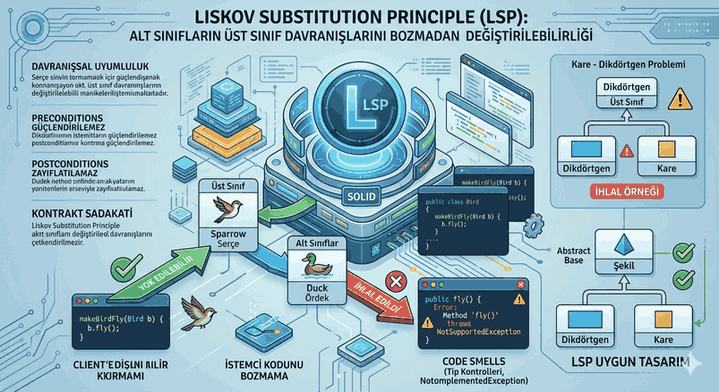
Note 3: The “Liskov Substitution Principle” (LSP) and OCP are siblings. If a subclass cannot replace its superclass, you have not implemented OCP correctly.
Technical Checklist
Are if-else or switch-case blocks growing continuously inside the class? (If yes, OCP is being violated).
Do you have to update unit tests for existing classes for a new feature?
Are dependencies made to concrete classes or interfaces?
11. Conclusion
The Open-Closed Principle ensures that software is “evolvable.” Crowning this principle with plugin architecture allows software to become not just a product, but a living platform. Increasing capabilities while maintaining the immutability of the code is the clearest sign of professional-level engineering discipline. When designing a system, the question “What would I need to change if a new rule comes to this module tomorrow?” should turn into the answer “Nothing, I just need to add a new class,” guided by OCP.