We use cookies and other tracking technologies to improve your browsing experience on our website, to show you personalized content and targeted ads, to analyze our website traffic, and to understand where our visitors are coming from.
⚠️
GDPR & Cookie Policy Notice
In accordance with data protection regulations; the use of mandatory cookies is required for the core functions of our website to operate, ensure data security, and perform analytics. If you reject the use of cookies, it is not possible to benefit from the services on our website due to technical limitations and data synchronization interruptions. You must consent to the use of cookies to access the content on our site.
CAP Theorem and Database Selection: The Balance Between Consistency and Availability
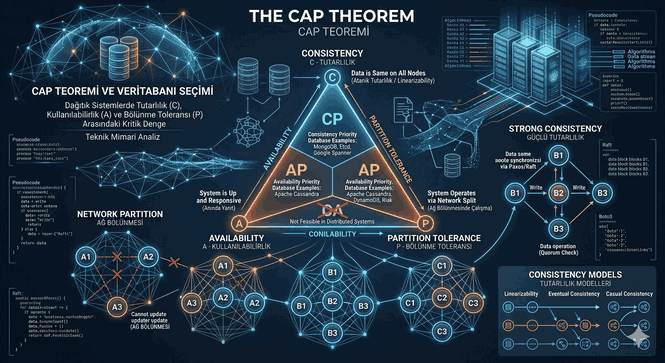
One of the fundamental building blocks of distributed systems, the CAP Theorem (Brewer’s Theorem), provides a mathematical framework for the critical trade-offs that must be made when designing systems that communicate over a network. Proposed by Eric Brewer in 2000 and proven by Seth Gilbert and Nancy Lynch in 2002, this principle argues that a distributed data system cannot simultaneously satisfy all three of the following properties to their fullest extent:
Consistency: Every read receives the most recent write or an error.
Availability: Every request receives a (non-error) response, without the guarantee that it contains the most recent write.
Partition Tolerance: The system continues to operate despite an arbitrary number of messages being dropped (or delayed) by the network between nodes.
Figure 1: CAP Theorem and Database Selection: The Balance Between Consistency and Availability.
1. Technical Analysis of CAP Components
Since “Network Partition” is an unavoidable reality in a distributed architecture, modern systems must, by default, accept the P (Partition Tolerance) property. In this case, the designer is forced to choose between CP or AP.
In these systems, data integrity takes precedence over everything. If a network partition occurs and the system cannot verify the freshness of the data across all nodes, it rejects the request rather than returning erroneous data. They are generally based on the principles of Atomic Consistency or Linearizability.
Prominent Structures: Google Spanner, MongoDB (default mode), HBase.
Protocols: Paxos, Raft.
1.2. Availability (AP - Availability-Oriented Systems)
It is a priority for the system to respond under all circumstances. Even if there is a break in the network, the reached node presents the data it holds (even if it is stale) to the client. These structures generally adopt the Eventual Consistency model.
The “C” in the CAP theorem is often misunderstood. In technical literature, this refers to all nodes seeing the same data at the same time, rather than consistency in ACID principles.
2.1. Ensuring Consistency with the Raft Consensus Algorithm
One of the most popular algorithms used to ensure consistency in CP systems is Raft. Raft is built on a “Leader” election and “Log Replication” mechanism.
The following pseudo-code simulates how a leader distributes a log entry to other nodes and commits it once a quorum is achieved:
classRaftNode:
def__init__(self, node_id, peers):
self.node_id = node_id
self.peers = peers
self.log = []
self.commit_index =0 self.state ="Follower"defreceive_append_entries(self, leader_id, term, entry):
# Add data from the leader to the log self.log.append(entry)
returnTrue, self.node_id
defreplicate_log(self, entry):
if self.state !="Leader":
returnFalse votes =1# Own votefor peer in self.peers:
success, p_id = peer.receive_append_entries(self.node_id, current_term, entry)
if success:
votes +=1# Quorum Check (N/2 + 1)if votes > (len(self.peers) +1) /2:
self.commit_index +=1 self.apply_to_state_machine(entry)
return"Committed"return"Failed - No Quorum"
3. Database Selection and Architectural Decisions
Database selection is shaped by the application’s business logic.
3.1. CP Selection: Financial and Inventory Systems
In a banking application, it is unacceptable for the balance to be displayed incorrectly. Therefore, Strong Consistency is required.
Etcd: Used in orchestration tools like Kubernetes to store configuration data consistently.
Redis (Wait Command): Redis is generally AP-oriented, but it can be brought closer to CP characteristics by forcing synchronous replication with the WAIT command.
3.2. AP Selection: Social Media and Analytics
It is better for a tweet or a like count to be updated 1 second late than for the system to stop.
Cassandra: Designed for large-scale write operations. It resolves conflicts with the “LWW” (Last Write Wins) strategy.
Riak: Tracks data versions using Vector Clocks.
4. PACELC: The Extended Version of CAP
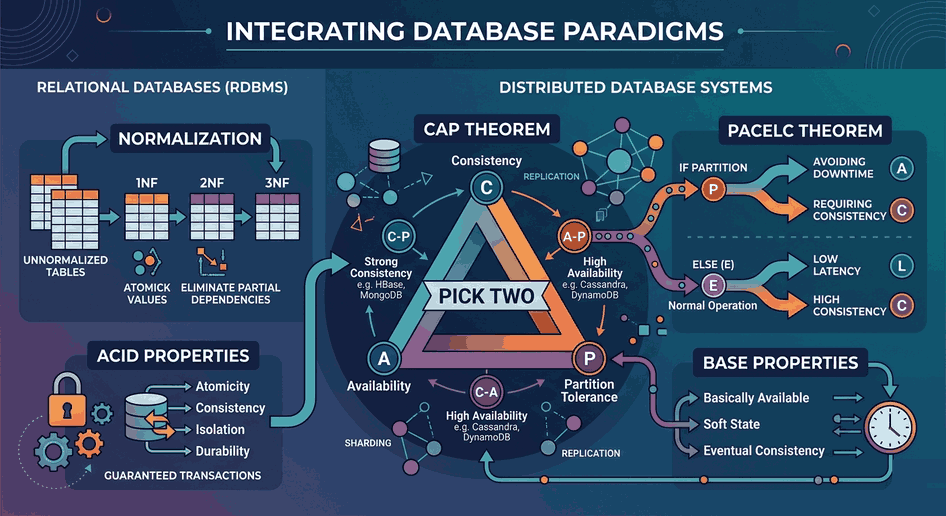
In the modern world, the CAP theorem can be insufficient because a network partition does not always occur. The PACELC theorem also questions the balance of latency and consistency during normal operation (Else).
PACELC Formulation:
In case of P (Partition); A (Availability) or C (Consistency) is chosen.
In E (Else - Normal case); L (Latency) or C (Consistency) is chosen.
For example, Amazon DynamoDB is a PA/EL system. While it chooses availability (A) during a partition, it targets low latency (L) in normal conditions.
5. Software Resources and Library Integrations
Some critical libraries used in consistency and availability management for distributed system developers:
JGroups (Java): Used for clustering and reliable group communication. Ideal for communication between nodes in AP systems.
Akka (Scala/Java): Simplifies distributed state management with the “Actor Model” architecture.
Consul (Go): A Raft-based tool that uses the CP model for Service Discovery.
Boto3 (Python): Allows you to exhibit CP-like behavior in an AP system on AWS DynamoDB with the ConsistentRead=True parameter.
Example: A Distributed Lock Mechanism with Python (CP Approach)
In an operation requiring consistency, using a lock via etcd to prevent access to the same resource simultaneously:
import etcd3
defperform_consistent_update(resource_id, new_value):
client = etcd3.client()
# Creating a distributed lock (with Lease) lock = client.lock(f'lock-{resource_id}', ttl=10)
if lock.acquire():
try:
# Critical Section print(f"Updating {resource_id} to {new_value}")
client.put(resource_id, new_value)
finally:
lock.release()
else:
print("Could not acquire lock, consistency preserved.")
6. Conclusion and Strategic Notes
Database selection is not just a technology preference, but a declaration of which type of error the system will tolerate.
High-Traffic Read-Heavy Systems: Load should be distributed through ReadOnly replicas by preferring AP/EL.
Critical Write Operations: CP-oriented, Quorum-based write protocols (e.g., MongoDB Write Concern: majority) should be used.
Hybrid Models: Many databases today (Couchbase, CosmosDB) offer “Tunable Consistency.” This allows the CAP balance to be changed on a per-query basis.
Technical Note: A system can never be “CA.” Because network partition is not an option, but a risk at the hardware and infrastructure level. If a system rejects the “P” property, it means it runs on a single physical server and is not distributed. In this case, the CAP theorem cannot be mentioned anyway.
A distributed systems architect should seek an answer to the question “Which type of data loss or latency is least costly for my business model?” instead of the question “Is there a perfect database?”
Summary Table: CAP and Database Classification
System Type
Priority
Example Databases
Core Use Case
CP
Consistency
etcd, HBase, MongoDB
Financial records, configuration management
AP
Availability
Cassandra, Voldemort
Content streams, log collection, analytics
CA
(Theoretical/Local)
RDBMS (Postgres, MySQL)
Single-server ACID requirements
This architectural perspective is the most powerful tool for managing the complexity encountered in microservices transitions and data layer designs.