We use cookies and other tracking technologies to improve your browsing experience on our website, to show you personalized content and targeted ads, to analyze our website traffic, and to understand where our visitors are coming from.
⚠️
GDPR & Cookie Policy Notice
In accordance with data protection regulations; the use of mandatory cookies is required for the core functions of our website to operate, ensure data security, and perform analytics. If you reject the use of cookies, it is not possible to benefit from the services on our website due to technical limitations and data synchronization interruptions. You must consent to the use of cookies to access the content on our site.
Behind the Scenes: Memory Management and Garbage Collector Mechanisms in Python
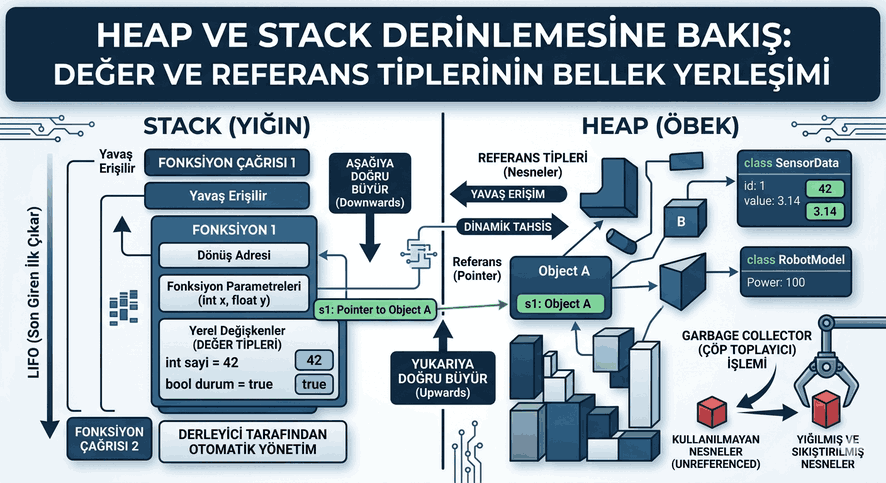
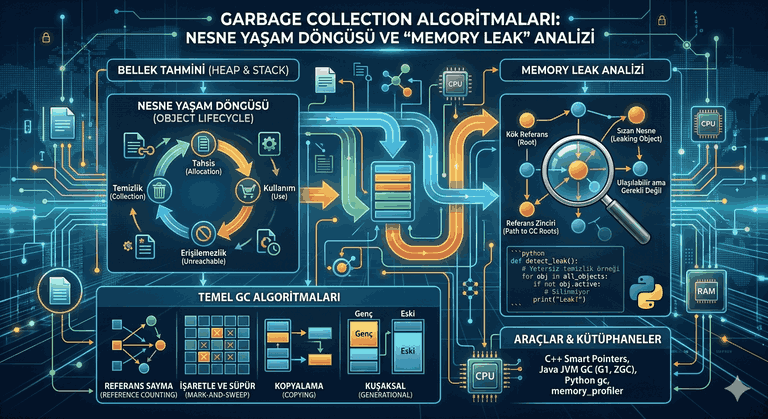
Python quietly handles complex processes like memory management in the background, thanks to the high-level abstraction it offers to the developer. However, in performance-critical applications, understanding how this silent architecture works is vital for resolving “Memory Leak” issues or optimizing resource consumption. Memory management in Python consists of a layered structure such as Reference Counting, Generational Garbage Collection, and Memory Pools.
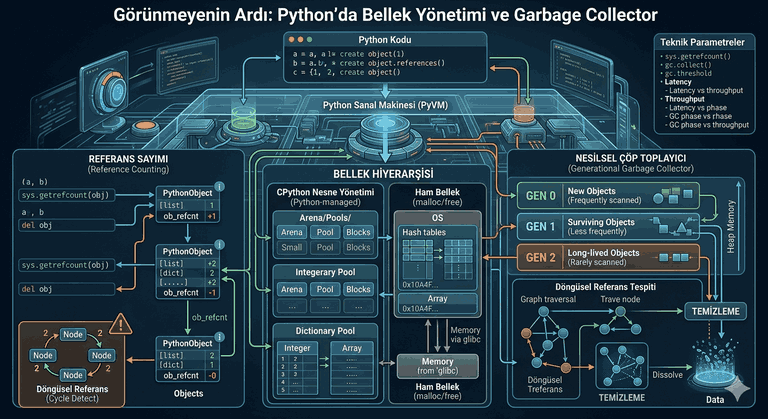
Figure 1: Behind the Scenes: Memory Management and Garbage Collector Mechanisms in Python
1. CPython Memory Hierarchy and Layered Structure
CPython, the standard implementation of Python, uses a specialized hierarchy to manage memory. This structure ensures that raw memory from the operating system (OS) is efficiently distributed to objects.
Layer 0: The Operating System, responsible for raw memory.
Layer 1: Memory allocators like C’s standard malloc function.
Layer 2 (The Object Allocator): CPython’s own “Object Allocator” mechanism. Here, specialized management is applied for objects smaller than 512 bytes.
Layer 3 (Object-specific Allocators): Optimized allocators for specific data types (e.g., int, dict, list).
Python uses a structure of Arenas, Pools, and Blocks to reduce the cost (system call overhead) of constantly requesting small objects from the OS. An Arena is typically 256 KB in size and contains 4 KB Pools. This hierarchy minimizes memory fragmentation.
2. Basic Mechanism: Reference Counting
In Python, the primary factor determining the lifetime of an object is its reference count. Every object holds a counter (ob_refcnt) that tracks how many different variables or structures point to it.
How it Works?
When an object is created or assigned to a variable, its counter increases.
When a reference to the object is deleted (del) or goes out of scope, the counter decreases.
When the counter reaches zero, the memory used by the object is immediately freed.
import sys
# Creating an objecta = [1, 2, 3]
print(sys.getrefcount(a)) # Output: 2 (One is 'a', the other is the copy entering the function)b = a
print(sys.getrefcount(a)) # Output: 3del b
print(sys.getrefcount(a)) # Output: 2
Advantage of Reference Counting: It is real-time. The object is deleted from memory the moment it is no longer needed.
Disadvantage: It is insufficient in cases of “Reference Cycles”.
3. Circular References and Garbage Collector (GC)
If two or more objects refer to each other, their reference counts never drop to zero. This situation leads to memory leaks. Python uses the Garbage Collector (GC) module to solve this problem.
classNode:
def__init__(self):
self.cycle =Nonex = Node()
y = Node()
x.cycle = y
y.cycle = x
del x
del y
# Objects are not deleted from memory because they hold each other!
The GC runs periodically to detect these cycles and determines which ones are “unreachable” by simulating reference counts.
4. Generational Collection Concept
It is very costly for the GC to scan all objects every time. Based on the Weak Generational Hypothesis (the hypothesis that “young objects are more likely to die”), Python divides objects into three generations:
Generation 0 (Gen 0): All newly created objects are included here. Scanning is performed most frequently in this generation.
Generation 1 (Gen 1): Objects that survive (survive) a Gen 0 scan are moved here.
Generation 2 (Gen 2): It is the generation containing the longest-lived objects. It is scanned rarely.
Each generation has a threshold value. When the number of objects in Gen 0 exceeds the threshold, the GC is triggered.
5. Manual Intervention and Fine-tuning with the gc Module
Developers can optimize Python’s automatic memory management via the gc library.
gc.collect(): Manually triggers the garbage collector.
gc.set_threshold(threshold0, threshold1, threshold2): Sets the scanning frequency of the generations.
gc.disable(): Turns off automatic collection (used in high-performance code that does not contain cycles).
Technical Note: Especially when working with large datasets or when thousands of small objects are created and deleted, increasing GC thresholds can improve performance.
6. Using “Slots” in Memory Management: __slots__
By default, classes in Python use a dictionary (__dict__). Dictionaries are flexible but memory consumption is high. If millions of objects are to be created, the __slots__ structure should be used.
classEfficientPoint:
__slots__ = ['x', 'y'] # Uses a fixed-size array instead of a dictionarydef__init__(self, x, y):
self.x = x
self.y = y
When __slots__ is used, a dictionary is not created for each object, which significantly reduces memory usage per object.
7. Distinction Between Mutable and Immutable Objects
The type of objects is also of critical importance in memory management:
Immutable:int, str, tuple. Python does not delete frequently used objects such as small integers (between -5 and 256) from memory; it reuses them using the “interning” method.
Mutable:list, dict, set. These objects request new memory space each time.
8. Tools and Libraries for Memory Analysis
The following libraries are industry standards for measuring the memory footprint of your code:
tracemalloc: Comes with Python. Shows where memory allocations are made line by line.
objgraph: Visualizes reference graphs between objects. Ideal for finding circular references.
memory_profiler: Reports function-based memory usage as a time series.
import tracemalloc
tracemalloc.start()
# Code block to be tracked# ...snapshot = tracemalloc.take_snapshot()
top_stats = snapshot.statistics('lineno')
for stat in top_stats[:10]:
print(stat)
9. Important Notes and Best Practices
Avoid Global Variables: Global variables remain in memory until the program terminates because their reference counts do not reset. Keep data in functional scope.
Use with Blocks: When resources like files or network sockets are closed with a with block, the references to the objects associated with them are cleared faster.
Prefer Generator for Large Data: Instead of loading an entire list into memory, process the data as a stream using the yield keyword.
Beware of Circular Reference Risk: Especially in callback functions and complex class relationships, you can access objects without increasing the reference count by using the weakref (weak reference) library.
Conclusion
Python’s memory management is designed to balance flexibility and performance. Reference counting is fast and effective, but the generational GC mechanism kicks in for edge cases like circular references. As a developer, knowing these layers not only enables you to write faster code, but also allows you to build scalable architectures that use system resources efficiently. Although memory management in Python is “invisible,” its effect is always felt.