We use cookies and other tracking technologies to improve your browsing experience on our website, to show you personalized content and targeted ads, to analyze our website traffic, and to understand where our visitors are coming from.
⚠️
GDPR & Cookie Policy Notice
In accordance with data protection regulations; the use of mandatory cookies is required for the core functions of our website to operate, ensure data security, and perform analytics. If you reject the use of cookies, it is not possible to benefit from the services on our website due to technical limitations and data synchronization interruptions. You must consent to the use of cookies to access the content on our site.
Abstract Class vs Interface: In-depth Technical Analysis and Architectural Decision Processes
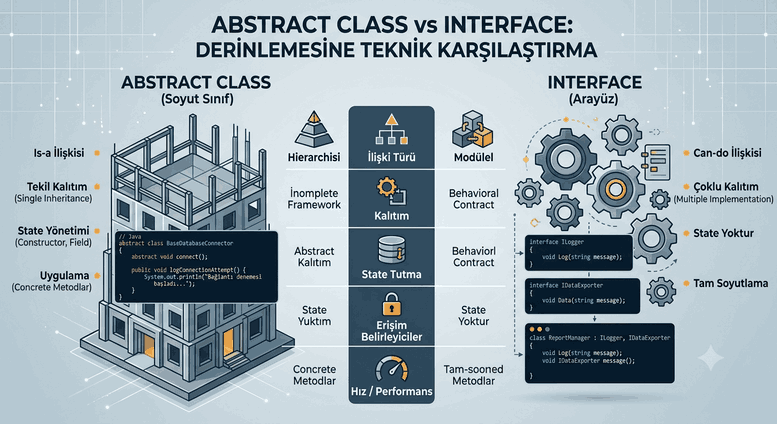
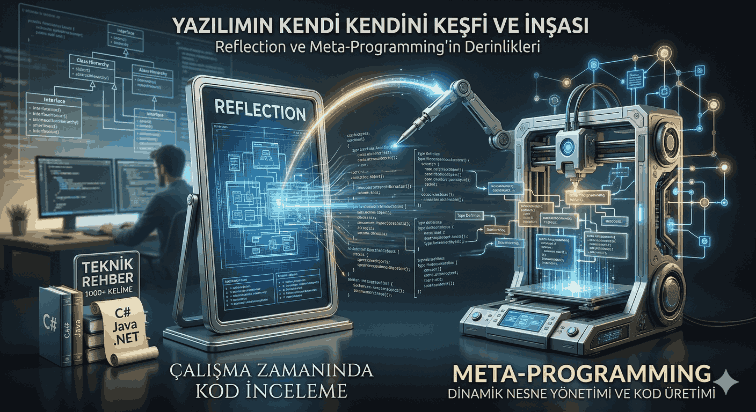
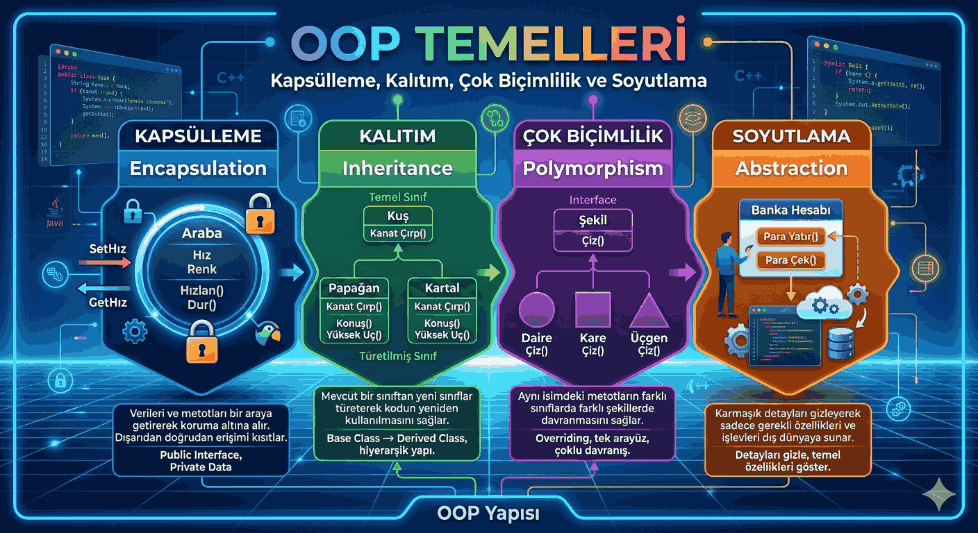
In software architecture, “Abstraction” is a fundamental mechanism for managing complexity and ensuring the extensibility of a system. In object-oriented programming (OOP) languages, the two main carriers of this mechanism are Abstract Class and Interface structures. Although many developers think of these two structures as alternatives to each other, in technical depth, the differences between them have critical effects on design patterns and system performance.
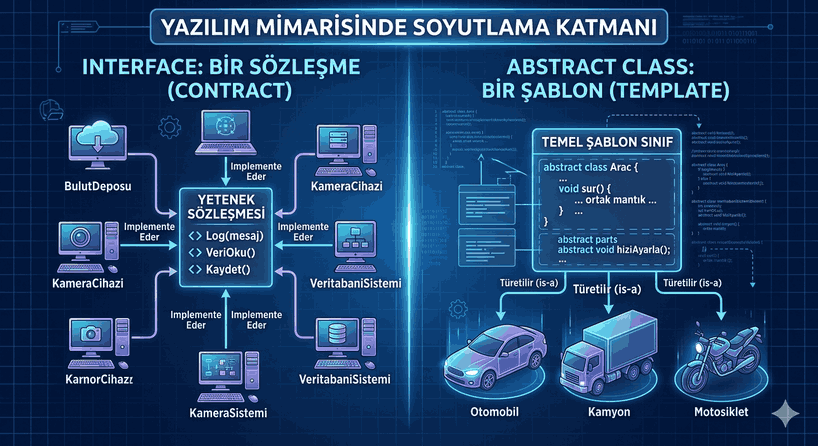
Figure 1: Abstract Class vs Interface: In-depth Technical Analysis and Architectural Decision Processes.
Abstract Class: The Foundation of Hierarchical Design
An Abstract Class represents an incomplete template that defines the essential characteristics of a class. It represents an “is-a” relationship.
Core Characteristics
Inheritance: A class can inherit from only one Abstract Class.
State Management: It can hold constructors, protected/private fields, and state.
Implementation: It can contain both fully defined methods (concrete) and abstract method signatures.
Code Sharing: When you need to share a common block of code (business logic) among subclasses.
State Control: When you need to protect or manage the internal state of the class.
Versioning: When adding a new method, you can add it as a default method instead of abstract to prevent breaking changes in existing subclasses.
When to Choose an Interface?
Extending the System: When you want to provide a common capability to classes in different hierarchies (e.g., ISerializable or ICloneable).
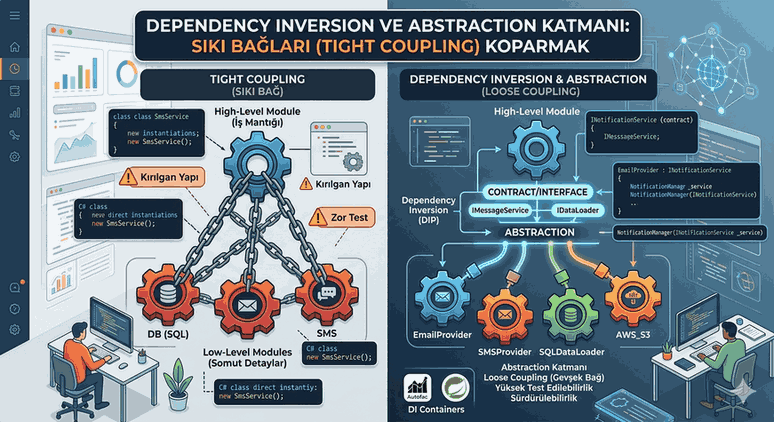
Dependency Injection (DI): In modular structures where systems need to be loosely coupled, enabling communication through interfaces instead of concrete classes (Dependency Inversion).
Multiple Capabilities: When a class needs to take on multiple roles, such as being both ICacheable and ILoggable.
Technical Notes and Architectural Tips
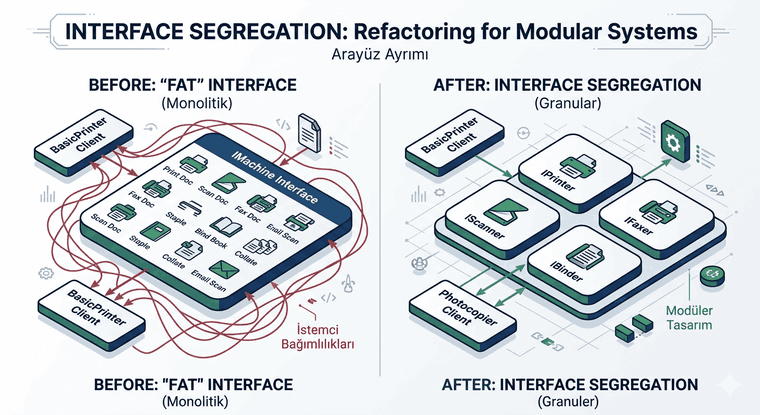
Interface Segregation Principle (ISP): Avoid “fat interfaces.” Instead, create specialized, small interfaces. For example, instead of an IUser interface, prefer segregated structures like IUserReader and IUserWriter.
Modern Approach: In modern languages (C# 8.0+, Java 8+), interfaces can contain default methods. This has pushed interfaces into the territory of abstract classes; however, the restriction on maintaining state remains the interface’s strongest distinguishing feature.
Performance: In mission-critical, high-frequency code blocks (such as high-frequency trading systems), an Abstract Class may be preferred to avoid the Virtual Table (V-Table) lookup cost. However, the branch prediction mechanisms of modern processors make this difference negligible for most applications.
Conclusion
An Abstract Class builds the skeleton of a structure, while an Interface sets the rules for how that structure communicates with the outside world. Good architecture requires using these two structures to complement each other rather than viewing them as mutually exclusive. When designing your classes, guiding your decisions with the questions “Is it a…?” leads you to an Abstract Class, while “Can it do…?” directs you to an Interface.
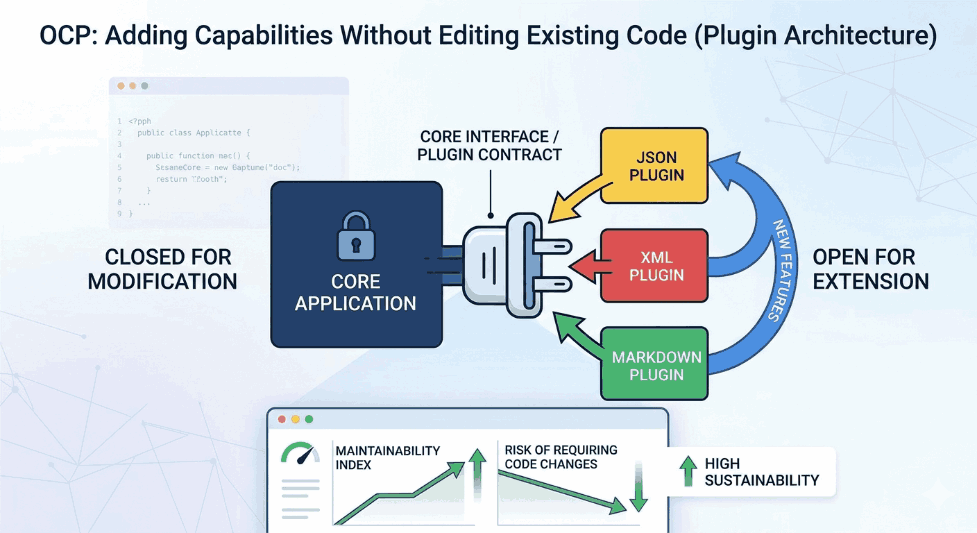
Always keep the future extensibility needs of the project (Open/Closed Principle) in the foreground. Remember that overly complex abstraction can lead to “Over-Engineering,” reducing code readability.
Recommended resources for developers:
Robert C. Martin - Clean Architecture
Erich Gamma et al. - Design Patterns: Elements of Reusable Object-Oriented Software
Microsoft Documentation - C# Object-Oriented Programming Guidelines
Oracle Java Tutorials - Interfaces and Abstract Classes