We use cookies and other tracking technologies to improve your browsing experience on our website, to show you personalized content and targeted ads, to analyze our website traffic, and to understand where our visitors are coming from.
⚠️
GDPR & Cookie Policy Notice
In accordance with data protection regulations; the use of mandatory cookies is required for the core functions of our website to operate, ensure data security, and perform analytics. If you reject the use of cookies, it is not possible to benefit from the services on our website due to technical limitations and data synchronization interruptions. You must consent to the use of cookies to access the content on our site.
JIT (Just-In-Time) Compilation Process: Optimizing Code in Machine Language
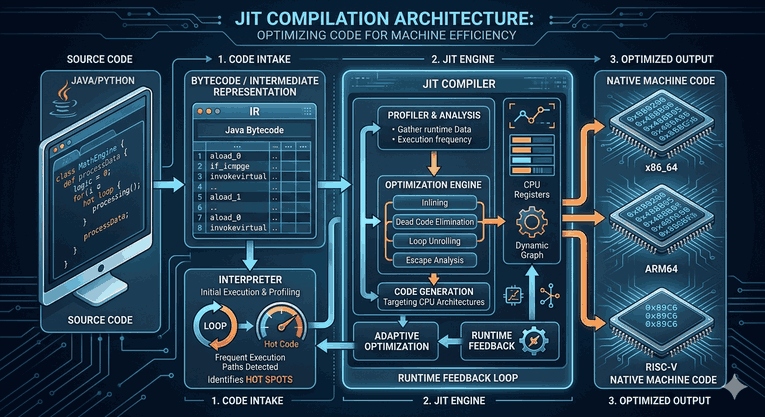
JIT (Just-In-Time) Compilation, representing the pinnacle of performance in the software world, is a hybrid mechanism that combines the flexibility of interpreted languages with the speed of compiled languages. In modern runtime environments, particularly in structures like the JVM (Java Virtual Machine), .NET CLR (Common Language Runtime), and the V8 Engine, JIT compilers ensure that code is converted into machine language and optimized according to the processor architecture during the execution phase.
1. Theoretical Foundations and Operating Logic of JIT Compilation
Traditional compilers (AOT - Ahead-of-Time) compile source code for the target architecture once, and the resulting binary file is executed directly. However, in the JIT architecture, the process is more dynamic. Code is first translated into a platform-independent Intermediate Representation (IR).
Conversion Stages:
Source Code: High-level code written by the programmer.
Bytecode / CIL: Portable intermediate form produced by the compiler (javac, msc, etc.).
JIT Compilation: At runtime, detection of “hot” code blocks and translation into machine code.
Native Code: Sequences of $0$s and $1$s that the processor can execute directly.
2. Profiling and “Hot Spot” Analysis
JIT compilers do not compile every line. This would unnecessarily increase the startup time. Instead, the Adaptive Optimization technique is used. At runtime, a “profiler” monitors which functions are called most frequently or which loops consume the most CPU time. These regions are called “Hot Spots”.
Interpretation: The code is interpreted slowly in the initial phase.
Tiered Compilation: Initially, a fast but less optimized compilation (C1 compiler) is performed. If the code remains “hot,” it moves to the second phase (C2 compiler), where more aggressive optimizations are applied.
3. Advanced Optimization Techniques
The greatest advantage of JIT compilers over AOT compilers is their possession of runtime data. With this data, the following techniques are applied:
3.1. Inlining
The bodies of small and frequently called functions are copied directly into the point where they are called. In this way, function call (call stack) costs and branching delays are eliminated.
3.2. Dead Code Elimination
Code blocks that will never run or calculations whose results are not used are identified and removed from the machine code.
3.3. Loop Unrolling
Iterations within a loop are converted into consecutive instructions to avoid tiring branch predictors.
3.4. Escape Analysis
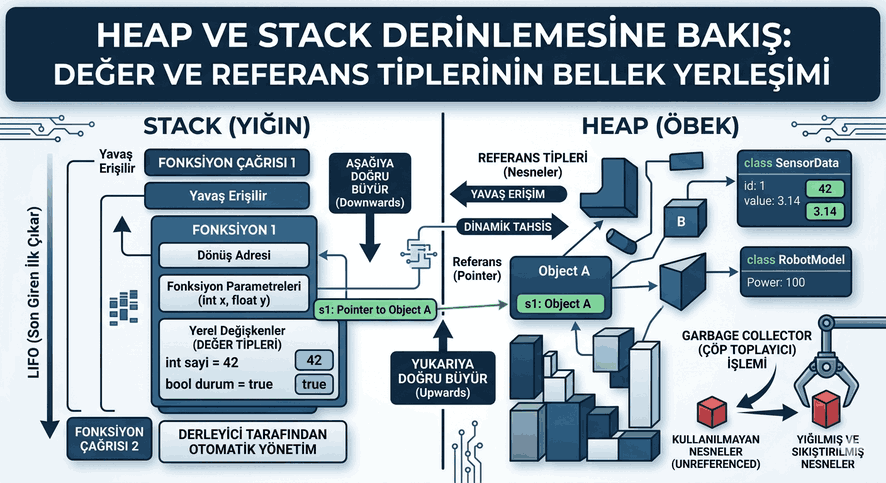
If an object lives only within a single method and does not leak, JIT can create this object on the “Stack” instead of the “Heap” or distribute it entirely to registers. This dramatically reduces the Garbage Collector (GC) load.
4. Applied Code Analysis and Bytecode Transformation
Let’s examine how a Java method is handled by the JIT:
publicclassMathEngine {
publicintmultiply(int a, int b) {
return a * b;
}
publicvoidprocessData(int[] data) {
for (int i = 0; i < data.length; i++) {
// Hot Spot: Frequently called addition operationint result = multiply(data[i], 2);
data[i]= result;
}
}
}
The bytecode (Intermediate Representation) equivalent of the code above is approximately:
When the JIT sees the invokevirtual command and notices that this loop runs thousands of times, it inlines the multiply method. Consequently, the machine code sent to the processor takes on this logic:
data[i] = data[i] << 1; (Bit shifting optimization instead of multiplication).
5. Modern JIT Engines and Libraries
V8 Engine (JavaScript & WebAssembly)
V8 uses “Hidden Classes” and “Inline Caching” to bring dynamically typed JavaScript close to machine speed. It works with Ignition interpreter and TurboFan optimizer layers.
GraalVM
Graal, which revolutionized the Java world, writes the JIT compiler itself in Java. Thanks to the Truffle Framework, it can also run languages like Ruby, Python, and R on the JVM with high performance.
LLVM (Low Level Virtual Machine)
It offers its own JIT engine (LLVM ORC). It is used, especially in data science libraries (for example, Numba), to compile Python code to machine code via LLVM IR.
6. JIT vs. AOT: Critical Comparison
Feature
JIT (Just-In-Time)
AOT (Ahead-of-Time)
Compilation Time
Runtime
Build time
Memory Usage
Higher (Compiler stays in RAM)
Lower
Optimization
Dynamic (PGO - Profile Guided)
Static
Platform Independence
High (Bytecode is portable)
Low (Binary is target-oriented)
7. Impact at the Hardware Level: Register Allocation
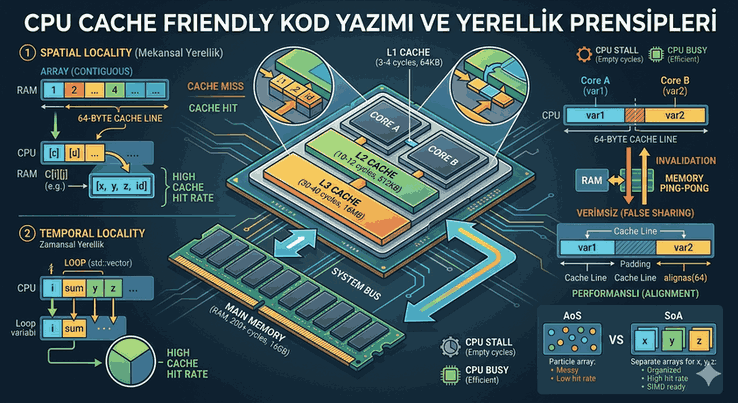
JIT compilers know how many registers the target processor (x86_64, ARM64, RISC-V) has while producing machine code. By placing variables into these registers instead of writing them to memory (RAM), it ensures operations are performed at L1 Cache speed.
Especially by using SIMD (Single Instruction, Multiple Data) instruction sets (like AVX-512), it can process multiple data points within a loop in a single CPU cycle (Vectorization).
8. Technical Notes and Implementation Strategies
Note 1: Warm-up Period:
Systems using JIT are slow when the application first opens. This is because the code is still being interpreted. In high-traffic systems, important methods should be compiled by the JIT using “Warm-up” scripts.
Note 2: Deoptimization:
If the JIT assumes a variable will always be an Integer and compiles the code, but a String arrives there at runtime, the JIT performs a “Bailout.” It cancels the compiled code, returns to interpretation, and initiates re-compilation. This situation causes performance loss (Polymorphic inline cache misses).
9. Conclusion and Future Projection
JIT technology today not only accelerates languages but also lowers cloud computing costs. Optimized code that can do more work with fewer CPU cycles minimizes energy consumption on the server side. In the future, it is expected that machine learning-powered JIT compilers (ML-driven compilers) will predict the flow of code and optimize it before a “hot spot” even forms.
Developments in WebAssembly (WASM), in particular, are bringing JIT performance inside the browser to native levels, completely erasing the line between desktop applications and web applications. It is a necessity for software architects to understand the JIT behaviors (inlining limits, heap strategies, etc.) of the platforms they use to design high-scale systems.