We use cookies and other tracking technologies to improve your browsing experience on our website, to show you personalized content and targeted ads, to analyze our website traffic, and to understand where our visitors are coming from.
⚠️
GDPR & Cookie Policy Notice
In accordance with data protection regulations; the use of mandatory cookies is required for the core functions of our website to operate, ensure data security, and perform analytics. If you reject the use of cookies, it is not possible to benefit from the services on our website due to technical limitations and data synchronization interruptions. You must consent to the use of cookies to access the content on our site.
Inversion of Control (IoC) Containers: Dependency Injection (DI) Lifetime Management
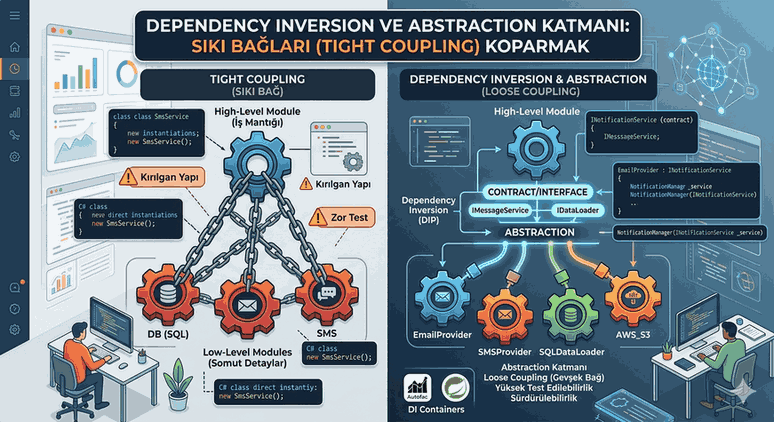
In software architectures, the process of creating objects and managing their relationships is critical for project scalability and maintainability. In modern software development practices, classes creating their own dependencies (tight coupling) hinders code testability and reduces flexibility. To overcome this, the Inversion of Control (IoC) principle and its most common implementation, Dependency Injection (DI), delegate object management to a centralized structure.
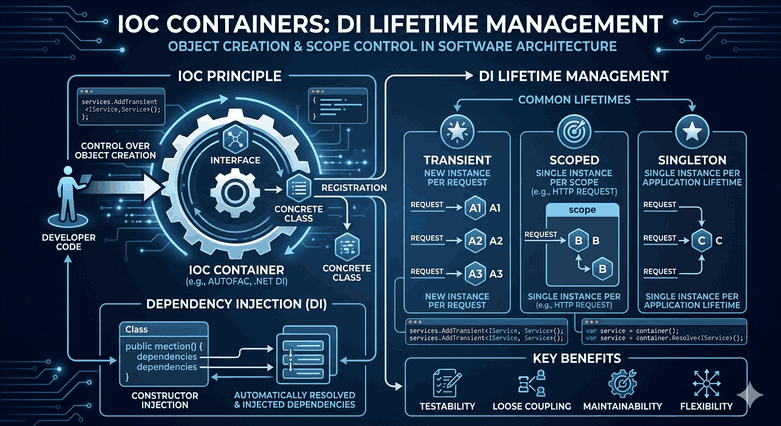
Figure 1: Inversion of Control (IoC) Containers: Dependency Injection (DI) Lifetime Management.
1. IoC and DI Conceptual Framework
Inversion of Control (IoC)
In traditional programming, the flow of application and the control of object creation reside in the code written by the developer. IoC is the transfer of this control from the program itself to a framework or a container. It operates on the “Don’t call me, I’ll call you” (Hollywood Principle) philosophy.
Dependency Injection (DI)
DI is the “injection” of dependencies—objects that another object needs—from the outside, instead of creating them within the object itself. This process is generally performed in three ways:
Constructor Injection: Providing dependencies through the class’s constructor.
Property (Setter) Injection: Assigning dependencies through public properties.
Method Injection: Passing the dependency as a parameter only during the execution of a specific method.
2. Role and Mechanism of IoC Containers
IoC containers are advanced libraries where all components (services) in an application are registered and automatically resolved when needed. The container manages the following processes:
Registration: Defining which concrete class corresponds to which interface.
Resolution: When an object is requested, scanning its entire dependency tree to create the object.
Lifetime Management: Determining how long the created object will remain alive.
3. Lifetime Management: Technical Details
When a service is registered in an IoC container, its creation and destruction times must be defined. An incorrectly chosen lifetime can lead to memory leaks or serious architectural errors such as “captured dependency.”
3.1. Transient
A new object instance is created every time it is requested. It is ideal for lightweight, stateless services.
Usage Area: Data validation classes, helper methods.
Performance: There is a cost of frequent object creation, but memory management is safer because the object is cleaned up by the GC (Garbage Collector) once it finishes its task.
3.2. Scoped
A single object instance is created throughout a “scope” (usually an HTTP request). The object is destroyed when the request is completed.
Usage Area: Database contexts (Entity Framework DbContext), user session information.
Important Note: Scope management should be handled with care in asynchronous operations or background tasks.
3.3. Singleton
It is created once when the application starts, and the same object instance is used until the application closes.
using Microsoft.Extensions.DependencyInjection;
var builder = WebApplication.CreateBuilder(args);
// Registration Operationsbuilder.Services.AddTransient<ITransientOperation, Operation>();
builder.Services.AddScoped<IScopedOperation, Operation>();
builder.Services.AddSingleton<ISingletonOperation, Operation>();
var app = builder.Build();
Consumption of Services
When we call these services within a Controller, we observe that the Transient ID changes with every HTTP request, the Scoped ID remains constant throughout the request, and the Singleton ID never changes until the application is restarted.
5. Advanced IoC Libraries and Features
Some popular IoC containers in the modern software world include:
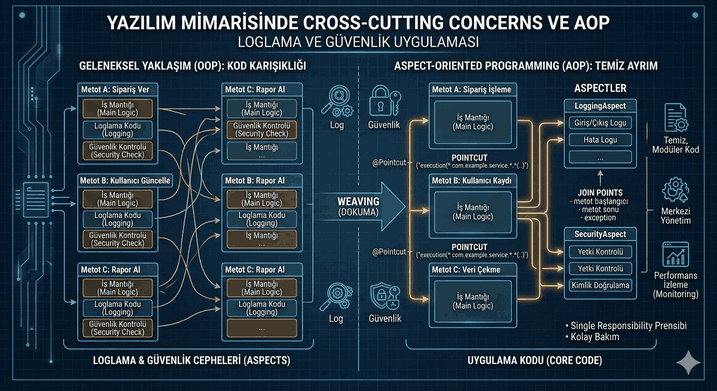
Autofac: The most preferred third-party library in the .NET world. It stands out with module-based registration, Property Injection, and Intercept (AOP) support.
Ninject: Highly readable (fluent interface) but slightly heavier in terms of performance.
Castle Windsor: A mature container used widely in enterprise projects, possessing a very flexible structure.
StructureMap: One of the oldest DI libraries for .NET (it has now been replaced by Lamar).
Advanced Registration Example with Autofac
Unlike the standard .NET DI container, Autofac offers features such as “Auto-activation” or “Circular Dependency” resolution.
This is one of the most common mistakes. It occurs when a shorter-lived object (Scoped or Transient) is injected into a longer-lived object (Singleton).
Result: Since the Scoped object is “trapped” within the Singleton, it cannot be destroyed and continues to live with an incorrect state throughout the application. This situation leads to database connection errors (zombie connections).
Service Locator Anti-Pattern
Injecting IServiceProvider directly into the code and manually resolving objects from it (GetService<T>) is an anti-pattern. This hides the class’s dependencies and makes unit testing impossible. Constructor Injection should always be preferred.
7. Performance and Optimization in IoC Containers
IoC containers produce objects using reflection at runtime. In large projects, resolving thousands of classes can cause performance loss. To optimize this:
Compiled Expressions: Modern containers (e.g., DryIoc or Lamar) compile expression trees for fast object production.
Lazy Initialization: The use of Lazy<T> should be encouraged to ensure that a dependency is created only when needed.
AOT (Ahead-of-Time) Compilation: Especially in mobile and cloud-based applications, libraries that provide compile-time code generation instead of runtime reflection can be used (e.g., structures integrated with MediatR).
Technical Notes:
Disposable Objects: If an object created by the container implements the IDisposable interface, the container automatically calls the Dispose() method at the end of its lifetime. Singleton objects are only disposed of when the application shuts down.
Validation: By enabling the ValidateScopes property during application startup, lifetime mismatches (Captured Dependency) can be detected during the development phase.
8. Conclusion
IoC containers and Dependency Injection are the building blocks of modern software architecture. Proper management of dependencies ensures that code is suitable for unit testing and eliminates tight coupling between classes. However, the misuse of lifetime types such as Transient, Scoped, and Singleton can lead to performance issues and bugs that are difficult to detect. When choosing a library for a project, software architects should focus not only on popularity but also on the lifetime management capabilities and performance outputs provided by the library.