We use cookies and other tracking technologies to improve your browsing experience on our website, to show you personalized content and targeted ads, to analyze our website traffic, and to understand where our visitors are coming from.
⚠️
GDPR & Cookie Policy Notice
In accordance with data protection regulations; the use of mandatory cookies is required for the core functions of our website to operate, ensure data security, and perform analytics. If you reject the use of cookies, it is not possible to benefit from the services on our website due to technical limitations and data synchronization interruptions. You must consent to the use of cookies to access the content on our site.
Cross-Cutting Concerns: Logging and Security with Aspect-Oriented Programming (AOP)
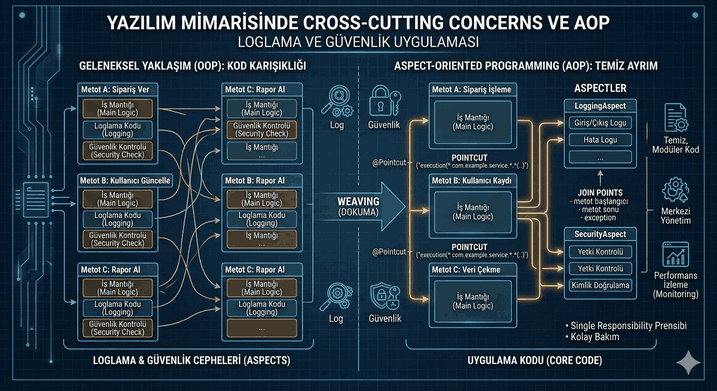
In modern software architectures, keeping business logic clean and maintainable is one of the greatest challenges. Functionalities such as logging, security checks, error management, and transaction management, which are interspersed among the code performing the primary functions of an application, are called “Cross-Cutting Concerns.” These structures are repeated across many different modules of the application and significantly reduce the readability, testability, and modularity of the code.
This is where Aspect-Oriented Programming (AOP) comes into play as a powerful paradigm designed to manage these scattered structures from a central point.
Figure 1: Cross-Cutting Concerns: Logging and Security with Aspect-Oriented Programming (AOP).
1. The Concept of Cross-Cutting Concerns and Code Pollution
In software development, the “Separation of Concerns” principle dictates that each module should be responsible only for its own functionality. However, there are requirements that do not fit into the object-oriented programming (OOP) hierarchy.
Logging: Recording operation details at the entry and exit of each method.
Security (Authentication/Authorization): Ensuring that specific methods are only called by authorized users.
Caching: Caching frequently used data for performance.
Exception Handling: Establishing a standard response mechanism for error situations.
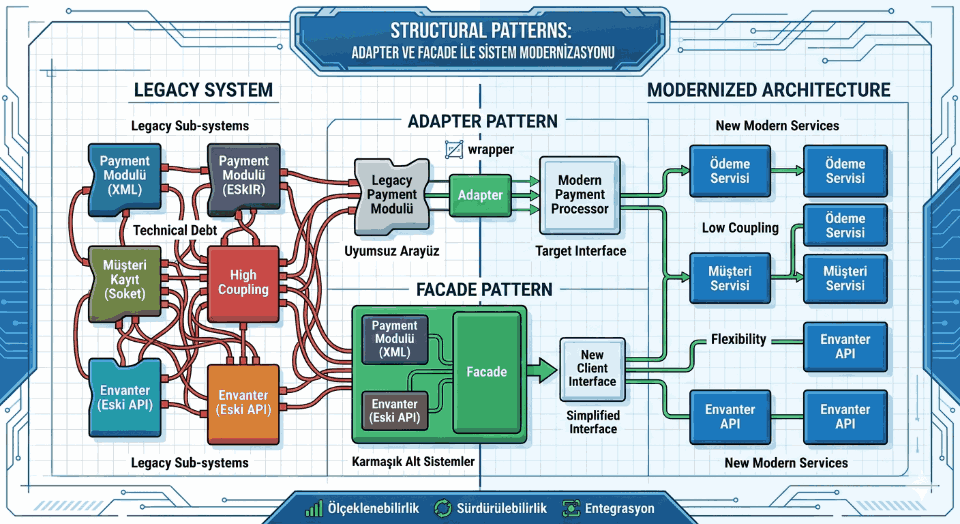
If AOP is not used, these operations are manually written into every method. This leads to problems known as “Code Tangling” and “Code Scattering.” AOP abstracts these codes from the core business logic and collects them in components called “Aspects.”
2. Basic AOP Terminology
To understand AOP, it is necessary to know the technical equivalents of these basic concepts:
Aspect: A modularized version of a concern that affects multiple classes. For example, “LoggingAspect”.
Join Point: A point in the execution flow of the program where an operation occurs, such as calling a method or throwing an exception.
Pointcut: An expression that determines which Join Points will be affected by an Aspect. It is a filter.
Advice: The action to be taken when a specific Pointcut is captured. (e.g., Log before the method starts).
Weaving: The process of integrating Aspects into application code. This can occur at compile-time, load-time, or runtime.
3. Advanced Logging Strategies with AOP
Logging is the most common use case for AOP. In the classic approach, logger.info(...) lines are found within every method. With AOP, this process is decoupled.
Technical Implementation: Spring AOP and AspectJ
In the Java ecosystem, Spring AOP uses a dynamic proxy mechanism, while AspectJ offers more advanced bytecode manipulation. Below is an example of a Performance Logging Aspect that measures the execution time of all service methods:
@Aspect@ComponentpublicclassPerformanceTrackingAspect {
privatestaticfinal Logger logger = LoggerFactory.getLogger(PerformanceTrackingAspect.class);
// Pointcut targeting methods in the entire service package@Pointcut("execution(* com.app.service.*.*(..))")
publicvoidserviceLayerExecution() {}
@Around("serviceLayerExecution()")
public Object profileMethodExecution(ProceedingJoinPoint joinPoint) throws Throwable {
long startTime = System.currentTimeMillis();
// Where the actual business logic is executed Object result = joinPoint.proceed();
long elapsedTime = System.currentTimeMillis() - startTime;
logger.info("Method: {} | Execution Time: {} ms",
joinPoint.getSignature().toShortString(),
elapsedTime);
return result;
}
}
In this structure, we can centrally monitor performance data for all methods in the service package without touching a single method.
4. AOP in the Security and Authorization Layer
Security checks should be removed from control blocks like if(!user.hasRole("ADMIN")) located at the top of business logic code. AOP provides declarative security management.
Authorization Control with Custom Annotation
By creating our own notation, we can activate security only on specific methods:
Then we construct the Aspect structure that listens for this annotation:
@Aspect@ComponentpublicclassSecurityAspect {
@Before("@annotation(securedRole)")
publicvoidcheckAuthorization(SecuredRole securedRole) {
String requiredRole = securedRole.value();
User currentUser = SecurityContext.getCurrentUser();
if (currentUser ==null||!currentUser.getRoles().contains(requiredRole)) {
thrownew UnauthorizedException(requiredRole +" authority is required for this action.");
}
}
}
Thanks to this approach, securing a method becomes as simple as writing @SecuredRole("ADMIN") on top of it.
5. Modern Software Libraries and Tools
Popular libraries used to implement AOP are:
AspectJ (Java): The industry standard. Offers the highest performance through compile-time weaving. Supports complex pointcut expressions.
Spring AOP (Java): Integrated with the Spring Framework, it is easy to use. Works at runtime using JDK Dynamic Proxy or CGLIB.
PostSharp (.NET): The most powerful tool in the .NET world that performs code injection at the MSIL (Microsoft Intermediate Language) level.
Castle Windsor / Autofac (Interceptors): Allow AOP to be applied in the .NET side through Dependency Injection containers using “Interception” logic.
Python Decorators: In Python, AOP is solved functionally with decorators that are inherent in the language.
6. Exception Handling and Resilience
Catching specific exception types thrown throughout the system and converting them into meaningful messages or HTTP status codes for the user is much more elegant with AOP.
Especially in microservice architectures, AOP is indispensable for setting up a retry mechanism after a service receives an error. Libraries like Resilience4j apply Circuit Breaker and Retry patterns by using AOP proxies.
7. Technical Details to Consider When Using AOP
Although AOP cleans up code, its misuse can lead to “hidden” behaviors in the system:
Proxy Boundaries (Self-Invocation): In proxy-based structures like Spring AOP, if a method inside a class calls another method in the same class, the Aspect is not triggered. This is because the call is made via this, not through the proxy. This can be overcome with AspectJ (bytecode weaving).
Performance Overhead: Runtime weaving and intensive use of reflection can cause millisecond delays in very high-traffic systems. In this case, compile-time weaving should be preferred.
Debugging Difficulty: Since the program flow constantly jumps to Aspects, reading stack traces and debugging can become difficult. Therefore, Aspect codes should be kept as short and error-free as possible.
8. Database Transaction Management
The most critical yet least noticed application of AOP is @Transactional management. Opening a database connection, starting the process (begin), rolling back in case of an error, and committing upon success are performed by a “Transaction Advice” wrapped around the method by AOP.
// In the background, AOP wraps this method with try-catch blocks and manages the DB transaction.@TransactionalpublicvoidupdateAccountBalance(Long id, BigDecimal amount) {
Account account = repository.findById(id);
account.setBalance(amount);
repository.save(account);
}
Conclusion and Technical Assessment
Cross-cutting concerns are not about “how” the software does things, but about “how it behaves” across the system. Aspect-Oriented Programming is not a competitor to object-oriented programming (OOP), but a component that complements it. It ensures that the code remains fully compliant with the “Single Responsibility” principle.
Offloading repetitive tasks such as logging and security to Aspects means fewer lines of code, fewer errors, and much higher maintainability. Especially in large-scale enterprise projects, the use of AOP is not a choice, but an architectural necessity.
Note: Be careful not to make your “Pointcut” expressions too broad when implementing AOP. An Aspect that accidentally affects all library methods or system functions can cause the application to crash or lead to serious performance losses. Always take care to use the narrowest selectors possible.