We use cookies and other tracking technologies to improve your browsing experience on our website, to show you personalized content and targeted ads, to analyze our website traffic, and to understand where our visitors are coming from.
⚠️
GDPR & Cookie Policy Notice
In accordance with data protection regulations; the use of mandatory cookies is required for the core functions of our website to operate, ensure data security, and perform analytics. If you reject the use of cookies, it is not possible to benefit from the services on our website due to technical limitations and data synchronization interruptions. You must consent to the use of cookies to access the content on our site.
Lazy, Eager, and Explicit Loading: Avoiding the "N+1 Problem" with Data Loading Strategies
In modern software architectures, database interactions play a decisive role in the scalability and response time of an application. One of the biggest performance bottlenecks encountered, especially when using Object-Relational Mapping (ORM) tools, is the N+1 Query Problem. To overcome this issue and optimize the data access layer, it is essential to have a deep understanding of Lazy, Eager, and Explicit Loading strategies.
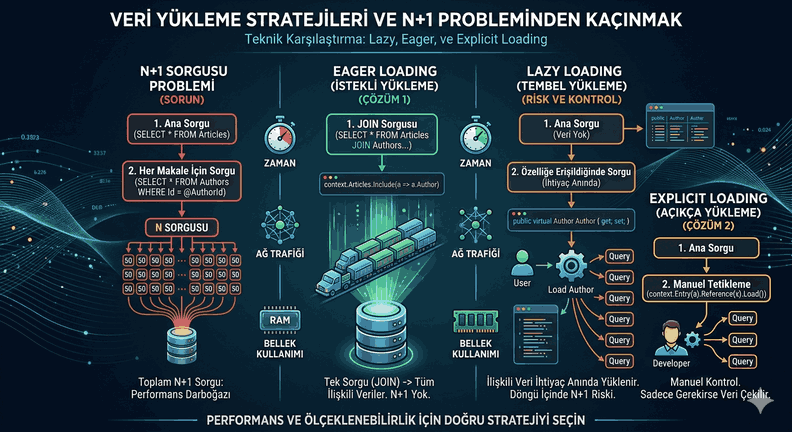
Figure 1: Lazy, Eager, and Explicit Loading: Avoiding the “N+1 Problem” with Data Loading Strategies.
1. The N+1 Query Problem: The Silent Killer of Performance
The N+1 problem occurs when a main data set (N records) and a separate query for each of the related data associated with those records are executed. As a result, a total of $N+1$ queries are sent to the database.
Example Scenario:
Assume you want to display 50 articles and the author of each article in a blog application:
The main query that fetches all articles: SELECT * FROM Articles; (1 query)
The query that fetches the relevant author for each article: SELECT * FROM Authors WHERE Id = @AuthorId; (50 queries)
This situation increases network traffic, exhausts the database connection pool, and leads to significant latency.
2. Eager Loading
Eager Loading is the process of fetching related data at the same time with a single query (usually using JOIN) while the main data set is being retrieved. Although it may seem costly at the database level, it completely eliminates the N+1 problem on the application side.
Technical Implementation (Entity Framework Core)
The Include and ThenInclude methods are used for this strategy in EF Core.
// A single JOIN query is sent to the database.var articles = context.Articles
.Include(a => a.Author)
.Include(a => a.Comments)
.ThenInclude(c => c.User)
.ToList();
Pros and Cons
Pros: All data is obtained with a single database round-trip.
Cons: Over-fetching data can increase memory usage. Queries containing too many JOINs can become complex.
3. Lazy Loading
Lazy Loading is a strategy where related data is loaded from the database only at the moment when an attempt is made to access it. Data is not loaded until the navigation property on the object is called.
Technical Infrastructure and Proxy Objects
This mechanism is generally carried out through Proxy classes or Virtual keywords. The ORM tool creates a proxy that derives from your class at runtime and triggers the database query when the relevant property is called.
Example Structure
publicclassArticle{
publicint Id { get; set; }
publicstring Title { get; set; }
// Being virtual is critical for Lazy Loadingpublicvirtual Author Author { get; set; }
}
Critical Risk: Uncontrolled Query Explosion
Although Lazy Loading provides comfort to the developer, it is the root cause of the N+1 problem. If a related property is accessed within a foreach loop, a new SQL query runs every time the loop turns.
4. Explicit Loading
Explicit Loading is when the developer manually decides when data will be loaded within the flow of the code. Data is not loaded initially, but is triggered with the Load() method when needed.
Implementation Example
var article = context.Articles.FirstOrDefault(a => a.Id == 1);
// Load related data based on a specific conditionif (needComments)
{
context.Entry(article)
.Collection(a => a.Comments)
.Load();
}
This method is the safest middle ground for preventing unnecessary loading in large object networks.
5. Advanced Optimization Techniques
Relying only on ORM methods is not sufficient when implementing data loading strategies. The following techniques take performance to the next level:
A. Projection Queries (Select)
Mapping only the required fields into a DTO (Data Transfer Object) instead of fetching all table columns saves you from the cost of SELECT *.
var data = context.Articles
    .Select(a => new ArticleDto {
        Title = a.Title,
        AuthorName = a.Author.Name
    }).ToList();
B. Split Queries
Using too many JOINs can lead to the “Cartesian Product” problem, creating massive result sets. The AsSplitQuery() feature, which comes with EF Core 5.0+, fetches relationships with separate queries but in an optimized way.
var articles = context.Articles
    .Include(a => a.Comments)
    .AsSplitQuery()
    .ToList();
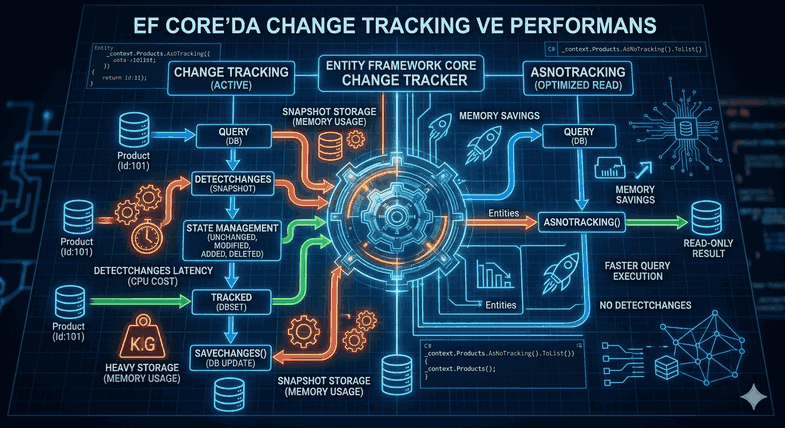
C. No-Tracking
If no updates will be made to the fetched data (Read-only scenarios), turning off the ORM’s object tracking mechanism provides memory and CPU savings.
var list = context.Articles.AsNoTracking().ToList();
6. Strategy Selection Matrix
Criterion
Eager Loading
Lazy Loading
Explicit Loading
Number of Queries
Low (Usually 1)
High (N+1 Risk)
Medium (Controlled)
Amount of Data
High (Risk of unnecessary loading)
Minimum (Only what is needed)
Selective
Use Case
Where the relationship will always be used
Optional, rarely accessed data
Scenarios containing complex business logic
Complexity
Medium
Low
High
7. Software Libraries and Ecosystem Support
Different languages and frameworks manage these strategies with different libraries:
Java (Spring Boot / Hibernate): Hibernate uses Lazy Loading for collections by default. The strategy can be changed with @EntityGraph or FetchType.EAGER.
.NET (Entity Framework Core): Lazy Loading is disabled by default. It can be activated with the Microsoft.EntityFrameworkCore.Proxies package.
Python (SQLAlchemy / Django ORM): Django has select_related (Eager-JOIN) and prefetch_related (Eager-Separate Query) methods.
Node.js (Sequelize / TypeORM): Eager Loading is managed with relations or include parameters.
8. Implementation Notes and Architectural Recommendations
Query Monitoring: Monitoring SQL Profiler or ORM logs during the development phase is critical to catching the N+1 problem before going live.
Standardize DTO Usage: Avoid returning Entity objects directly at the API layer. This leads to unintentional Lazy Loading triggers and JSON serialization errors.
Avoid Deep Relationships: Queries requiring more than three ThenIncludes usually indicate a problem in the database design or that the query needs to be broken down.
Caution with Large Data Sets: Using Eager Loading on tables containing thousands of records can cause the server memory (RAM) to fill up rapidly. Paging is mandatory in these situations.
Choosing the right data loading strategies not only increases the execution speed of the code but also reduces the total cost of ownership (TCO) of the system, enabling resources to be used efficiently. For a modern software engineer, these strategies are the most powerful optimization instruments in the toolbox.