In-Depth Technical Analysis of AI Architecture and Development Processes

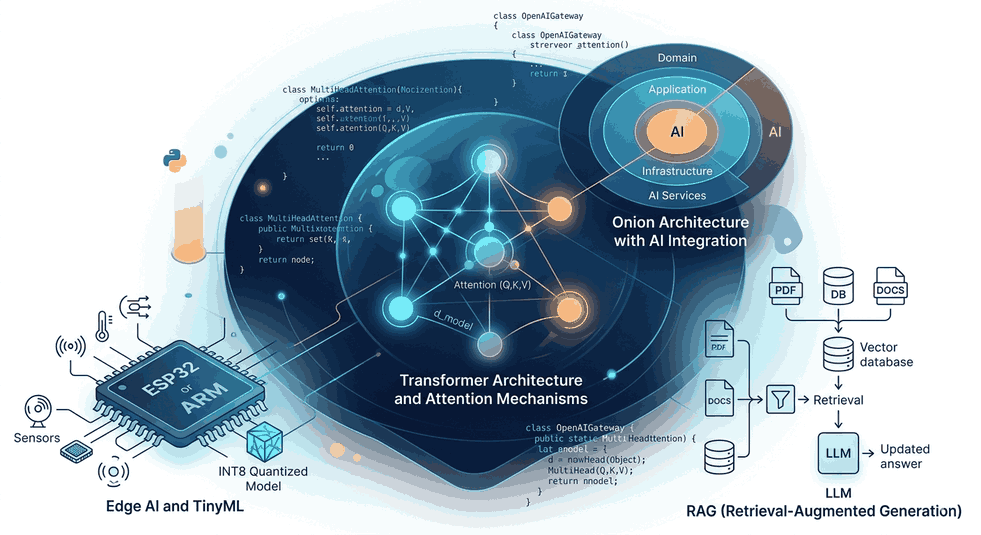
The modern software ecosystem is evolving beyond traditional deterministic algorithms toward structures based on probabilistic computing and deep learning. Entering the “kitchen” of the models at the center of this evolution requires understanding the underlying mathematical and architectural building blocks, rather than just calling ready-made APIs. This article examines a wide technical spectrum, from Transformer architecture to edge computing, architectural design patterns, and data-driven generation methods.

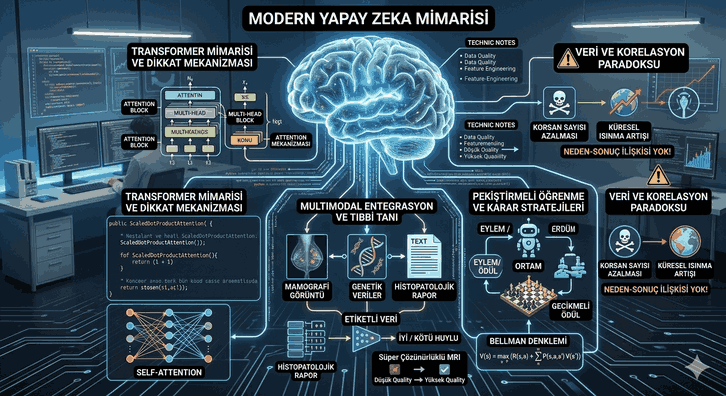
In-Depth Technical Analysis of AI Architecture and Development Processes

Figure 1: In-Depth Technical Analysis of AI Architecture and Development Processes.


1. Transformer Architecture and Multi-Head Attention Mechanisms

The success of today’s Large Language Models (LLMs) is based on the Transformer architecture introduced in 2017. Unlike traditional RNN (Recurrent Neural Networks) or LSTM (Long Short-Term Memory) models, Transformers process data in parallel rather than sequentially.

Scaled Dot-Product Attention

The heart of the Transformer is the “Attention” mechanism, which mathematically calculates the relationship of a word with all other words in a sentence. This process is conducted through three main matrices: Query (Q), Key (K), and Value (V).

The mathematical formulation is as follows:

$$Attention(Q, K, V) = \text{softmax}\left(\frac{QK^T}{\sqrt{d_k}}\right)V$$

Here, $d_k$ represents the dimension of the key vectors and ensures the stabilization of gradients by preventing the growth of the dot product.

Multi-Head Attention Implementation Example (Python/PyTorch)

import torch
import torch.nn as nn
import torch.nn.functional as F

class MultiHeadAttention(nn.Module):
    def __init__(self, d_model, num_heads):
        super(MultiHeadAttention, self).__init__()
        self.num_heads = num_heads
        self.d_model = d_model
        assert d_model % num_heads == 0
        
        self.depth = d_model // num_heads
        
        self.wq = nn.Linear(d_model, d_model)
        self.wk = nn.Linear(d_model, d_model)
        self.wv = nn.Linear(d_model, d_model)
        
        self.dense = nn.Linear(d_model, d_model)
        
    def split_heads(self, x, batch_size):
        x = x.view(batch_size, -1, self.num_heads, self.depth)
        return x.permute(0, 2, 1, 3)

    def forward(self, v, k, q, mask):
        batch_size = q.size(0)
        
        q = self.split_heads(self.wq(q), batch_size)
        k = self.split_heads(self.wk(k), batch_size)
        v = self.split_heads(self.wv(v), batch_size)
        
        # Scaled dot-product attention
        matmul_qk = torch.matmul(q, k.transpose(-1, -2))
        dk = torch.tensor(self.depth, dtype=torch.float32)
        scaled_attention_logits = matmul_qk / torch.sqrt(dk)
        
        if mask is not None:
            scaled_attention_logits += (mask * -1e9)
            
        attention_weights = F.softmax(scaled_attention_logits, dim=-1)
        output = torch.matmul(attention_weights, v)
        
        output = output.permute(0, 2, 1, 3).contiguous()
        concat_attention = output.view(batch_size, -1, self.d_model)
        
        return self.dense(concat_attention)

2. AI Integration with Onion Architecture

When incorporating artificial intelligence services into a software project, one of the greatest risks is the domain logic becoming dependent on technological tools. Onion Architecture reverses this dependency, isolating the core logic.

  • Domain Layer: Contains the “Entity” and “Value Object” structures required for the AI model’s inputs and outputs.
  • Application Layer: Interactors (Services) that coordinate LLM calls are located here.
  • Infrastructure Layer: Concrete implementations (Adapters) that connect to OpenAI, Hugging Face, or a local Llama 3 model reside in this layer.

Model Abstraction with Dependency Injection

To ensure the software can use GPT-4 one day and a local model the next, the “Inversion of Control” principle must be applied.

public interface IAIService {
    Task<string> ProcessPromptAsync(string prompt);
}

// Concretization in the Infrastructure layer
public class OpenAIGateway : IAIService {
    public async Task<string> ProcessPromptAsync(string prompt) {
        // API call logic
    }
}

// Usage in Domain/Application layer
public class TextAnalyzer {
    private readonly IAIService _aiService;
    public TextAnalyzer(IAIService aiService) => _aiService = aiService;
    
    public async Task Analyze(string text) {
        var result = await _aiService.ProcessPromptAsync(text);
        // Analysis operations
    }
}

3. Edge AI and TinyML: Artificial Intelligence on Resource-Constrained Devices

Cloud-based artificial intelligence solutions may not always be efficient (due to latency, cost, or privacy). Edge AI refers to running the model directly on processors such as ESP32, Arduino, or ARM-based chips.

Model Optimization Techniques

Because memory (SRAM) is limited on microcontrollers, models must undergo the following processes:

  1. Quantization: Converting 32-bit float weights into 8-bit integer (INT8) format.
  2. Pruning: Removing low-weight neurons that have no impact on the model’s output.
  3. Knowledge Distillation: A large teacher model transferring knowledge to a smaller student model.

TinyML Example: TensorFlow Lite for Microcontrollers

The tflite-micro library is used to classify accelerometer data on an Arduino.

#include <TensorFlowLite_ESP32.h>
#include "model_data.h" // Pre-trained model converted to a C array

// Memory pool allocation
const int kTensorArenaSize = 10 * 1024;
uint8_t tensor_arena[kTensorArenaSize];

void setup() {
  static tflite::MicroMutableOpResolver<5> resolver;
  resolver.AddFullyConnected();
  resolver.AddSoftmax();
  
  static tflite::MicroInterpreter interpreter(
      model, resolver, tensor_arena, kTensorArenaSize, error_reporter);
      
  interpreter.AllocateTensors();
}

4. RAG (Retrieval-Augmented Generation) Mechanism

Static LLM models do not know information that appeared after their training data cutoff date. RAG solves this problem by “reminding” the model of relevant documents from external sources (vector databases) instead of retraining the model (fine-tuning).

RAG Workflow Pipeline

  1. Ingestion: PDF or SQL data is divided into small parts (Chunks).
  2. Embedding: These parts are converted into semantic vectors (e.g., sentence-transformers).
  3. Vector Store: Vectors are stored in databases like Pinecone, Milvus, or ChromaDB.
  4. Retrieval: The documents most similar to the user’s question are found using “Cosine Similarity”.
  5. Generation: The query + documents are sent to the LLM as context.

RAG Implementation with LangChain

from langchain_community.vectorstores import Chroma
from langchain_community.embeddings import HuggingFaceEmbeddings
from langchain.text_splitter import RecursiveCharacterTextSplitter

# 1. Document Processing
text_splitter = RecursiveCharacterTextSplitter(chunk_size=500, chunk_overlap=50)
texts = text_splitter.split_documents(documents)

# 2. Vectorization and Storage
embeddings = HuggingFaceEmbeddings(model_name="all-MiniLM-L6-v2")
vector_db = Chroma.from_documents(texts, embeddings, persist_directory="./db")

# 3. Retrieval
query = "What are the system's security protocols?"
docs = vector_db.similarity_search(query)

# 4. LLM Feeding
context = "\n".join([doc.page_content for doc in docs])
prompt = f"Context: {context}\n\nQuestion: {query}\nAnswer:"

Technical Notes and Advanced Strategies

Note 1: Curse of Dimensionality in Vector Space As vector dimensions increase (e.g., 1536d), Euclidean distance begins to lose its meaning. “Cosine Similarity” is generally preferred in RAG systems because directional similarity is more critical than magnitude differences.

Note 2: Fine-Tuning vs. RAG If the system needs to learn new information, RAG should be preferred; if the system needs to acquire a specific style, tone, or format, Fine-tuning (LoRA/QLoRA) should be chosen.

Note 3: GPU Memory Management When running LLMs locally (Self-hosting), KV Cache management directly affects memory consumption. Libraries such as vLLM use PagedAttention to manage GPU memory dynamically, providing a 20-40% increase in efficiency.

Conclusion

The development of artificial intelligence systems is a intersection of mathematical modeling, system architecture, and hardware constraints. Every layer—from the theoretical foundation of the Transformer architecture to the modularity provided by Onion Architecture and the dynamic data capability of RAG systems—is vital for a sustainable AI ecosystem. Developers moving beyond being mere API consumers to mastering these subsystems play a key role in building optimized and high-performance autonomous systems.

#ai #data-engineering #big-data #ai-architecture #transformer-architecture #deep-learning #machine-learning

Related Contents

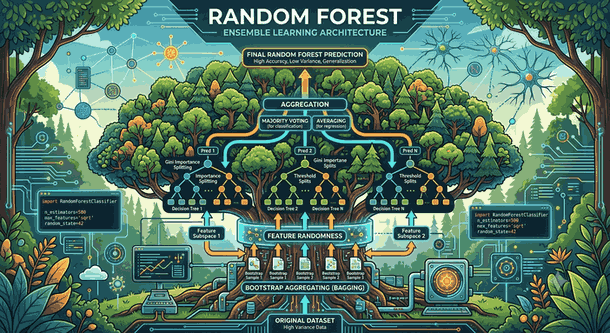
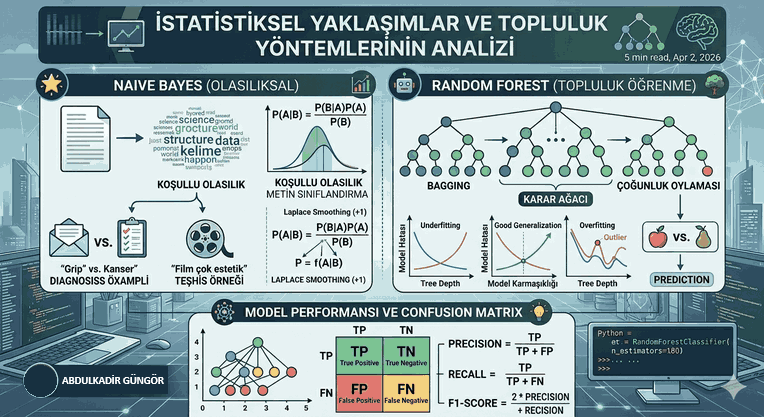
Technical Architecture and Implementation Principles of the Random Forest Algorithm

Random Forest is a powerful "Ensemble Learning" algorithm that achieves more stable and high-accuracy results by combining the predictions of numerous "Decision Tree" structures. By utilizing "Bagging" and "Feature Randomness" techniques, it minimizes the "overfitting" tendency of a single tree; thus, it is a "robust" model that exhibits high "generalization" success even with noisy data and does not require scaling.

ai machine-learning random-forest python decision-tree ensemble-learning supervised-learning feature-importance hyperparameter-tuning artificial-intelligence deep-learning ai-engineering

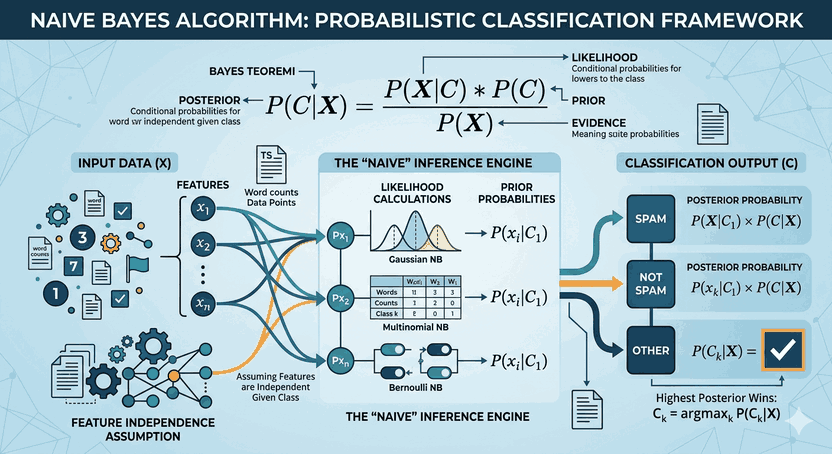
Theoretical Foundations and Application Strategies of the Naive Bayes Algorithm

Naive Bayes is a fast and effective probabilistic classification algorithm based on Bayes' Theorem that assumes full independence between features. It provides a strong foundation for problems such as text classification, spam filtering, and sentiment analysis, especially in high-dimensional datasets, with low computational cost.

ai naive-bayes bayes-theorem scikit-learn gaussian-naive-bayes multinomial-naive-bayes bernoulli-naive-bayes machine-learning deep-learning ai-engineering

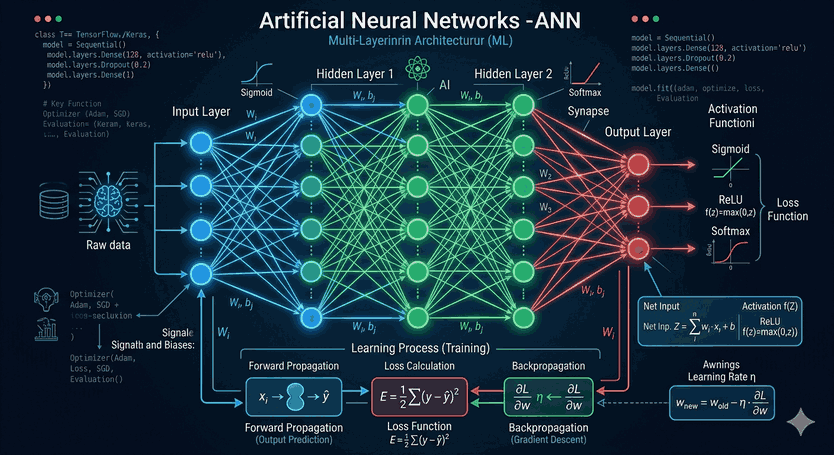
Artificial Neural Networks: A Journey from Biological Inspiration to Mathematical Architecture

A technical article detailing the biological foundations, advanced mathematical architecture, backpropagation algorithms, and deep learning optimization techniques of artificial neural networks, complete with Python code examples.

ai artificial-neural-networks deep-learning python ai-technologies nlp data-science machine-learning

Architectural Depth of Large Language Models: Alignment, Optimization, and Efficient Adaptation

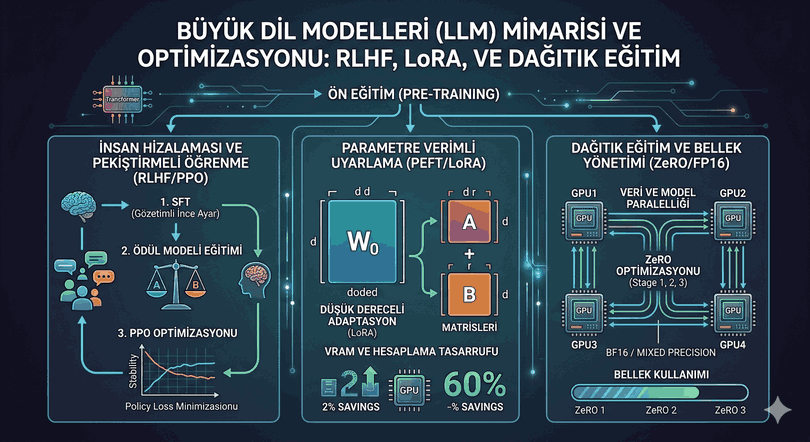
[-Veri Analiz Okulu, Notes 11-] A deep technical article covering the alignment of Large Language Models (LLMs) with human feedback, their efficient adaptation via Low-Rank Adaptation (LoRA), and their optimization in distributed hardware architectures.

ai veri-analizi-okulu vao python llm rlhf nlp lora deep-learning ai-engineering machine-learning

The Neural Architecture of Modern Language Models and Their Evolution from Token-Level to Reasoning

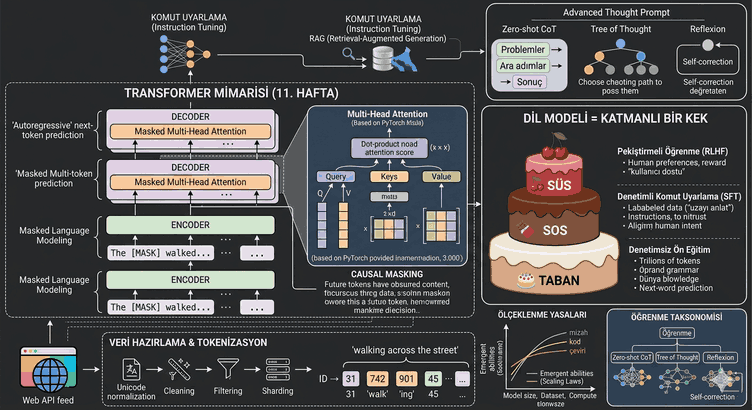
[-Veri Analiz Okulu, Notes 10-] This article is a comprehensive examination covering the mathematical foundations of the Transformer architecture, the vectorial operations of attention mechanisms, and the processes by which large language models (LLMs) derive meaning from data with technical depth.

ai veri-analizi-okulu vao python transformer-architecture nlp llm tokenization attention-mechanism neural-networks ai-alignment pytorch machine-learning

The Anatomy of Modern Deep Learning: A Technical Journey from Gradients to Attention Mechanisms

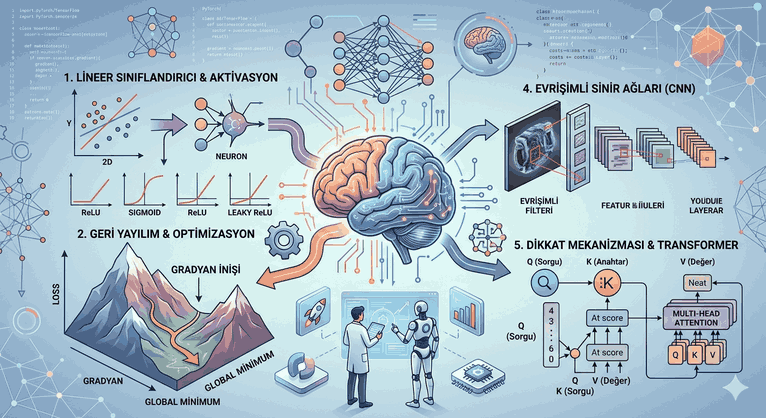
[-Veri Analiz Okulu, Notes 9-] A technical article covering the mathematical background of backpropagation, CNNs, and attention mechanisms, which form the foundation of deep learning, along with optimization algorithms and modern architectural structures.

ai veri-analizi-okulu vao python back-propagation cnn transformer attention-mechanism pytorch machine-learning

Delicate Balances and Strategic Approaches in Modern Machine Learning

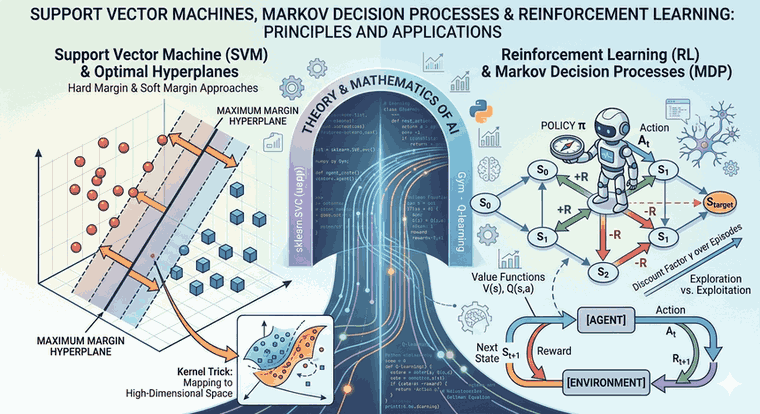
[-Veri Analiz Okulu, Notes 8-] This article analyzes the geometric optimization strategies of Support Vector Machines, the reward-oriented decision-making mechanisms of Reinforcement Learning, and the mathematical foundations of Markov Decision Processes with technical depth.

ai veri-analizi-okulu vao python svm deep-learning reinforcement-learning algorithm-analysis machine-learning

Engineering Analysis of Statistical Approaches and Ensemble Methods in Machine Learning

[-Veri Analiz Okulu, Notes 7-] A technical article analyzing the mathematical depth of Naive Bayes and Random Forest algorithms, based on Bayesian probability theory and ensemble learning methods, with model performance metrics.

ai veri-analizi-okulu vao python naive-bayes random-forest confusion-matrix python-coding statistical-learning algorithm-analysis machine-learning

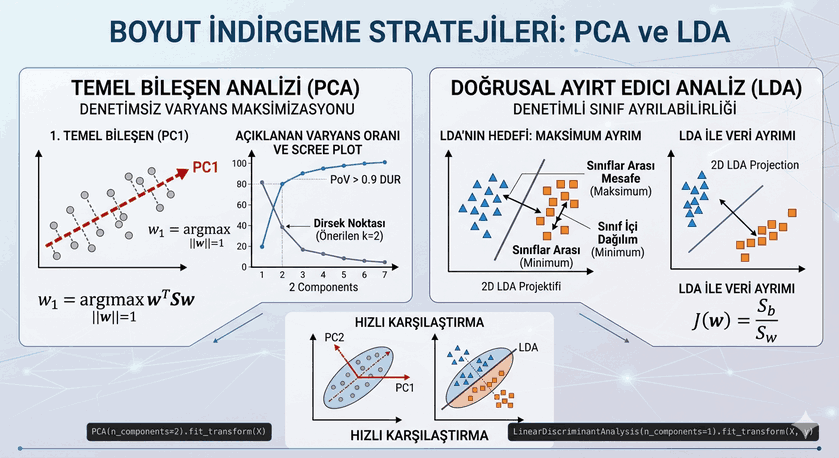
Dimensionality Reduction Strategies and Algorithmic Depth in Machine Learning

[-Veri Analiz Okulu, Notes 6-] Examines PCA and LDA techniques used to reduce the complexity of high-dimensional data, covering their mathematical foundations, impact on classification performance, and in-depth Python-based technical implementation examples.

ai veri-analizi-okulu vao python dimensionality-reduction pca lda classification statistical-analysis data-science machine-learning

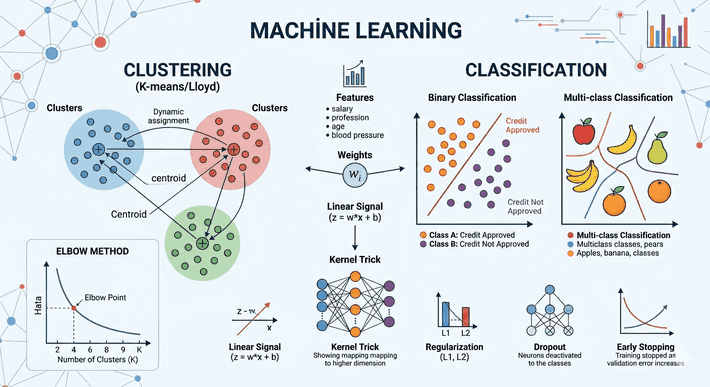
Modern Clustering and Classification Strategies in Machine Learning

[-Veri Analiz Okulu, Notes 5-] A comprehensive and technical article covering everything from linear classification models to K-means clustering algorithms, and from model optimization to regularization techniques that prevent overfitting.

ai veri-analizi-okulu vao python deep-learning kmeans clustering classification lloyd-algorithm data-science machine-learning

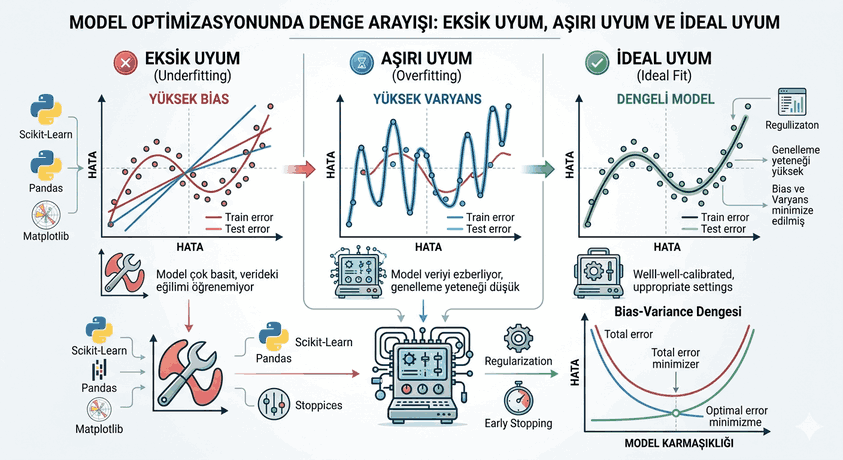
The Quest for Balance in Model Optimization: A Stability Analysis of Machine Learning from Underfitting to Overfitting

[-Veri Analiz Okulu, Notes 4-] This article examines the balance between model complexity and generalization capability in machine learning, exploring the concepts of underfitting and overfitting with technical depth.

ai veri-analizi-okulu vao python deep-learning model-fitting over-fitting under-fitting data-science machine-learning

Architectural Foundations and Algorithmic Strategies of Modern Artificial Intelligence

[-Veri Analiz Okulu, Notes 3-] A technical paper on the attention mechanism of the Transformer architecture, multimodal data integration, and the mathematical decision strategies of reinforcement learning.

ai veri-analizi-okulu vao python deep-learning transformer-architecture multi-modal-ai bellman-equation data-science machine-learning

The Layered Architecture and Algorithmic Depth of Machine Learning

[-Veri Analiz Okulu, Notes 2-] A technical and mathematical analysis of the hierarchical structure of machine learning, data processing layers, and fundamental learning paradigms (supervised, unsupervised, reinforcement).

ai veri-analizi-okulu vao python deep-learning reinforcement-learning data-science machine-learning

From Data Engineering to Cognitive Revolution: The Technical Anatomy of AI and Machine Learning

[-Veri Analiz Okulu, Notes 1-] This comprehensive technical review analyzes the evolutionary process of artificial intelligence, from rule-based expert systems to modern transformer architectures and generative networks, through biological analogies and practical application layers in the software world.

ai veri-analizi-okulu vao python deep-learning pytorch transformer data-science machine-learning

Advanced Analytical Modeling and Algorithmic Visualization Strategies in High-Dimensional Data Spaces

This is a technical guide for processing high-dimensional data with maximum efficiency using hardware-based memory optimization, advanced feature engineering, and algorithmic pipelines.

ai data-engineering big-data statistical-analysis data-mining algorithmic-visualization machine-learning

The Digital Ontology of Data: A Deep Look from Binary Logic to Quantum Superposition

A technical examination of the transformation process of data from its raw form to strategic insight, viewed through the perspectives of deterministic systems, algorithmic depth, and computational social sciences.

ai data-science machine-learning computational-analysis quantum-computers nlp gis digital-transformation

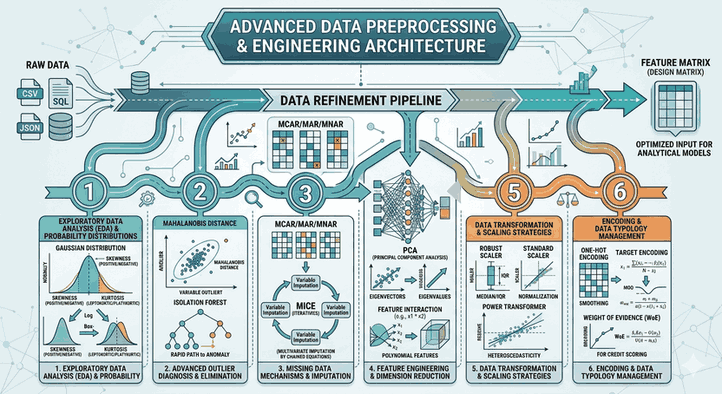
Advanced Data Preprocessing and Engineering Architecture in Data Science

A technical examination of the transformation of data from raw form into a processed feature matrix in analytical modeling processes; a synthesis of statistical methodologies and computational techniques.

ai data-science machine-learning data-preprocessing feature-engineering statistical-analysis data-mining

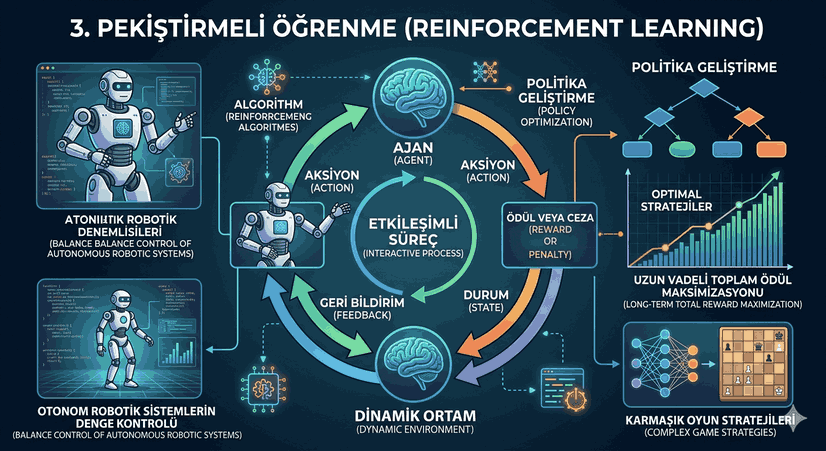
Reinforcement Learning: Dynamic Decision Mechanisms and the Mathematics of Autonomous Systems

A technical guide detailing the mathematical foundations, deep architectures, and technical implementation methods of reinforcement learning, which optimizes optimal decision strategies through reward mechanisms in dynamic environments.

ai data-engineering big-data reinforcement-learning deep-learning python machine-learning

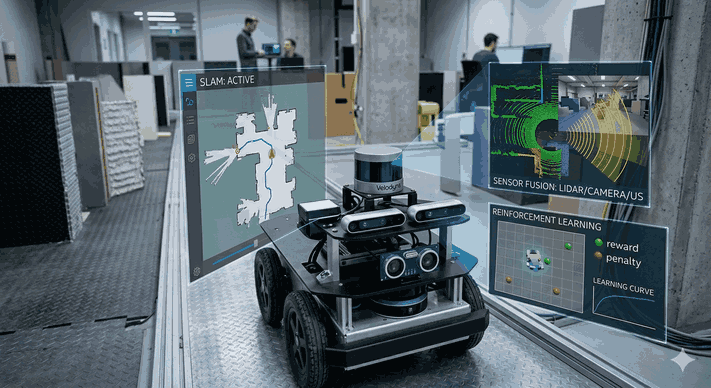
Engineering Architecture of Autonomous Systems: SLAM, Sensor Fusion, and Reinforcement Learning Processes

A comprehensive guide examining the technical depth of localization, data integration, and machine learning algorithms in robotic systems, along with C++ and Python implementations.

ai autonomous-systems big-data slam reinforcement-learning robotics robotics machine-learning

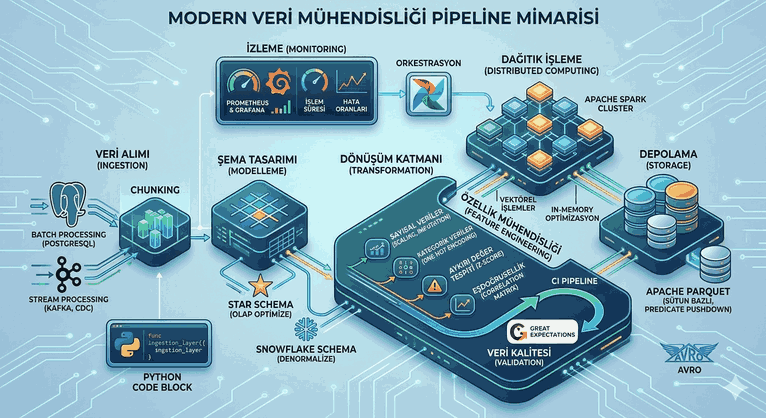
Modern Data Engineering: Scalable Pipeline Architectures and Analytical Transformation Strategies

A comprehensive guide to end-to-end high-performance data pipeline design, covering distributed computing engines, in-memory optimization techniques, and complex feature engineering processes.

ai data-engineering big-data statistical-analysis distributed-computing statistical-modeling machine-learning

In-Memory Computing and Low-Latency Data Processing Strategies in Modern Data Architectures

Optimizing performance at the hardware level in the data ecosystem: In-memory architectures, CPU cache hierarchy, and low-latency data processing techniques.

ai data-architecture memory-management low-latency system-design performance-optimization

Advanced Data Preprocessing and Algorithmic Optimization Strategies in Machine Learning Pipelines

A guide to maximizing model performance through advanced feature engineering, statistical imputation techniques, ensemble modeling strategies, and Bayesian optimization. Engineering discipline in data analytics using modern tools like SHAP and Isolation Forest.

ai data-engineering big-data data-analytics algorithm-optimization feature-engineering machine-learning

Advanced Data Science Strategies: Graph Analytics, Synthetic Data, and XAI Architectures

A comprehensive technical analysis of network theory, data generation techniques, and model transparency that provides depth in modern data analytics.

ai data-engineering big-data graph-analysis xai synthetic-data machine-learning

Unsupervised Learning: The Hidden Geometry of Data and Algorithmic Discovery Techniques

This article details methodologies used to extract meaningful patterns from unlabeled datasets, including clustering, dimensionality reduction, and anomaly detection, along with their mathematical foundations and modern software implementations.

ai data-engineering big-data unsupervised-learning pca clustering machine-learning

Mathematical Optimization and Applied Algorithm Strategies in Supervised Learning Architecture

A mathematical modeling method that learns a mapping function from labeled data consisting of input-output pairs, aiming to predict continuous or categorical values.

ai data-engineering supervised-learning algorithm python machine-learning