We use cookies and other tracking technologies to improve your browsing experience on our website, to show you personalized content and targeted ads, to analyze our website traffic, and to understand where our visitors are coming from.
⚠️
GDPR & Cookie Policy Notice
In accordance with data protection regulations; the use of mandatory cookies is required for the core functions of our website to operate, ensure data security, and perform analytics. If you reject the use of cookies, it is not possible to benefit from the services on our website due to technical limitations and data synchronization interruptions. You must consent to the use of cookies to access the content on our site.
Modern Data Engineering: Scalable Pipeline Architectures and Analytical Transformation Strategies
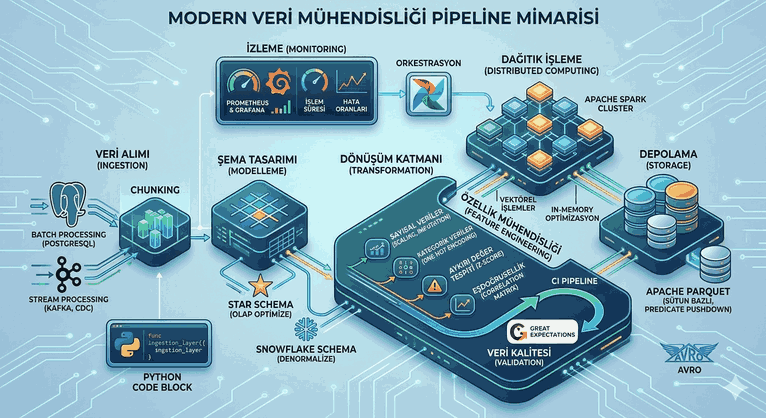
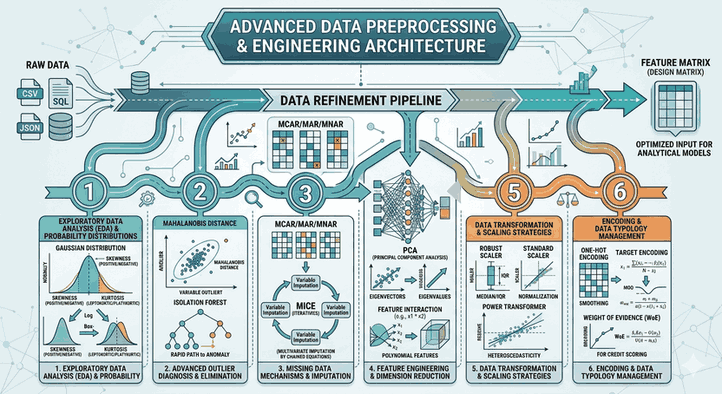
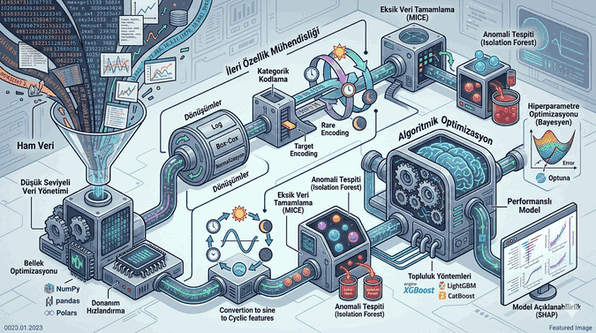
In today’s data ecosystems, the transformation of raw data from an unprocessed heap into a strategic asset relies on the integration of complex systems. This process requires not only moving data from one point to another but also transforming it with low latency and high accuracy, while preserving the semantic structure of the data.
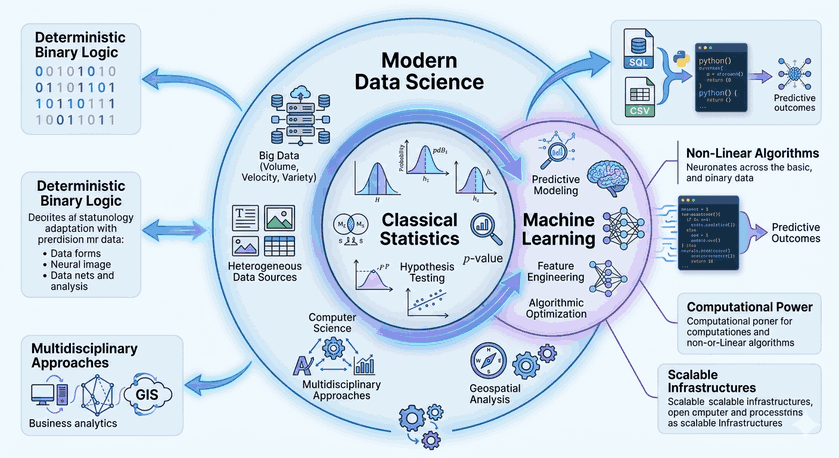
Figure 1: Modern Data Engineering: Scalable Pipeline Architectures and Analytical Transformation Strategies.
1. Data Ingestion and Source Integration
In modern architectures, data ingestion occurs along two main axes: Batch processing and Stream processing. Data coming from relational databases (PostgreSQL, MS SQL) or log files is typically tracked via CDC (Change Data Capture) mechanisms.
Within the Python ecosystem, pandas and Dask are used for the manipulation of large datasets, while Apache Kafka or Spark Streaming are the standards for real-time data streams.
import pandas as pd
import numpy as np
defingestion_layer(file_path):
# Memory-friendly data reading with chunking mechanism chunks = pd.read_csv(file_path, chunksize=10000)
processed_data = []
for chunk in chunks:
# Pre-cleaning: Dropping unnecessary columns clean_chunk = chunk.dropna(subset=['id', 'timestamp'])
processed_data.append(clean_chunk)
return pd.concat(processed_data)
2. Schema Design and Data Modeling Paradigms
In the Data Warehouse layer, how data is structured directly affects query performance. Onion Architecture and N-Tier approaches ensure that data is refined between layers (Raw -> Silver -> Gold).
Star Schema: Analytical queries (OLAP) are optimized with a central “Fact” table and surrounding “Dimension” tables.
Snowflake Schema: A structure where dimension tables are normalized, saving storage space but increasing query complexity.
3. Advanced Data Transformation and Feature Engineering
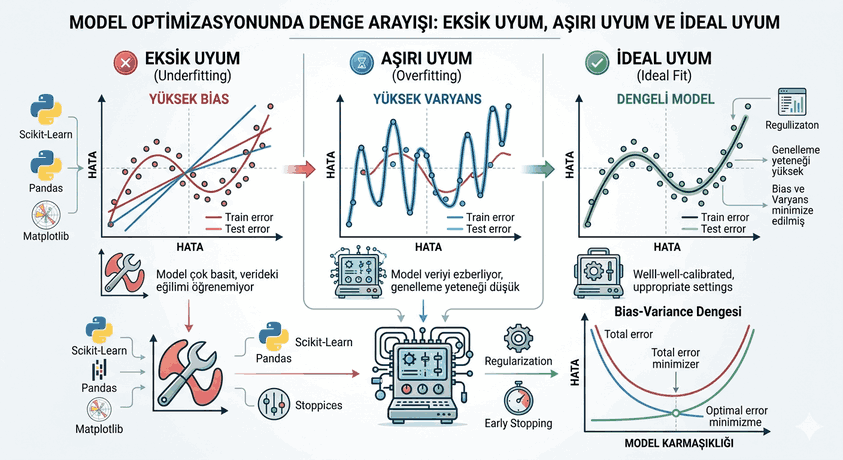
Statistical transformations must be applied to prepare raw data for machine learning models. Specifically, missing value management and outlier detection determine the model’s variance and bias balance.
from sklearn.preprocessing import StandardScaler, OneHotEncoder
from sklearn.impute import SimpleImputer
from sklearn.compose import ColumnTransformer
# Data preprocessing pipelinedeftechnical_transformation(df):
numeric_features = df.select_dtypes(include=['int64', 'float64']).columns
categorical_features = df.select_dtypes(include=['object']).columns
# Median Imputation and Standardization for numeric data numeric_transformer = Pipeline(steps=[
('imputer', SimpleImputer(strategy='median')),
('scaler', StandardScaler())
])
# One-Hot Encoding for categorical data categorical_transformer = OneHotEncoder(handle_unknown='ignore')
preprocessor = ColumnTransformer(
transformers=[
('num', numeric_transformer, numeric_features),
('cat', categorical_transformer, categorical_features)
])
return preprocessor.fit_transform(df)
4. Data Quality and Validation Layer
Libraries like Great Expectations are used to measure data quality in continuous integration (CI) processes. Data type validation, checking null ratios, and detecting data drift are performed at this stage.
Z-Score Outlier Detection: Anomalies are identified by calculating how much the data deviates from the mean using the formula $Z = (X - \mu) / \sigma$.
Correlation Matrix: Pearson or Spearman coefficients are analyzed to prevent multicollinearity between variables.
5. Distributed Processing and Orchestration
When large-scale datasets do not fit into the memory of a single machine, distributed computing engines like Apache Spark come into play. Spark performs parallel processing on clusters by dividing data into partitions.
from pyspark.sql import SparkSession
from pyspark.sql.functions import col, avg
# Initialize Spark sessionspark = SparkSession.builder.appName("DataEngineering").getOrCreate()
# Distributed data processing exampledefspark_process(df_spark):
return df_spark.groupBy("category") \
.agg(avg("price").alias("average_price")) \
.filter(col("average_price") >100)
6. Storage Technologies and File Formats
In Data Lake architectures, Apache Parquet or Avro, which perform columnar storage, are preferred over text-based formats like CSV or JSON. Thanks to its “predicate pushdown” feature, Parquet allows reading only the relevant columns from the disk, reducing I/O costs by up to 80%.
7. Modern CI/CD and Monitoring (Observability)
The success of a data pipeline depends on its sustainability in the production environment. Pipeline metrics (processing time, data volume, error rates) are tracked with Prometheus and Grafana. Furthermore, SQL-based transformations are versioned and documented using dbt (data build tool).
This technical depth ensures that data is not only processed but also run on a high-performance, secure, and scalable architecture. Operational excellence is achieved when the engineering approach is combined with code cleanliness (SOLID principles) and architectural modularity.