Advanced Data Preprocessing and Algorithmic Optimization Strategies in Machine Learning Pipelines

In modern data science and machine learning pipelines, processing raw data and preparing it for the modeling stage constitutes approximately 80% of the total project time. In this process, it is essential not only to call library functions but also to understand the statistical distribution of the data and the mathematical expectations of the algorithms. Below, advanced data analytics processes are covered comprehensively with technical details and application code.

Advanced Data Preprocessing and Algorithmic Optimization Strategies in Machine Learning Pipelines

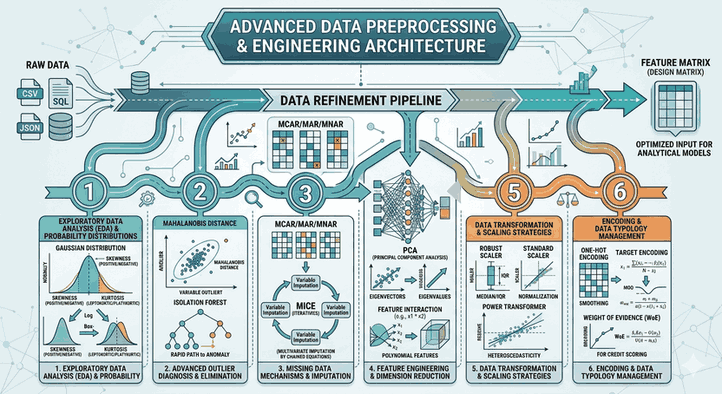
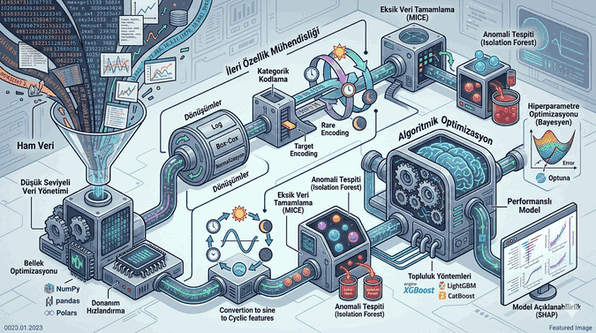
Figure 1: Advanced Data Preprocessing and Algorithmic Optimization Strategies in Machine Learning Pipelines.


1. Advanced Feature Engineering

Feature engineering is the art of using domain knowledge and mathematical transformations to uncover hidden patterns in data.

Variable Transformations and Distribution Optimization

Linear models assume that data is normally distributed and the relationship between variables is linear. If your data is right-skewed, a Log or Power Transformer (Box-Cox, Yeo-Johnson) should be applied to increase the model’s learning capacity.

import pandas as pd
import numpy as np
from scipy import stats
from sklearn.preprocessing import PowerTransformer

# Removing skewness from data
pt = PowerTransformer(method='yeo-johnson')
df['target_transformed'] = pt.fit_transform(df[['target_variable']])

# Logarithmic transformation (adding 1 for zero values)
df['feature_log'] = np.log1p(df['feature_column'])

Vectorization of Categorical Variables

Standard One-Hot Encoding leads to the “curse of dimensionality” in high-cardinality columns (those with a large number of unique classes). Instead, Target Encoding, which is based on the mean of the target variable, or weighted Rare Encoding should be used.

from category_encoders import TargetEncoder

# Target Encoding implementation
# Fit only on the train set to prevent Data Leakage
encoder = TargetEncoder(cols=['city', 'occupation'])
df_encoded = encoder.fit_transform(X_train, y_train)

2. Statistical Imputation of Missing Data and Outliers

Filling missing values only with the mean artificially reduces the variance in the data. Instead, an Iterative Imputer (MICE algorithm), which uses correlations between variables, should be preferred.

Multivariate Missing Data Imputation

IterativeImputer models each variable as a function of the others and estimates the missing values.

from sklearn.experimental import enable_iterative_imputer
from sklearn.impute import IterativeImputer
from sklearn.ensemble import RandomForestRegressor

# Random Forest-based MICE imputation
it_imputer = IterativeImputer(estimator=RandomForestRegressor(), max_iter=10, random_state=42)
df_imputed = it_imputer.fit_transform(df)

Robust Analysis of Outliers

For outlier detection, rather than Z-Score, a more robust approach based on the median, such as Modified Z-Score or Isolation Forest, should be used. Isolation Forest identifies anomalies by looking at the number of splits required to isolate the data.

from sklearn.ensemble import IsolationForest

iso_forest = IsolationForest(contamination=0.05, random_state=42)
outliers = iso_forest.fit_predict(df)
# -1 values represent outliers
df_clean = df[outliers == 1]

3. Algorithmic Modeling and Ensemble Strategies

In modern analytical approaches, structures that combine the predictions of multiple models (Ensemble Learning) have become standard instead of using a single model.

Gradient Boosting Machines (GBM) and Optimization

XGBoost, LightGBM, and CatBoost algorithms minimize the error function by performing gradient-based optimization. In these models, early_stopping_rounds and regularization (L1/L2) parameters play a critical role in preventing overfitting.

import lightgbm as lgb

params = {
    'objective': 'regression',
    'metric': 'rmse',
    'learning_rate': 0.01,
    'feature_fraction': 0.8,
    'lambda_l1': 0.1,
    'lambda_l2': 0.5,
    'boosting_type': 'gbdt'
}

dtrain = lgb.Dataset(X_train, label=y_train)
model = lgb.train(params, dtrain, num_boost_round=1000, valid_sets=[dtrain], 
                  callbacks=[lgb.early_stopping(stopping_rounds=50)])

Model Stacking

Stacking is the training of a “Meta-Model” that takes the predictions of different models (e.g., an SVM, a Random Forest, and a KNN) as input.

from sklearn.ensemble import StackingRegressor
from sklearn.linear_model import RidgeCV

estimators = [
    ('lr', RidgeCV()),
    ('rf', RandomForestRegressor(n_estimators=10, random_state=42))
]
reg = StackingRegressor(estimators=estimators, final_estimator=RandomForestRegressor(n_estimators=10, random_state=42))
reg.fit(X_train, y_train)

4. Hyperparameter Optimization and Bayesian Approach

Instead of brute-force methods like GridSearch, Bayesian Optimization (such as the Optuna library), which searches for the best parameters through a probabilistic model, should be used. This method scans the search space more intelligently by learning from previous trials.

import optuna

def objective(trial):
    n_estimators = trial.suggest_int('n_estimators', 100, 1000)
    max_depth = trial.suggest_int('max_depth', 3, 20)
    regressor = RandomForestRegressor(n_estimators=n_estimators, max_depth=max_depth)
    # Scoring and cross-validation processes...
    return score

study = optuna.create_study(direction='maximize')
study.optimize(objective, n_trials=50)

5. Model Evaluation and Business Decision Mechanisms

Looking only at Accuracy or R-Squared values can be misleading. For classification problems, the Precision-Recall Curve and F1-Score should be analyzed, while for regression, MAE (Mean Absolute Error) and RMSE (Root Mean Squared Error) should be analyzed together.

  • SHAP (SHapley Additive exPlanations): Uses game theory to explain why a model gives importance to a particular feature. It enables the transparency of black-box models (XGBoost, etc.).
  • Permutation Importance: Measures the true impact by seeking an answer to how much model performance drops when the values of a feature are randomly shuffled.

Technical Library References

  • Data Manipulation: Pandas, NumPy, Polars (for high-performance data processing).
  • Visualization: Matplotlib, Seaborn, Plotly.
  • Machine Learning: Scikit-Learn, XGBoost, LightGBM, CatBoost.
  • Optimization: Optuna, Scikit-Optimize.
  • Model Explainability: SHAP, LIME.

In conclusion, an advanced data analysis process is a combination of mathematical rigor and programming competence. Every step from data preprocessing to deploying the model to production must be managed with a systematic engineering discipline.

#ai #data-engineering #big-data #data-analytics #algorithm-optimization #feature-engineering #machine-learning

Related Contents

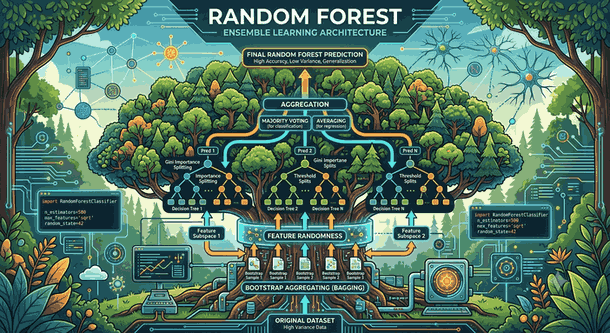
Technical Architecture and Implementation Principles of the Random Forest Algorithm

Random Forest is a powerful "Ensemble Learning" algorithm that achieves more stable and high-accuracy results by combining the predictions of numerous "Decision Tree" structures. By utilizing "Bagging" and "Feature Randomness" techniques, it minimizes the "overfitting" tendency of a single tree; thus, it is a "robust" model that exhibits high "generalization" success even with noisy data and does not require scaling.

ai machine-learning random-forest python decision-tree ensemble-learning supervised-learning feature-importance hyperparameter-tuning artificial-intelligence deep-learning ai-engineering

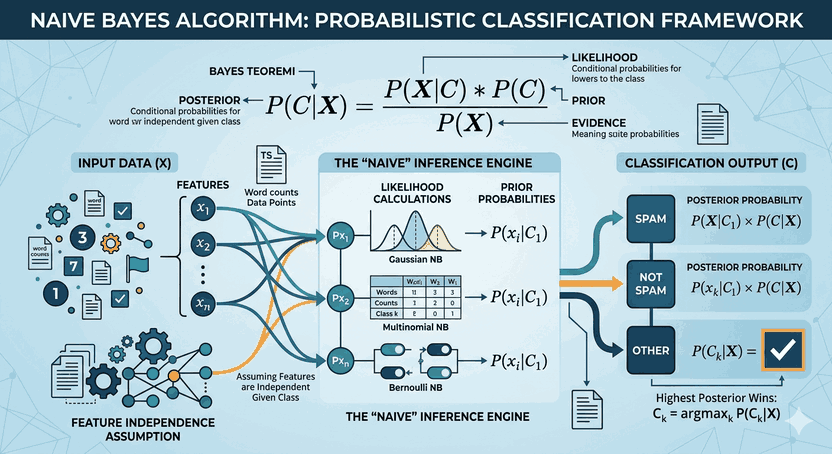
Theoretical Foundations and Application Strategies of the Naive Bayes Algorithm

Naive Bayes is a fast and effective probabilistic classification algorithm based on Bayes' Theorem that assumes full independence between features. It provides a strong foundation for problems such as text classification, spam filtering, and sentiment analysis, especially in high-dimensional datasets, with low computational cost.

ai naive-bayes bayes-theorem scikit-learn gaussian-naive-bayes multinomial-naive-bayes bernoulli-naive-bayes machine-learning deep-learning ai-engineering

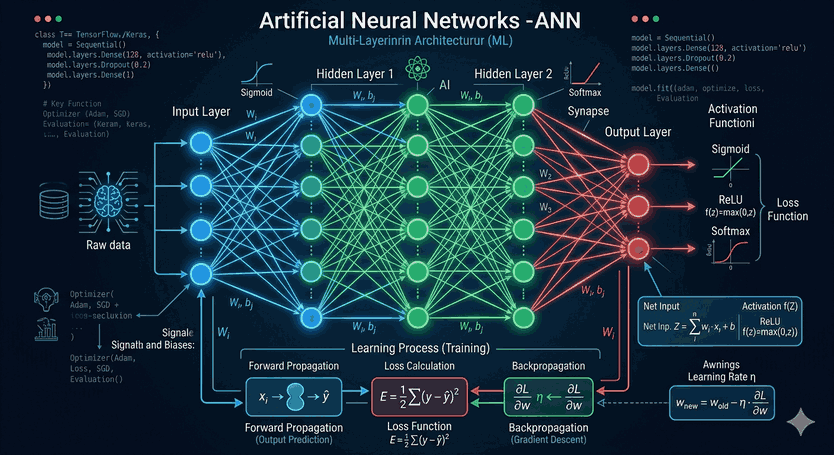
Artificial Neural Networks: A Journey from Biological Inspiration to Mathematical Architecture

A technical article detailing the biological foundations, advanced mathematical architecture, backpropagation algorithms, and deep learning optimization techniques of artificial neural networks, complete with Python code examples.

ai artificial-neural-networks deep-learning python ai-technologies nlp data-science machine-learning

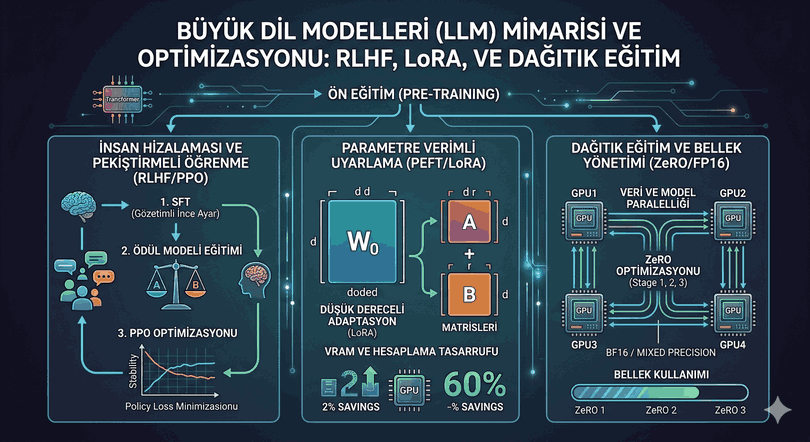
Architectural Depth of Large Language Models: Alignment, Optimization, and Efficient Adaptation

[-Veri Analiz Okulu, Notes 11-] A deep technical article covering the alignment of Large Language Models (LLMs) with human feedback, their efficient adaptation via Low-Rank Adaptation (LoRA), and their optimization in distributed hardware architectures.

ai veri-analizi-okulu vao python llm rlhf nlp lora deep-learning ai-engineering machine-learning

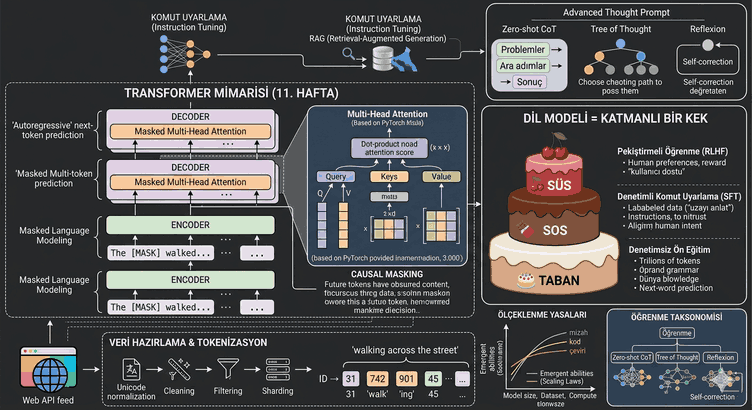
The Neural Architecture of Modern Language Models and Their Evolution from Token-Level to Reasoning

[-Veri Analiz Okulu, Notes 10-] This article is a comprehensive examination covering the mathematical foundations of the Transformer architecture, the vectorial operations of attention mechanisms, and the processes by which large language models (LLMs) derive meaning from data with technical depth.

ai veri-analizi-okulu vao python transformer-architecture nlp llm tokenization attention-mechanism neural-networks ai-alignment pytorch machine-learning

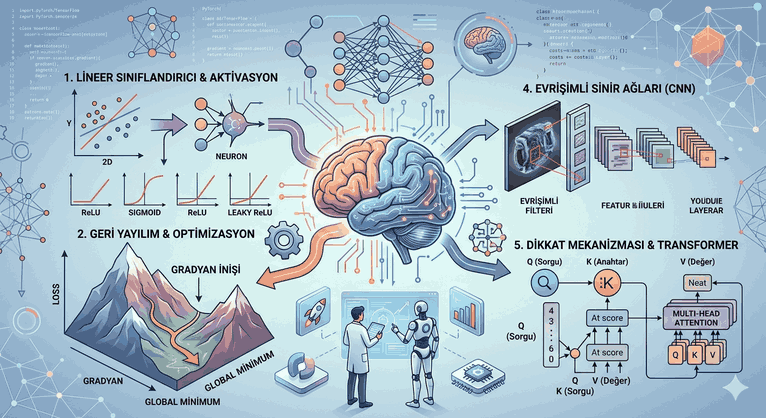
The Anatomy of Modern Deep Learning: A Technical Journey from Gradients to Attention Mechanisms

[-Veri Analiz Okulu, Notes 9-] A technical article covering the mathematical background of backpropagation, CNNs, and attention mechanisms, which form the foundation of deep learning, along with optimization algorithms and modern architectural structures.

ai veri-analizi-okulu vao python back-propagation cnn transformer attention-mechanism pytorch machine-learning

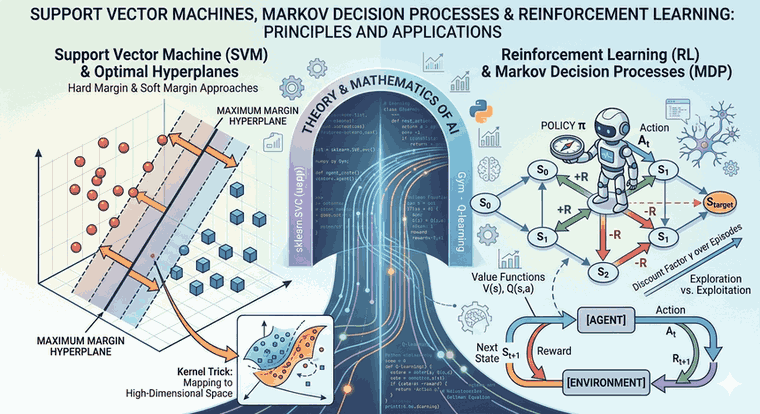
Delicate Balances and Strategic Approaches in Modern Machine Learning

[-Veri Analiz Okulu, Notes 8-] This article analyzes the geometric optimization strategies of Support Vector Machines, the reward-oriented decision-making mechanisms of Reinforcement Learning, and the mathematical foundations of Markov Decision Processes with technical depth.

ai veri-analizi-okulu vao python svm deep-learning reinforcement-learning algorithm-analysis machine-learning

Engineering Analysis of Statistical Approaches and Ensemble Methods in Machine Learning

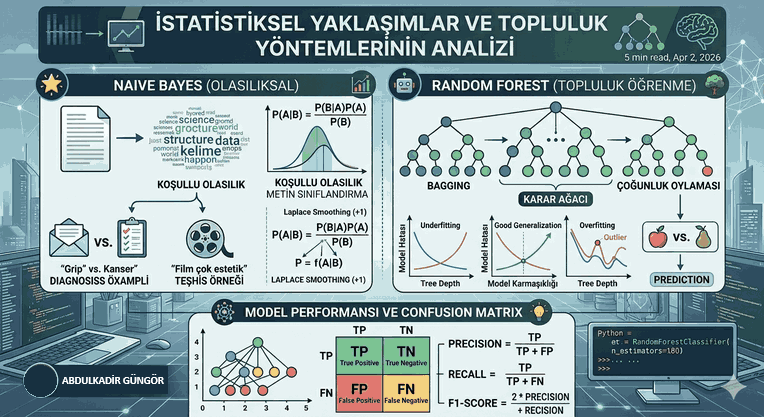
[-Veri Analiz Okulu, Notes 7-] A technical article analyzing the mathematical depth of Naive Bayes and Random Forest algorithms, based on Bayesian probability theory and ensemble learning methods, with model performance metrics.

ai veri-analizi-okulu vao python naive-bayes random-forest confusion-matrix python-coding statistical-learning algorithm-analysis machine-learning

Dimensionality Reduction Strategies and Algorithmic Depth in Machine Learning

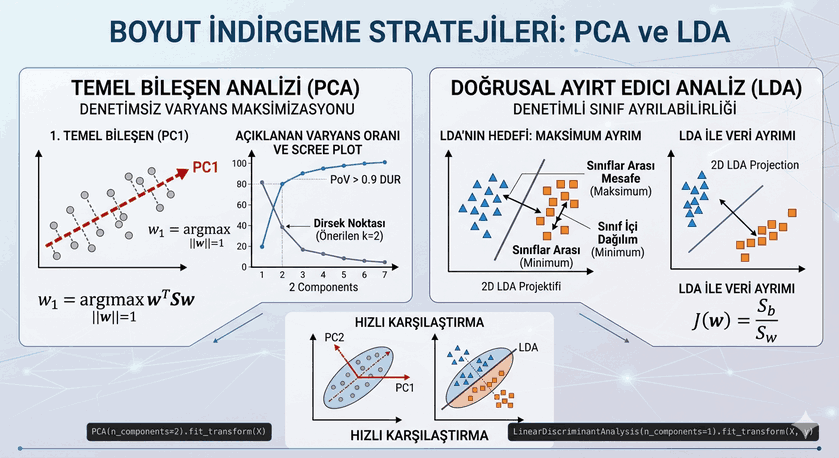
[-Veri Analiz Okulu, Notes 6-] Examines PCA and LDA techniques used to reduce the complexity of high-dimensional data, covering their mathematical foundations, impact on classification performance, and in-depth Python-based technical implementation examples.

ai veri-analizi-okulu vao python dimensionality-reduction pca lda classification statistical-analysis data-science machine-learning

Modern Clustering and Classification Strategies in Machine Learning

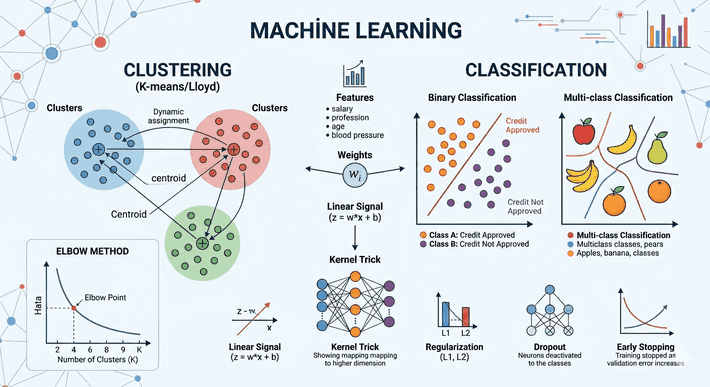
[-Veri Analiz Okulu, Notes 5-] A comprehensive and technical article covering everything from linear classification models to K-means clustering algorithms, and from model optimization to regularization techniques that prevent overfitting.

ai veri-analizi-okulu vao python deep-learning kmeans clustering classification lloyd-algorithm data-science machine-learning

The Quest for Balance in Model Optimization: A Stability Analysis of Machine Learning from Underfitting to Overfitting

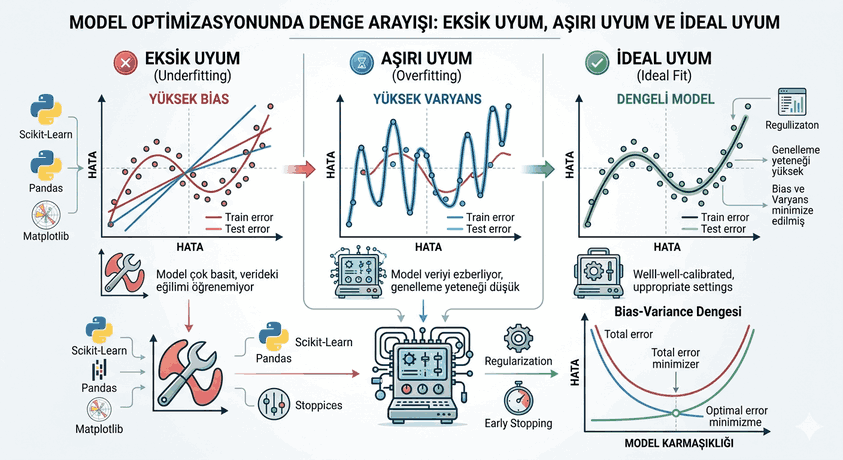
[-Veri Analiz Okulu, Notes 4-] This article examines the balance between model complexity and generalization capability in machine learning, exploring the concepts of underfitting and overfitting with technical depth.

ai veri-analizi-okulu vao python deep-learning model-fitting over-fitting under-fitting data-science machine-learning

Architectural Foundations and Algorithmic Strategies of Modern Artificial Intelligence

[-Veri Analiz Okulu, Notes 3-] A technical paper on the attention mechanism of the Transformer architecture, multimodal data integration, and the mathematical decision strategies of reinforcement learning.

ai veri-analizi-okulu vao python deep-learning transformer-architecture multi-modal-ai bellman-equation data-science machine-learning

The Layered Architecture and Algorithmic Depth of Machine Learning

[-Veri Analiz Okulu, Notes 2-] A technical and mathematical analysis of the hierarchical structure of machine learning, data processing layers, and fundamental learning paradigms (supervised, unsupervised, reinforcement).

ai veri-analizi-okulu vao python deep-learning reinforcement-learning data-science machine-learning

From Data Engineering to Cognitive Revolution: The Technical Anatomy of AI and Machine Learning

[-Veri Analiz Okulu, Notes 1-] This comprehensive technical review analyzes the evolutionary process of artificial intelligence, from rule-based expert systems to modern transformer architectures and generative networks, through biological analogies and practical application layers in the software world.

ai veri-analizi-okulu vao python deep-learning pytorch transformer data-science machine-learning

Advanced Analytical Modeling and Algorithmic Visualization Strategies in High-Dimensional Data Spaces

This is a technical guide for processing high-dimensional data with maximum efficiency using hardware-based memory optimization, advanced feature engineering, and algorithmic pipelines.

ai data-engineering big-data statistical-analysis data-mining algorithmic-visualization machine-learning

In-Depth Technical Analysis of AI Architecture and Development Processes

Explore AI development processes in-depth, from Transformer architecture to RAG systems, Onion Architecture integration, and Edge AI/TinyML optimizations. A comprehensive technical analysis supported by code examples and mathematical models.

ai data-engineering big-data ai-architecture transformer-architecture deep-learning machine-learning

The Digital Ontology of Data: A Deep Look from Binary Logic to Quantum Superposition

A technical examination of the transformation process of data from its raw form to strategic insight, viewed through the perspectives of deterministic systems, algorithmic depth, and computational social sciences.

ai data-science machine-learning computational-analysis quantum-computers nlp gis digital-transformation

Advanced Data Preprocessing and Engineering Architecture in Data Science

A technical examination of the transformation of data from raw form into a processed feature matrix in analytical modeling processes; a synthesis of statistical methodologies and computational techniques.

ai data-science machine-learning data-preprocessing feature-engineering statistical-analysis data-mining

Reinforcement Learning: Dynamic Decision Mechanisms and the Mathematics of Autonomous Systems

A technical guide detailing the mathematical foundations, deep architectures, and technical implementation methods of reinforcement learning, which optimizes optimal decision strategies through reward mechanisms in dynamic environments.

ai data-engineering big-data reinforcement-learning deep-learning python machine-learning

Engineering Architecture of Autonomous Systems: SLAM, Sensor Fusion, and Reinforcement Learning Processes

A comprehensive guide examining the technical depth of localization, data integration, and machine learning algorithms in robotic systems, along with C++ and Python implementations.

ai autonomous-systems big-data slam reinforcement-learning robotics robotics machine-learning

Modern Data Engineering: Scalable Pipeline Architectures and Analytical Transformation Strategies

A comprehensive guide to end-to-end high-performance data pipeline design, covering distributed computing engines, in-memory optimization techniques, and complex feature engineering processes.

ai data-engineering big-data statistical-analysis distributed-computing statistical-modeling machine-learning

In-Memory Computing and Low-Latency Data Processing Strategies in Modern Data Architectures

Optimizing performance at the hardware level in the data ecosystem: In-memory architectures, CPU cache hierarchy, and low-latency data processing techniques.

ai data-architecture memory-management low-latency system-design performance-optimization

Advanced Data Science Strategies: Graph Analytics, Synthetic Data, and XAI Architectures

A comprehensive technical analysis of network theory, data generation techniques, and model transparency that provides depth in modern data analytics.

ai data-engineering big-data graph-analysis xai synthetic-data machine-learning

Unsupervised Learning: The Hidden Geometry of Data and Algorithmic Discovery Techniques

This article details methodologies used to extract meaningful patterns from unlabeled datasets, including clustering, dimensionality reduction, and anomaly detection, along with their mathematical foundations and modern software implementations.

ai data-engineering big-data unsupervised-learning pca clustering machine-learning

Mathematical Optimization and Applied Algorithm Strategies in Supervised Learning Architecture

A mathematical modeling method that learns a mapping function from labeled data consisting of input-output pairs, aiming to predict continuous or categorical values.

ai data-engineering supervised-learning algorithm python machine-learning