We use cookies and other tracking technologies to improve your browsing experience on our website, to show you personalized content and targeted ads, to analyze our website traffic, and to understand where our visitors are coming from.
⚠️
GDPR & Cookie Policy Notice
In accordance with data protection regulations; the use of mandatory cookies is required for the core functions of our website to operate, ensure data security, and perform analytics. If you reject the use of cookies, it is not possible to benefit from the services on our website due to technical limitations and data synchronization interruptions. You must consent to the use of cookies to access the content on our site.
From Data Engineering to Cognitive Revolution: The Technical Anatomy of AI and Machine Learning
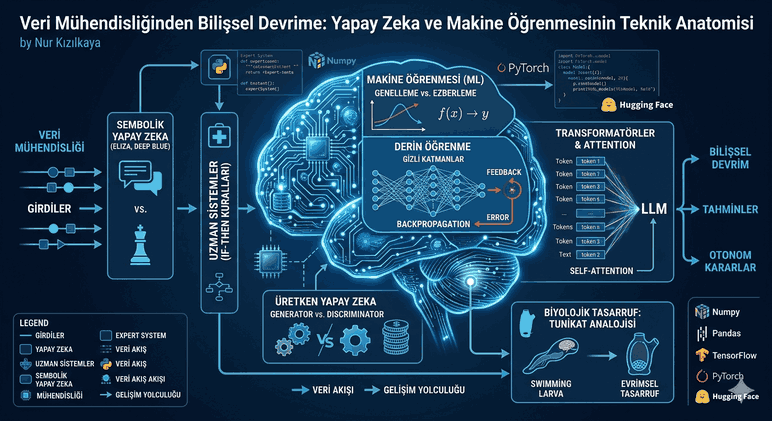
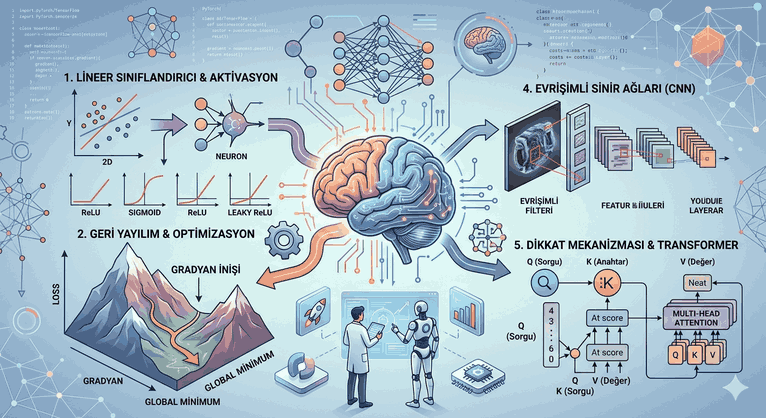
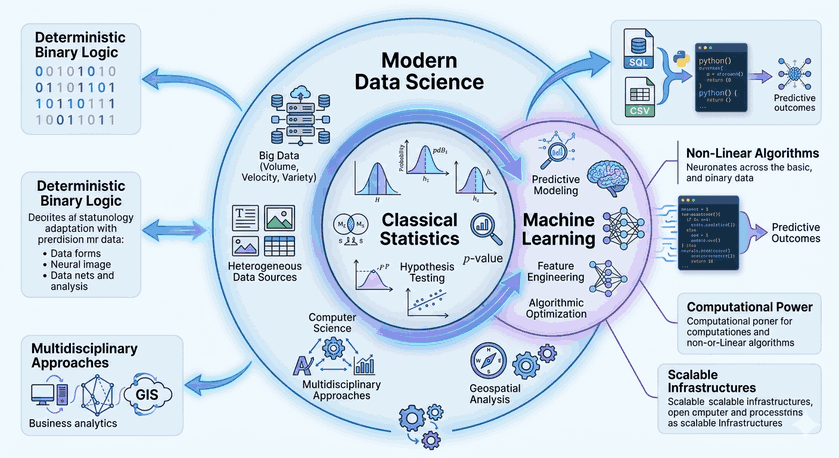
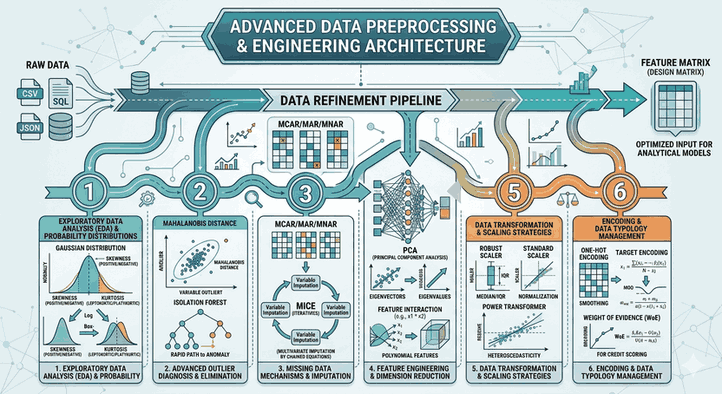
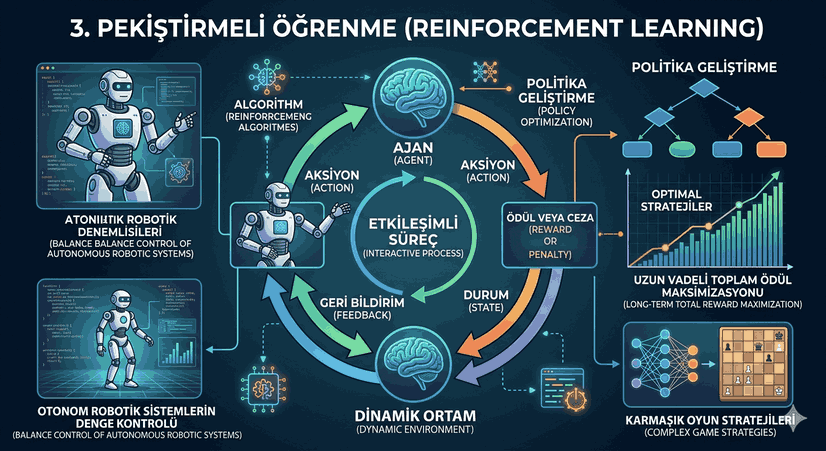
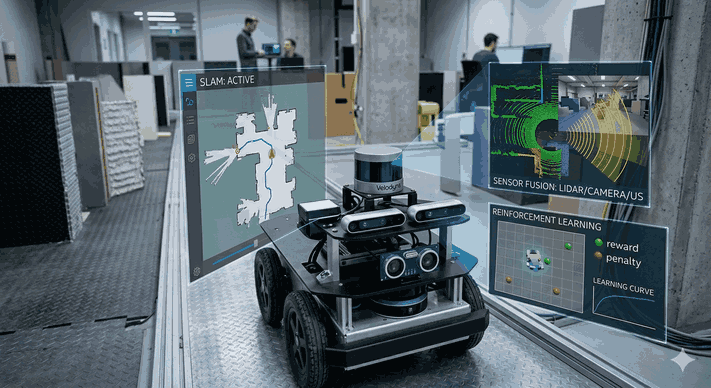
Artificial Intelligence (AI) is an interdisciplinary field representing the cutting edge of modern computation theory, transforming data into meaningful outputs, predictions, and autonomous decisions through algorithmic processes. Today, this journey has evolved from simple rule-based systems to massive transformer models with billions of parameters.
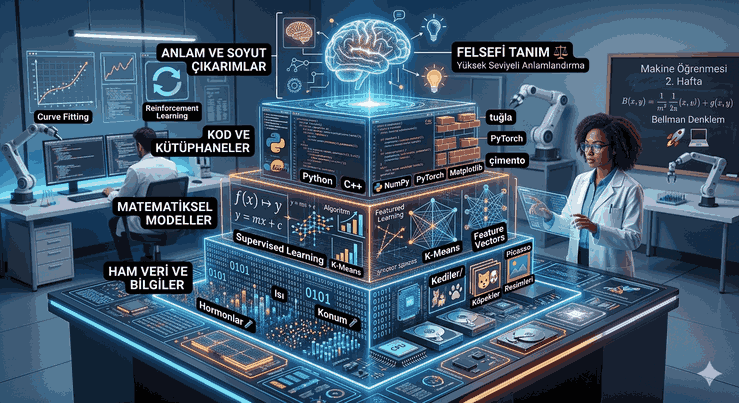
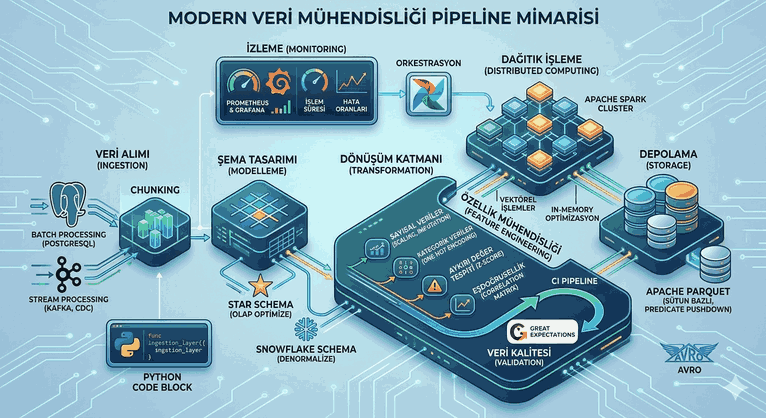
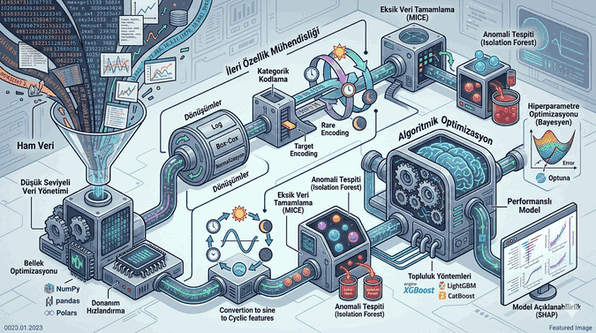
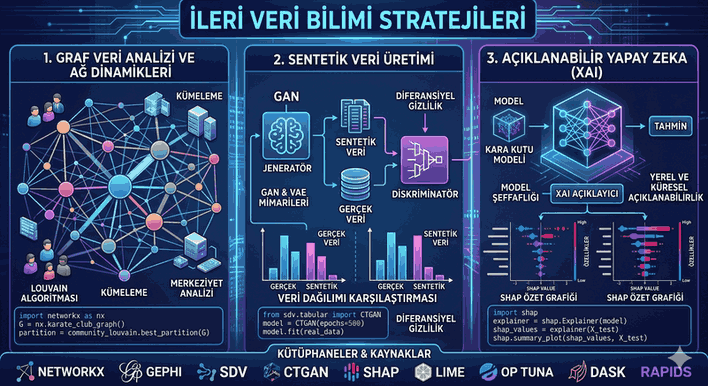
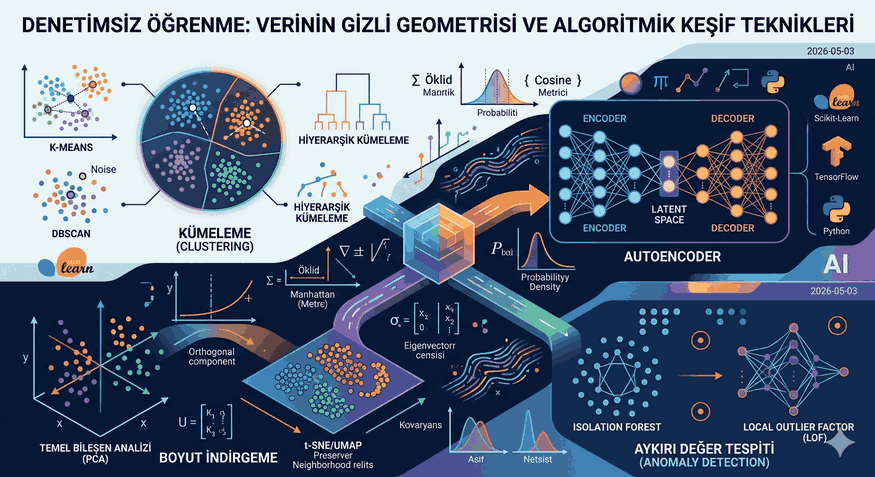
Figure 1: From Data Engineering to Cognitive Revolution: The Technical Anatomy of AI and Machine Learning.
1. Historical Perspective and Symbolic AI Approach
The early period of artificial intelligence was shaped by the approach called “Symbolic AI” or “Good Old Fashioned AI” (GOFAI). ELIZA, developed by Joseph Weizenbaum in 1966, is one of the most primitive yet effective examples of natural language processing (NLP). ELIZA imitated a psychotherapist using pattern matching and substitution methodology. Technically, ELIZA is a string processing engine that works through predefined scripts rather than a learning process.
The Deep Blue vs. Kasparov match in 1997 is a turning point in terms of search space optimization. Deep Blue could analyze 200 million chess positions per second using “brute-force” search capacity and the “alpha-beta pruning” algorithm. However, this system did not learn from data; it simply calculated the best move using heuristic evaluation functions entered by experts.
2. Expert Systems and Decision Support Mechanisms
Expert systems are knowledge-based systems that translate human knowledge in a specific domain into a series of “IF-THEN” rules. Expert systems used in medical diagnostic processes take symptoms as input and produce results through an inference engine.
Technical Example Modeling of a Decision Support Mechanism with Python
Below is a simple logical modeling of a decision support mechanism for a stroke case. This structure shows how rules are embedded into code:
classStrokeExpertSystem:
def__init__(self):
# Knowledge base: Defining weights for specific symptoms self.knowledge_base = {
"facial_droop": 0.4,
"speech_difficulty": 0.4,
"arm_weakness": 0.2 }
definfer_diagnosis(self, patient_symptoms):
confidence_score =0for symptom, is_present in patient_symptoms.items():
if is_present:
confidence_score += self.knowledge_base.get(symptom, 0)
# The decision threshold is set at 60%if confidence_score >=0.6:
return"Preliminary Diagnosis: Suspected Ischemic Stroke. Emergency CT scan recommended."return"Symptoms are below the threshold, alternative diagnoses should be evaluated."patient = {"facial_droop": True, "speech_difficulty": True, "arm_weakness": False}
expert = StrokeExpertSystem()
print(expert.infer_diagnosis(patient))
These systems are deterministic; that is, they always give the same output for the same input and do not have the ability to go outside the system.
3. Machine Learning and Mathematical Modeling Processes
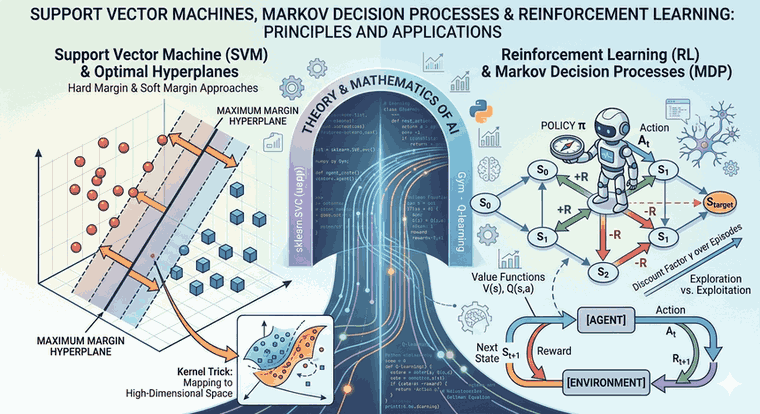
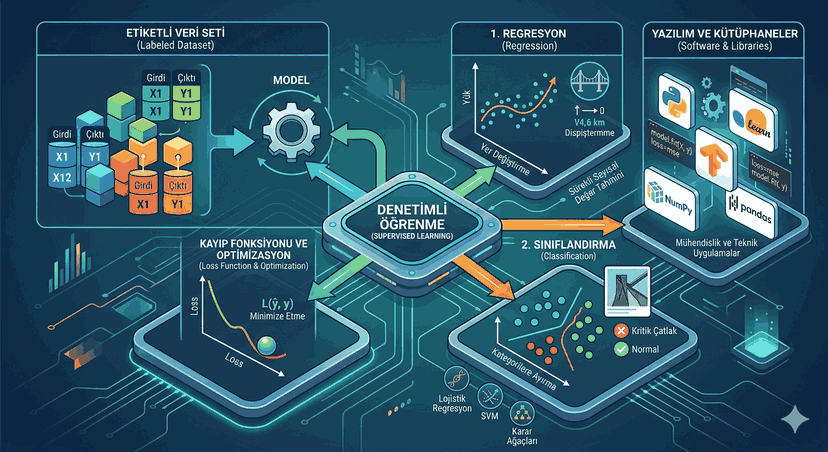
Machine learning, unlike rule-based systems, is a process that finds hidden patterns in data using statistical methods and constructs an $f(x) = y$ function. Here, the goal is to optimize the model’s weights ($w$) by minimizing the loss function.
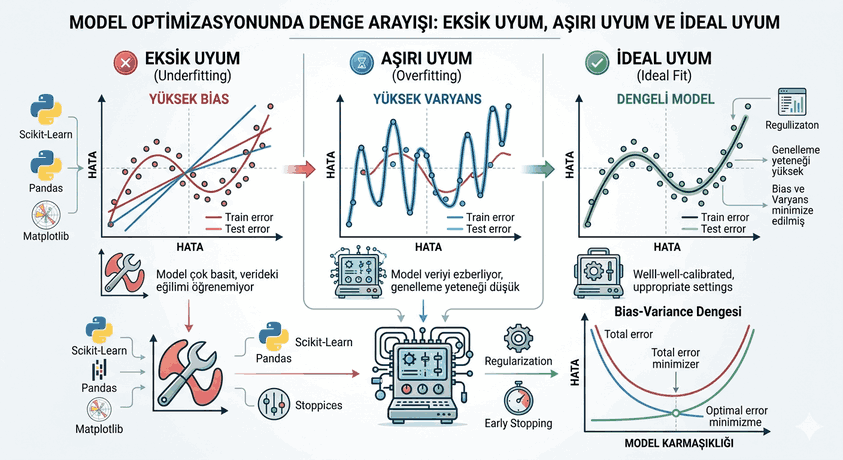
The Critical Balance Between Generalization and Overfitting
Generalization: The model’s ability to make accurate predictions on new data it has not seen in the training data.
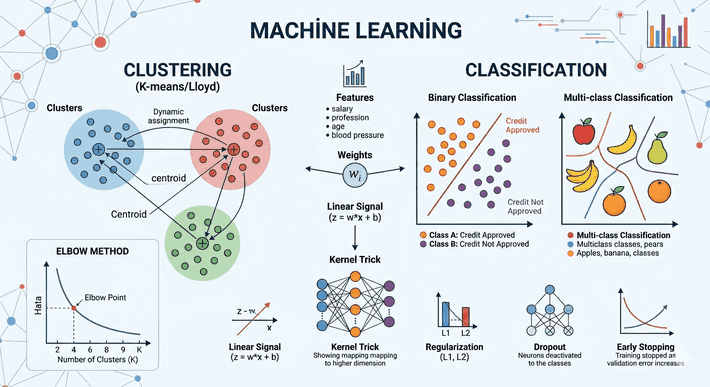
Overfitting: The model learning the noise in the data and showing high success only in the training set, failing in the real world. It is usually controlled by regularization (L1, L2) techniques.
4. Deep Learning and Layered Neural Networks
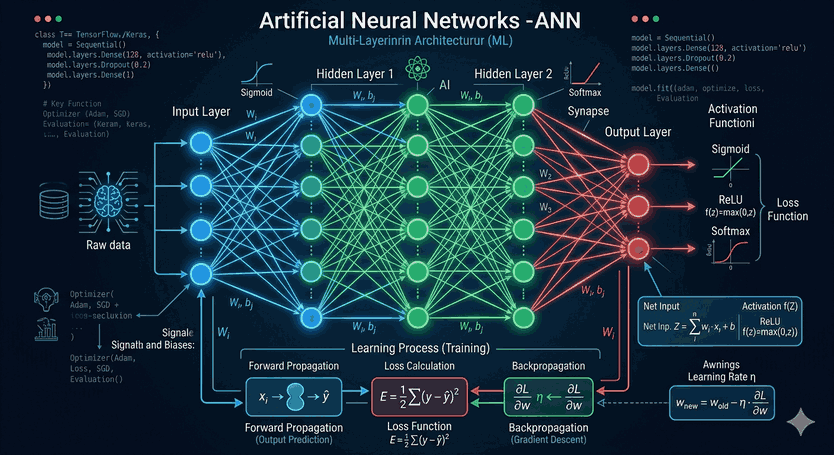
Deep Learning is a complex form of Artificial Neural Networks (ANN) with many hidden layers added. Each layer learns a more abstract representation of the data.
Backpropagation Algorithm and Error Distribution
Backpropagation is the fundamental algorithm that updates weights by distributing the error made by the network from the output layer to the input layer. It works in conjunction with Gradient Descent. Mathematically, the partial derivative of the total error with respect to each weight (${\partial E}/{\partial w}$) is calculated using the chain rule.
Constructing a Modern Deep Learning Layer with PyTorch
import torch
import torch.nn as nn
import torch.optim as optim
classDeepModel(nn.Module):
def__init__(self, input_dim, hidden_dim, output_dim):
super(DeepModel, self).__init__()
# Input to hidden layer transition self.layer1 = nn.Linear(input_dim, hidden_dim)
# Non-linear activation: ReLU self.activation = nn.ReLU()
# Hidden layer to output transition self.layer2 = nn.Linear(hidden_dim, output_dim)
defforward(self, x):
x = self.layer1(x)
x = self.activation(x)
x = self.layer2(x)
return x
# Hyperparameters and Optimizationmodel = DeepModel(input_dim=1024, hidden_dim=512, output_dim=10)
optimizer = optim.Adam(model.parameters(), lr=1e-4)
criterion = nn.CrossEntropyLoss()
5. Generative AI and Adversarial Learning Architectures
Generative AI does not just perform classification; it synthesizes new data. The most remarkable architecture here is Generative Adversarial Networks (GAN).
This architecture is based on the competition of two networks:
Generator: Starts from random noise and produces samples that resemble real data.
Discriminator: Acts as an “auditor” trying to understand whether the data is real or created by the generator.
The “Minimax” game theory approach used in this process has revolutionized synthetic data production by allowing two networks to improve each other.
6. Transformer Models and the Attention Mechanism Revolution
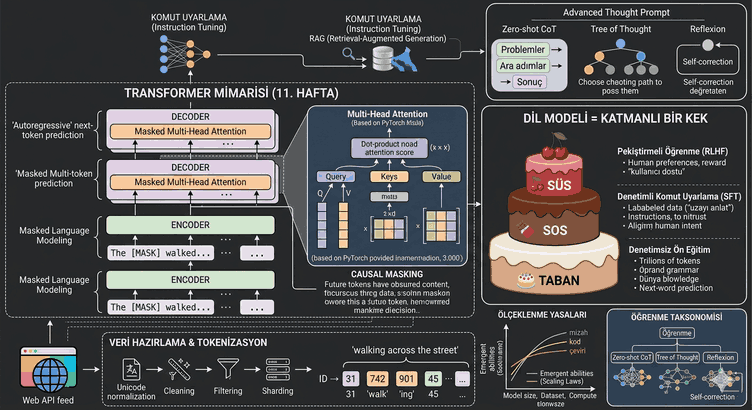
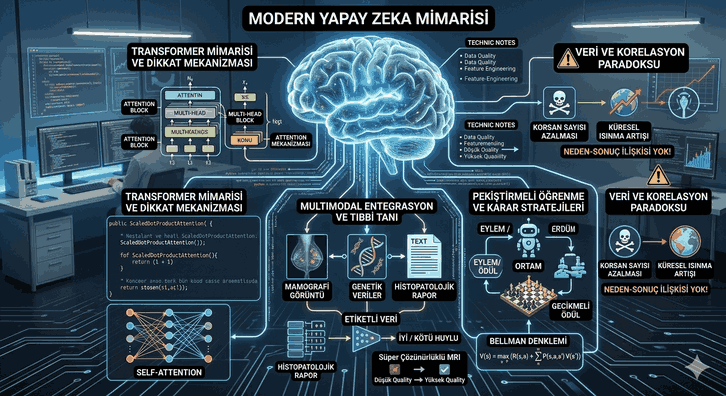
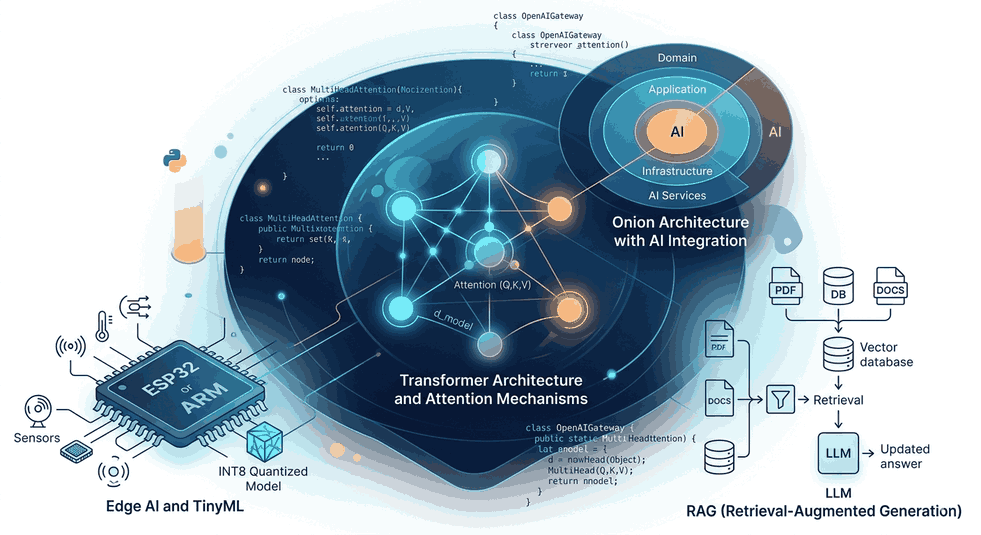
Published by Google researchers in 2017, the “Attention is All You Need” paper introduced the Transformer architecture that launched today’s era of LLMs (Large Language Models). Instead of processing data sequentially, Transformers calculate the context of all elements in the data simultaneously using the “Self-Attention” mechanism.
Thanks to this mechanism, the model analyzes the impact (context) of distant words on each other in long sentences without losing it. This parallel processing capability lies at the heart of the advanced natural language processing systems we use today.
7. Biological Conservation and Algorithmic Efficiency Relationship
In nature, intelligence has always been balanced with energy cost. A creature called the Tunicate (Sea Squirt) needs a brain to move and find a suitable home during its larval stage. However, once it attaches to a surface and transitions to a sedentary life form, it no longer needs complex decision-making mechanisms and digests its own brain for metabolic conservation.
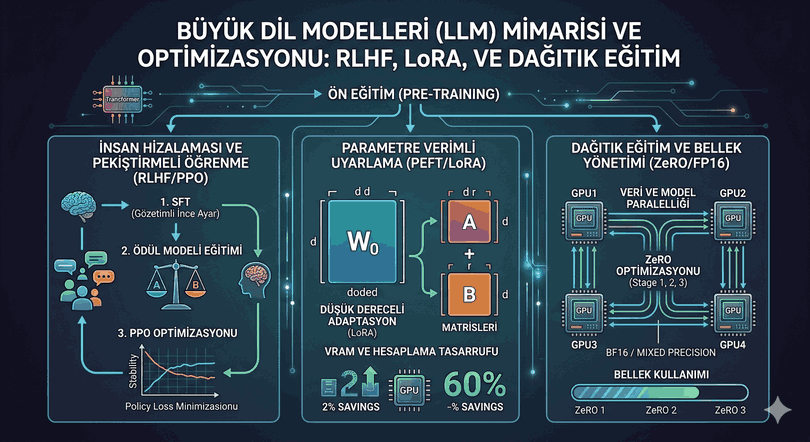
A similar “evolutionary conservation” process is applied in artificial intelligence systems. The following techniques are used to reduce the energy consumption of massive models (over-parameterized):
Pruning: Removing unimportant weights from the network.
Quantization: Storing weights with lower precision, such as 8-bit or 4-bit, instead of 32-bit.
Knowledge Distillation: Transferring the knowledge of a large model (Teacher) to a smaller and faster model (Student).
8. Summary of Technical Analysis and Software Resources
The AI systems of the future will be shaped not just by more data, but by more meaningful and Explainable AI processes. The process of turning raw data into “intelligence” is possible with a perfect harmony of software and hardware.
Core Libraries and Toolkits Used
NumPy and Pandas: Essential for data preprocessing and matrix mathematics.
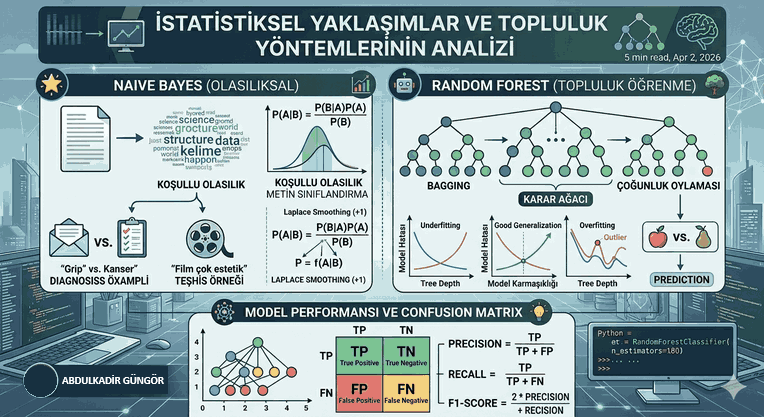
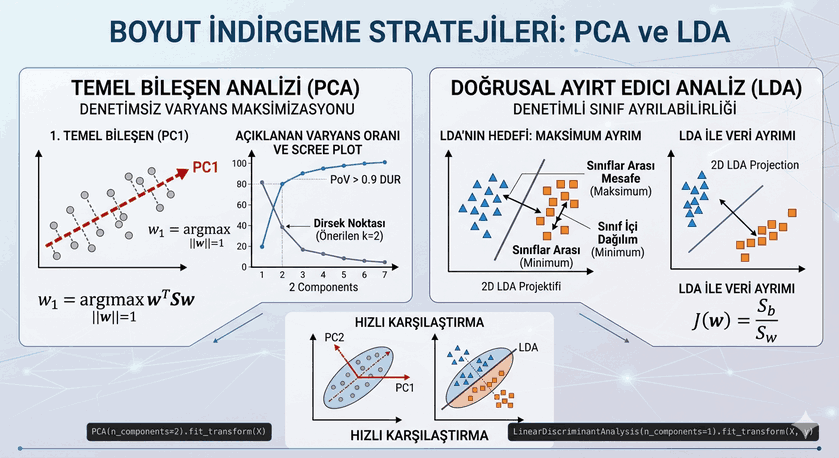
Scikit-Learn: Standard for clustering (K-Means), dimensionality reduction (PCA), and classical classification algorithms.
TensorFlow and PyTorch: The main frameworks where complex deep learning architectures are built.
Hugging Face: An ecosystem providing access to pre-trained Transformer models and datasets.
OpenCV: Used as a data preparation layer in image processing and computer vision projects.
Important Developer Notes
Memory Management: CUDA memory management is vital when working with large models. Commands like torch.cuda.empty_cache() are critical for clearing unnecessary loads on the GPU.
Data Pipeline: To prevent bottlenecks while data is being moved from disk to GPU, data loaders with “multi-processing” support should be used.
Explainability: To understand why the model made a prediction, the impact of features should be analyzed with SHAP or LIME libraries.
Intelligence is a byproduct that emerges from the correct structuring and purpose-oriented processing of data. Although today’s systems cannot yet imitate human consciousness, they continue to exhibit superhuman performance in specific tasks.