We use cookies and other tracking technologies to improve your browsing experience on our website, to show you personalized content and targeted ads, to analyze our website traffic, and to understand where our visitors are coming from.
⚠️
GDPR & Cookie Policy Notice
In accordance with data protection regulations; the use of mandatory cookies is required for the core functions of our website to operate, ensure data security, and perform analytics. If you reject the use of cookies, it is not possible to benefit from the services on our website due to technical limitations and data synchronization interruptions. You must consent to the use of cookies to access the content on our site.
Prompt Engineering vs Loop Engineering: From Single-Shot Answers to Self-Improving Loops in AI
When you ask an AI model a question, you’re actually choosing between two different worlds: either you expect the model to produce the correct answer in a single pass, in one breath, or you allow the model to repeatedly review, test, and correct what it has produced. Over the past few years, these two approaches have become separate disciplines known as “prompt engineering” and “loop engineering.” The difference between them isn’t just a technical preference; it’s a balancing act between cost, speed, reliability, and ultimately the quality of the product.
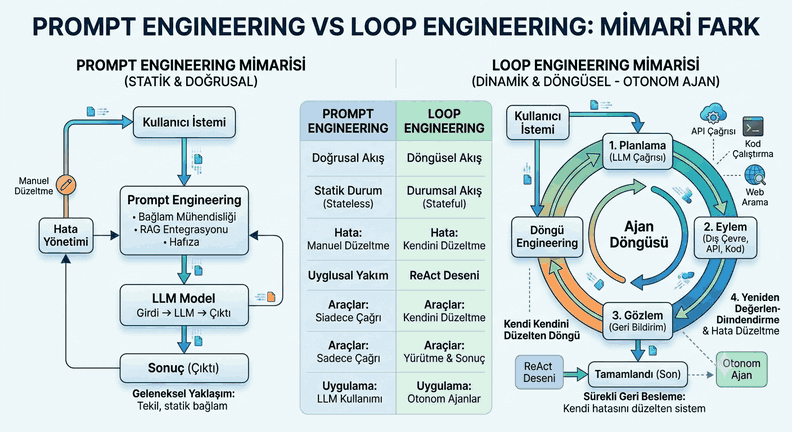
Figure 1: The architectural difference between Prompt Engineering and Loop Engineering.
In this post, we’ll take an in-depth look at one of the most fundamental questions a developer or product team faces: should we use AI by writing a good prompt, or should we have one AI’s output reviewed by another AI (or another call to the same model) and improved in a loop? The answer to this question is more nuanced than you might think, because the two approaches aren’t really alternatives to one another — they’re two complementary layers.
Before diving in, it’s worth clarifying something: the “loop” discussed here is different from the classic for or while loop in programming. In a classic loop, every step is deterministic, and the same input always produces the same output. A loop in the AI context, however, is a probabilistic system in which the model reinterprets its own generated text on every turn. This difference makes the design of the loop and its stopping conditions very different from classical software engineering, because here the concept of “error” isn’t binary — it’s a spectrum. An output doesn’t have to be 100% correct or 100% wrong; it can be partially good, and the purpose of the loop is to gradually raise that quality.
Understanding this distinction has a direct effect both on individual developers’ daily workflows and on the architectural decisions of enterprise product teams. Even though an e-commerce company automatically generating product descriptions and a bank automatically preparing a credit risk report use the same AI technology, their tolerance for accuracy — and therefore the engineering approach they need — are polar opposites. In the sections that follow, we’ll examine this difference through concrete examples, code snippets, and decision criteria.
1. What Is Prompt Engineering? The Limits of Single-Shot Intelligence
Prompt engineering is the art of carefully designing the input (the prompt) to get the desired output from a language model. Defining a role (“You are an experienced software architect”), providing examples (few-shot learning), encouraging step-by-step thinking (Chain-of-Thought), and clearly specifying the output format (JSON schema, XML tags) are the core tools of this discipline.
The appeal of prompt engineering is obvious: a single API call, low latency, predictable cost. For tasks like a customer support bot answering a simple question, summarizing an email, or translating a piece of text into a certain tone, a well-designed prompt is often enough. The instructions given in the model’s “system prompt” layer combine with the user’s message to shift the model’s probability distribution in the desired direction.
However, prompt engineering has a fundamental limitation: the model cannot check the accuracy of its own output independently of the real world. A language model selects the most probable word when predicting the next token; this doesn’t prevent it from producing a sentence that is logically coherent but factually wrong. This is known in the literature as “hallucination,” and it’s not possible to reduce this risk to zero with a single-shot prompt.
Layers of Prompt Engineering
An experienced engineer typically approaches prompt design in the following layers:
Context Layer: Determines what information you’ll give the model and in what order. RAG (Retrieval-Augmented Generation) systems come into play here; instead of relying on the “frozen” knowledge in its own weights, the model generates its answer based on up-to-date documents retrieved at runtime.
Instruction Layer: Defines what the task is, its constraints, and the expected format.
Few-shot Layer: Provides example input-output pairs the model can imitate.
Reasoning Layer: Surfaces the model’s intermediate steps (Chain-of-Thought) with instructions like “think step by step” or “plan first, then write.”
# Classic Chain-of-Thought Prompt Examplesystem_prompt ="""
You are a senior data engineer. Before optimizing the user's
SQL query, follow these steps in order:
1. Summarize the purpose of the query
2. List possible bottlenecks
3. Produce the optimized query
"""response = client.messages.create(
model="claude-sonnet-4-6",
max_tokens=800,
system=system_prompt,
messages=[{"role": "user", "content": user_query}]
)
This approach is powerful, but it has a clear ceiling. No matter how good a prompt the model receives, the output it produces in a single pass is nothing more than the model’s “best guess” at that moment. This is exactly where loop engineering comes in.
Role-Based Prompting and Its Limits
Another common prompting technique is assigning the model a particular identity or expertise (“You are a security auditor,” “Explain this like a pediatrician would”). This technique triggers the relevant subdistribution in the model’s training data more strongly, producing outputs that are more consistent in style and terminology. However, there’s an important pitfall to watch for here: assigning a role doesn’t give the model genuine expertise; it only makes the model present the knowledge it already has from a particular frame. Telling a model “you are a law professor” doesn’t improve its legal reasoning; it only shifts the tone and word choice of the answer closer to how a law professor would speak. Teams that miss this distinction can fall into a false sense of confidence, believing that role prompts magically increase accuracy.
Similarly, few-shot examples are extremely effective at reinforcing a particular format or reasoning pattern, but they may not produce the same effect on a problem type the model has never seen before (out-of-distribution). The success of prompt engineering depends largely on how close the task is to the model’s training distribution; the further you move from that distribution, even the best prompt can’t go beyond the model’s fundamental capabilities. It’s precisely at the point where this limit needs to be surpassed — that is, in situations where the accuracy of the task cannot be guaranteed by a single inference — that engineers turn to loop engineering.
2. What Is Loop Engineering? The Anatomy of Cyclical Intelligence
Loop engineering is the approach in which an AI output is not accepted as final in a single pass, but instead is put through a generate–evaluate–refine cycle. The key idea here is this: a model producing something and checking the accuracy of what it produced are cognitively different tasks. A model can make mistakes while writing code, but when you tell that same model (or a different model) “test this code, see if there’s a bug,” the model can often catch its own mistake.
This is also a well-known phenomenon in human cognition: the person who wrote a text has a hard time seeing their own mistakes, but can spot mistakes in someone else’s writing much more easily. AI models exhibit a similar asymmetry; generation and criticism require different “attention” distributions.
Core Components of the Loop
A loop engineering architecture typically consists of four components:
Generator: The model or prompt chain that produces the initial output.
Critic / Evaluator: A second model call, a rule-based validator, or an external test suite that scores the generated output against a set of criteria or flags its errors.
Refiner: The model call that updates the output based on the critic’s feedback.
Stopping Criterion: The rule that determines when the loop ends (maximum number of iterations, quality threshold, cost budget).
# A simple Generate-Evaluate-Refine loop (conceptual)defloop_engineering(task, max_iterations=3, quality_threshold=0.9):
output = generate(task)
for i in range(max_iterations):
score, feedback = evaluate(output, task)
if score >= quality_threshold:
break output = refine(output, feedback)
return output, score
This simple template forms the core of what’s known today as “agentic AI” systems. Orchestration libraries such as LangGraph, AutoGen, and CrewAI are essentially tools that expand this loop into more complex graph structures.
3. Actor-Critic Architecture: One AI Generates While Another Supervises
The most mature form of loop engineering is the actor-critic concept, borrowed from reinforcement learning. The distinction between “policy” (actor) and “reward model” (critic) that we see in RLHF and PPO has now moved from training time into inference time as well.
In practice, this works as follows: an “actor” model performs a task (writes code, drafts an article, produces a plan). A separate “critic” model scores this output against a predefined rubric (evaluation criteria) and provides concrete, actionable feedback. The actor takes this feedback and tries again. This process is very similar to a human editor reading a writer’s draft and leaving notes in the margins.
The LLM-as-a-Judge Approach
The most common implementation of this architecture is the “LLM-as-a-Judge” approach. Here, the model acting as critic scores the actor’s output on a scale of 1 to 10, or makes a pairwise comparison to decide “is A better, or B?” The biggest advantage of this approach is that it’s much cheaper and faster than human evaluation; the disadvantage is that the “judge” model inherits its own biases — for example, the tendency to systematically assume longer responses are of higher quality (length bias) is well documented in the literature.
defcritic_prompt(output, rubric):
returnf"""
Evaluate the following output against this criterion: {rubric} Output: {output} Provide your answer in this format:
{{"score": <number between 0-10>, "issues": [...], "suggestion": "..."}} """
This asymmetric structure — handling generation and evaluation with different “mindsets” — can be thought of as an inference-time reflection of training algorithms like GRPO (Group Relative Policy Optimization). In GRPO, the model evaluated a group of outputs generated for the same input relative to one another:
A similar logic operates in loop engineering: instead of a single absolute “correct answer,” multiple candidate outputs are generated, and these are compared against each other (or against a criterion) to select or synthesize the best one. This approach is called “self-consistency,” and it significantly increases accuracy, especially in mathematical reasoning tasks, by generating N different reasoning chains instead of a single answer and arriving at a final answer via majority voting.
4. Self-Refine and Reflexion: The Model Correcting Itself
A separate critic model isn’t always necessary. The technique called “Self-Refine” relies on the same model critiquing its own output. The model first produces an answer, then critiques its own output with the instruction “review this answer as an editor would, find its shortcomings,” and then updates the answer taking that critique into account.
The “Reflexion” architecture takes this a step further: if the model fails at a task after attempting it (for example, if a piece of code fails its tests), it converts the reason for the failure into a natural-language “self-reflection” note and uses this note as context in the next attempt. This works like a short-term memory mechanism; instead of repeating the same mistake over and over, the model “learns a lesson” from previous attempts.
defreflexion_loop(task, max_attempts=4):
memory = []
for attempt in range(max_attempts):
plan = generate(task, prior_reflections=memory)
result = execute(plan)
if result.success:
return result
reflection = reflect_on_failure(plan, result.error)
memory.append(reflection)
return result
The most concrete use case for this approach is software development. In a code generation loop, the typical flow works as follows: the model produces code, the code is compiled/run, the test suite (unit tests) is run, the output of failed tests is fed back to the model, and the model fixes the code. This loop is called “Generate-Test-Refine” and is the core working principle behind agentic coding tools like Claude Code. The critical point to note here is that the critic is rule-based and deterministic (whether a test suite passes or not is a clear fact); this eliminates the subjectivity problem seen in the “LLM-as-a-Judge” approach and makes the loop far more reliable.
5. Multi-Agent Systems: Orchestration and Role Distribution
When loop engineering moves beyond a single generator-critic pair, it turns into “multi-agent” architectures. Here, multiple AI agents taking on different roles are coordinated through an orchestrator. Libraries like AutoGen, CrewAI, and LangGraph were developed precisely to meet this need.
A typical multi-agent architecture includes the following roles:
Planner: Breaks the task down into subtasks.
Researcher: Gathers the necessary information (web search, database query, RAG).
Executor: Carries out the subtasks (writes code, generates documents).
Reviewer/QA: Reviews the output and provides feedback.
Orchestrator: Manages the flow of messages between agents and decides when the loop ends.
# A simplified multi-agent orchestrationclassOrchestrator:
def__init__(self, planner, executor, reviewer, max_rounds=5):
self.planner = planner
self.executor = executor
self.reviewer = reviewer
self.max_rounds = max_rounds
defrun(self, goal):
plan = self.planner.create_plan(goal)
for round_idx in range(self.max_rounds):
draft = self.executor.execute(plan)
verdict = self.reviewer.review(draft, goal)
if verdict.approved:
return draft
plan = self.planner.revise_plan(plan, verdict.feedback)
return draft
The biggest advantage of these architectures is that each agent works with its own specialized prompt — instead of a single giant “jack of all trades” prompt that does everything but excels at nothing, you get multiple small prompts, each with a narrow responsibility. This both improves output quality and makes debugging easier: when something goes wrong, isolating which agent malfunctioned is much easier than finding the bug inside a single monolithic prompt.
However, the cost of this approach is clear: each round means multiple model calls, which increases cost and latency in a non-linear way. A five-agent, three-round loop can require up to fifteen API calls compared to a single prompt call.
The Effect of Role Separation on Quality
Why is a single, massive prompt often replaced with multiple narrowly scoped agents? The underlying reason is that language models have a limited “attention budget.” If you ask a single model to plan, conduct research, write code, and review its own code all at once, the model allocates less “cognitive priority” to each of these tasks, and as a result each one may end up mediocre. When you split tasks across separate agents, each agent works much more focused within its own narrow context — much like it’s inefficient for one person at a software company to simultaneously be the architect, the developer, the test engineer, and the project manager.
For example, in a content production pipeline, the following role distribution is commonly seen: a “Researcher” agent scans and summarizes up-to-date sources on the topic; a “Writer” agent produces the draft text from this summary; an “SEO Auditor” agent checks the title, keyword density, and meta description alignment; an “Editor” agent checks style consistency and grammar. Because each agent works within its own narrow scope, the final output is far more consistent and error-free compared to a version produced by a single prompt. This approach, of course, comes at a cost: there’s a risk of information loss between agents — part of the context one agent produces may get lost when passed to the next agent. This is why it’s critical for the orchestrator to keep the messaging protocol between agents clear and structured (for example, via JSON schemas).
6. Test-Time Compute: Buying Thinking Time
One of the most important paradigm shifts in AI research between 2024 and 2026 has been the maturation of the “test-time compute” concept. OpenAI’s o1/o3 series and similar “reasoning” models internally generate a long chain of thought (extended thinking) before answering a question; even though this chain of thought isn’t shown to the user, it significantly improves the quality of the model’s final answer.
This approach is essentially loop engineering embedded inside the model. Without needing an external critic, the model runs a kind of generate-evaluate loop within its own internal process: it forms a hypothesis, tests it, backtracks if it finds a contradiction, and tries an alternative path. This is also called “inference-time scaling,” and its core premise is: instead of increasing the model’s parameter count, giving the same model more “thinking budget” (compute budget) while answering a question can yield similar quality gains.
Monte Carlo Tree Search and Tree of Thoughts
In some advanced systems, this internal loop is explicitly modeled as a search tree. In the “Tree of Thoughts” (ToT) approach, the model generates multiple possible “thought steps” for a problem, scores these steps with an evaluation function, expands the most promising branches, and prunes the weak ones. This is an adaptation, for language models, of the Monte Carlo Tree Search (MCTS) algorithm used in classic game trees.
deftree_of_thoughts(problem, breadth=3, depth=3):
frontier = [Thought(state=problem, path=[])]
for level in range(depth):
candidates = []
for thought in frontier:
candidates += generate_next_steps(thought, n=breadth)
scored = [(evaluate(c), c) for c in candidates]
scored.sort(key=lambda x: x[0], reverse=True)
frontier = [c for _, c in scored[:breadth]]
return frontier[0]
The cost of this approach is extremely high — answering a single question can require dozens, even hundreds, of internal model calls — but for “high-stakes” tasks like math olympiad-level problems or complex code architecture decisions, this cost can be more than justified.
It may help to draw an analogy here: a classic single-shot prompt is like a chess player playing the first move that comes to mind without any thought. Test-time compute, on the other hand, is like that same player mentally simulating a few possible scenarios before making a move, weighing the opponent’s possible countermoves, and choosing the safest path. The second approach is always slower, but it noticeably increases the chances of winning in complex positions. In AI models too, this “mental simulation” process works as an internal computation layer that isn’t shown to the user but directly affects the quality of the model’s final answer.
The practical consequence of this approach is an important architectural decision for product teams: for some tasks, is it better to pick a “cheaper” but faster model and build an external loop around it, or to use a “reasoning” model that already thinks at length internally with a single call? The general rule is this — if the task has an objective validation criterion (code, math, logic puzzles) and validation is cheap, an external loop is generally more controllable and transparent; if the task requires more of a “deep, multi-step but one-off reasoning” (analyzing an architectural decision, refuting a hypothesis), relying on the model’s own internal test-time compute mechanism can be more practical.
7. Prompt or Loop? A Decision Matrix
From everything covered so far, one shouldn’t draw the false conclusion that “loop engineering is always better.” On the contrary, the correct engineering decision depends on the nature of the task. The decision matrix below summarizes which approach should be preferred in which situation:
Criterion
Prompt Engineering
Loop Engineering
Task complexity
Low-medium (summarization, classification, format conversion)
High (code generation, multi-step planning, research)
Verifiability
Hard to measure accuracy with a clear criterion
An objective test/criterion exists (unit test, rule set)
Latency tolerance
Low latency is critical (real-time chat)
High latency is acceptable (background jobs)
Cost sensitivity
High-volume, low-cost jobs
Low-volume, high-value jobs
Error tolerance
Small errors are acceptable
Cost of error is high (financial, legal, security)
This table should be used not as a rule but as an intuition tool. For example, resorting to loop engineering to answer a routine question in a customer service chatbot makes the user wait unnecessarily and multiplies the cost. But in a scenario where the same system drafts a legal contract, having the output reviewed by a “legal check” agent is absolutely worth it given the cost of a potential mistake.
The Hybrid Approach: Adaptive Loop Depth
The most mature systems don’t actually make a fixed choice between the two; they dynamically adjust the loop depth based on the task’s risk level. This is called “adaptive compute allocation.” A simple question is answered with a single-shot prompt, while when the system perceives the complexity of the task (or the level of importance the user has indicated), it automatically adds a verification layer, and if necessary, triggers a second critic call.
Before getting swept up in the appeal of loop engineering, there are three important cost items that shouldn’t be overlooked.
Cost multiplication: Every additional iteration means an additional API call, and therefore additional token cost. A three-round generate-evaluate-refine loop can consume roughly three to six times more tokens than a single-shot prompt (counting both generator and critic calls).
Latency accumulation: Sequential API calls add up their latencies. Running a five-second model call three times in a row means making the user wait fifteen seconds. This can be unacceptable in real-time interactive applications; this is why loop engineering is mostly preferred in background jobs (batch processing) or in “deep research” scenarios where the user can afford to wait.
Risk of non-convergence: In some cases, a kind of “oscillation” can occur between the critic and the generator; the model makes a correction in one direction, the critic suggests the exact opposite, and the loop never reaches a stable point (convergence). This is why, in practice, every loop is given a maximum iteration limit and a “keep the best result so far” mechanism; even if the loop doesn’t reach the target, the highest-scoring candidate produced so far is returned. Experienced teams also add an “early stopping” logic to the loop: if the quality score doesn’t meaningfully increase between two consecutive iterations (for example, less than a one percent improvement), the loop is terminated without spending further resources. This allows the diminishing-returns curve to be detected early, preventing unnecessary cost.
defbounded_loop(task, max_iterations=5):
best_output, best_score =None, -1 output = generate(task)
for _ in range(max_iterations):
score, feedback = evaluate(output, task)
if score > best_score:
best_output, best_score = output, score
if score >=0.95:
break output = refine(output, feedback)
return best_output
9. A Practical Example: End-to-End Loop Engineering in Code Generation
Let’s proceed through a concrete example: imagine a developer wants code generated for an API endpoint along with its unit tests. In the pure prompt engineering approach, the engineer gives a single instruction (“write this endpoint, add its tests too”) and accepts the model’s output as is. In this approach, whether the code actually works, and whether it covers edge cases, remains uncertain.
In the loop engineering approach, the process works as follows:
Generate: The model produces the endpoint code and the tests.
Execute: The generated code is run in an actual sandbox environment, and the tests are executed.
Evaluate: The test results (passed/failed tests, error messages, linter warnings) are collected — because this evaluate step is deterministic, the LLM-as-judge subjectivity problem mentioned in the previous section is disabled here.
Refine: The error messages from failed tests are fed back to the model, and the model fixes the code.
Repeat: Steps 2-4 are repeated until all tests pass or the maximum number of iterations is reached.
This loop is exactly the working principle of agentic coding tools like Claude Code or “self-healing” test systems integrated into CI/CD pipelines. The critical lesson here is: the scenarios where loop engineering is most reliable are those where the feedback mechanism is objective and can be automated. Code either compiles or it doesn’t; a test either passes or it doesn’t. By contrast, in a subjective criterion like “how engaging is this article,” the payoff from loop engineering is more limited and less reliable, because the critic itself is a language model prone to error.
We can draw an analogy to a software team’s code review process. If a developer merged the code they wrote alone directly into the main branch, the error rate would be much higher; that’s why teams require review by another developer through a “pull request” process. Loop engineering is the AI version of this human workflow — except here, the reviewer can also be a model, or sometimes even an automated test suite. The difference is that human code review can take hours or days, whereas an AI loop can repeat the same work in seconds, continuously and tirelessly — which makes it especially scalable for high-volume, repetitive tasks.
10. Tools Used by AI Models: The Intersection of Function Calling and Loops
Another factor that makes loop engineering powerful is that models can now do more than just generate text — they can interact with the real world. This capability, called “function calling” or “tool use,” allows the model to call a calculator, a web search engine, a code executor, or a database query tool. The ReAct (Reasoning + Acting) framework combines these two capabilities: the model first reasons (“I need this piece of information”), then takes an action (calls a tool), then observes the tool’s result and returns to its reasoning.
Thought: I don't have current exchange rate information the user asked for, I need to call a tool.
Action: get_exchange_rate(from="USD", to="TRY")
Observation: 1 USD = 34.12 TRY
Thought: Now I can give the user the correct answer.
This ReAct loop is actually itself a form of loop engineering; each “Thought-Action-Observation” turn is a micro-loop in which the model receives new information from the world and updates its own plan. Modern agent frameworks (LangGraph, AutoGen) model this loop as graph nodes and edges, adding conditional logic about when the loop should end and which node should transition to which.
11. Safety and Quality Gates: The Role of Guardrails Inside the Loop
Loop engineering doesn’t just improve quality — it’s also a natural place to embed safety and compliance layers. A “guardrail” is a supervision layer that checks whether the generated output complies with certain rules — for example, ensuring a financial advisory assistant doesn’t give definitive investment advice, or that a health assistant doesn’t provide a diagnosis.
These guardrails can be naturally integrated into the evaluate step of the loop: the generator produces a response, the guardrail layer scans this response against policy rules, and if it detects a violation, it rejects the response and sends it back to the generator with an instruction like “change this part in this way.” This can be thought of as a “compliance loop” rather than a pure quality loop, and it has become nearly mandatory in enterprise AI applications (especially in the finance, healthcare, and legal sectors).
12. Scalability: Taking the Loop to Production
Running a loop engineering prototype in a Jupyter notebook is very different from turning it into a production system serving thousands of concurrent users. There are several critical issues to watch out for here:
Parallelization: Candidates that can be evaluated independently (for example, the N different reasoning chains in the self-consistency approach) should be generated in parallel rather than sequentially; this significantly reduces total latency.
Caching: If the same task keeps coming up repeatedly, caching the results of previous loops prevents unnecessary recomputation. Prompt caching in particular significantly lowers token cost for fixed system prompts and context blocks.
Observability: A loop can unexpectedly go into too many iterations in production and blow up the cost. This is why every loop needs upper bounds on iteration count, total token consumption, and total latency, along with monitoring/tracing infrastructure.
Progressive rollout: Instead of exposing loop engineering to all traffic at once, it’s necessary to first test it on a low-risk user segment and verify with A/B tests whether the loop actually delivers a quality improvement. Because in some tasks, the payoff from additional iterations quickly hits a diminishing-returns curve; after the third iteration, the quality gain can become unmeasurable while cost keeps rising.
13. The Intersection of RAG and Loop Engineering
Retrieval-Augmented Generation (RAG) is an architecture that lets the model produce answers based on a current or proprietary information source that isn’t stored in its own weights. On the surface, RAG looks like an extension of prompt engineering — after all, what’s being done is providing the model with better context. But advanced forms of RAG are actually examples of loop engineering.
In approaches like “Corrective RAG” (CRAG) and “Self-RAG,” the model first assesses whether the retrieved documents are actually relevant to the question. If the retrieved documents are found to be insufficient or irrelevant, the system generates a new search query and searches again. This is a much more robust architecture than the classic “retrieve-then-generate” approach, because it accounts for the possibility that the initial search might fail.
defself_rag(query, max_retries=2):
for attempt in range(max_retries):
docs = retrieve(query)
relevance = evaluate_relevance(docs, query)
if relevance >=0.7:
return generate_answer(query, docs)
query = rewrite_query(query, docs)
return generate_answer(query, docs, low_confidence=True)
This loop also has an interesting parallel with search engine optimization (SEO): just as a search engine tries to reinterpret a user’s query in different forms to find the most relevant result, the Self-RAG architecture also has the model rewrite its own query to reach better sources. For teams looking to improve the reliability of AI assistants working on enterprise knowledge bases (internal wikis, document archives), this approach offers a noticeable quality leap compared to pure RAG.
14. Frequently Asked Questions
Is learning prompt engineering necessary for loop engineering?
Yes. Loop engineering isn’t a discipline that replaces prompt engineering — it’s a layer built on top of it. Every generator and critic call within a loop still needs a well-designed prompt. Putting a weak prompt into a loop just leads to the same mistake being repeated several times at a higher cost. This is why optimizing the prompt for each individual step before setting up the loop significantly reduces the total number of iterations the loop needs.
Is loop engineering always more expensive?
In the short term, yes, because additional model calls mean additional token cost. But when you consider, over the long term, the cost a mistake would cause in production (a wrong line of code propagating to a live system, an incorrect legal statement making its way into a contract), the loop’s cost generally ends up much smaller in comparison. The right question isn’t “is it more expensive” but “does the cost of error in this task justify the cost of the loop.”
Can a single model really critique itself, or is a separate model needed?
Both are possible. A model critiquing its own output (self-refine) is cheaper, but carries the risk of reproducing the model’s blind spots — because if the same model tends to make the same mistake, it’s harder for it to notice its own error. A separate critic call working with a different model or a different “persona” reduces this blind-spot risk but increases cost. A separate critic can be preferred for critical tasks; self-refine for low-risk tasks.
Does loop engineering only make sense for large companies?
No. An individual developer can also achieve significant quality gains by setting up a simple “generate-test-refine” loop in their own automation script. For example, in a script that generates code for a personal project, automatically running the generated code and feeding error messages back to the model can be implemented with just a single extra line of logic and noticeably improves output quality.
What tools make loop engineering easier?
LangGraph is preferred for building graph-based loops that allow conditional branching. AutoGen and CrewAI are suited for multi-agent role distribution and chat-based orchestration. In simpler scenarios, you can write your own loop with a few functions without needing an external library — indeed, the example code snippets in this post demonstrate exactly that.
15. Conclusion: Two Paradigms, One Purpose
Prompt engineering and loop engineering aren’t two rival philosophies; they’re two answers, at different scales, to the same engineering problem. Prompt engineering focuses on the question “how do I get the best output from the model on the first try,” while loop engineering seeks an answer to “if the model’s first output isn’t good enough, how do I systematically improve it.” A mature AI product actually uses both together: a well-designed prompt ensures fewer iterations are needed on each turn of the loop, while a well-designed loop catches and compensates for the errors a flawed prompt might cause.
Future AI systems will likely make this distinction increasingly invisible; as test-time compute matures, the “loop” will stop being an external mechanism manually set up by the developer and instead become a natural part of the model’s own internal architecture. But for today, the question a developer or product team should ask remains clear: can this task be solved with a single good sentence, or does the model need to be allowed to test itself? The honest answer to this question is often a mixture of the two — and good engineering is simply about getting the ratio of that mixture right.
The common thread running through the concepts covered in this post is treating AI not as a “black box” but as a system on which we can make design decisions. Prompt engineering shapes this system’s input; loop engineering shapes how the system relates to its own output. Teams that use both together, deliberately, don’t just achieve higher-quality output — they also build an engineering culture that can predict in advance how much computation and cost a given task requires, and can therefore plan its budget and timeline much more accurately. Trying to improve AI only by “writing a better prompt” or only by “adding more loops” is looking at just one side of the coin; the real mastery lies in being able to re-establish the balance between the two, each time, according to the nature of the task.
Technical Note: Prompt engineering optimizes along the speed and cost axis, while loop engineering optimizes along the accuracy and reliability axis. Finding the right balance between the two depends on the task’s risk profile, its verifiability, and the user’s tolerance for waiting. Future intelligent systems will likely treat this balance not as a static architectural decision but as a “compute budget” dynamically calculated for each task.
Finally, it’s worth adding: the best way to learn these two paradigms isn’t by reading theory, but by trying both out on a small project and comparing them. Running a simple text classification task first with a single prompt, then with a three-round generate-evaluate-refine loop, and comparing the results, cost, and latency gives a far more lasting intuition than any theoretical explanation. In AI engineering, just as in other engineering disciplines, the most solid form of learning comes from measuring and observing.