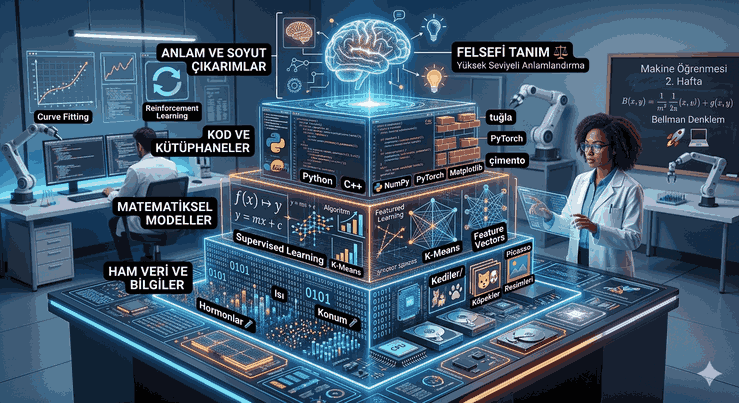
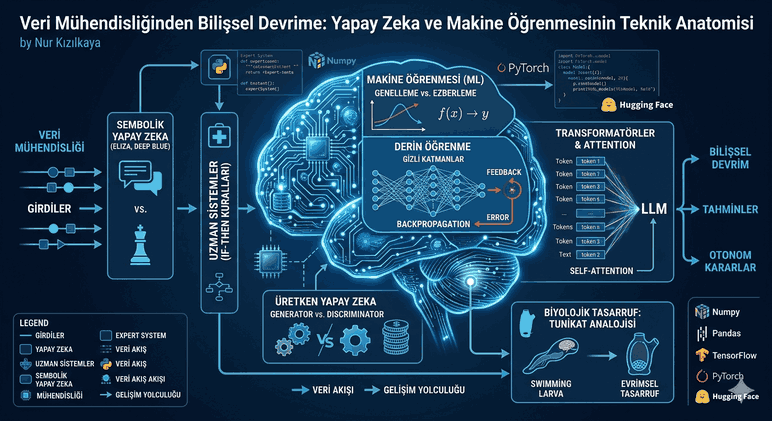
The Anatomy of Modern Deep Learning: A Technical Journey from Gradients to Attention Mechanisms

The revolution in the world of artificial intelligence over the last decade is essentially the result of the perfect synchronization of mathematical optimization, linear algebra, and hardware capabilities. Deep learning is not just about multi-layer neural networks; it is an engineering art that has fundamentally changed how we represent data.

The Anatomy of Modern Deep Learning: A Technical Journey from Gradients to Attention Mechanisms

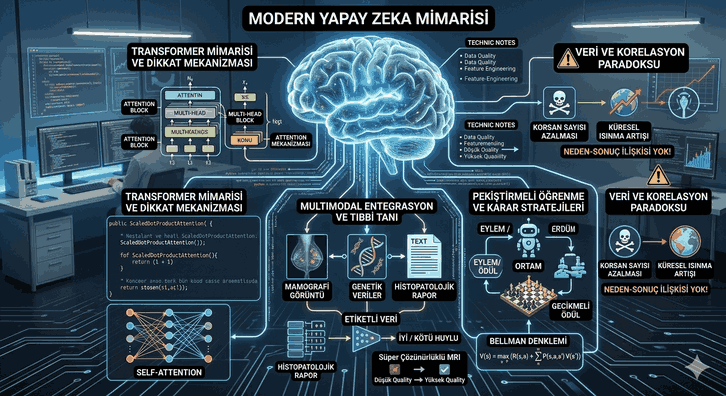
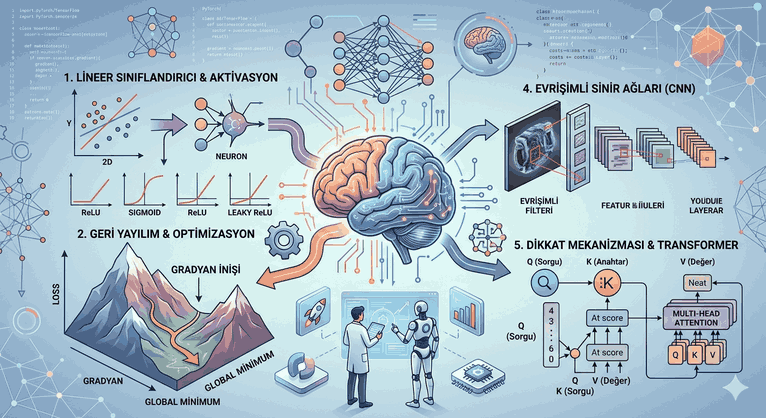
Figure 1: The Anatomy of Modern Deep Learning: A Technical Journey from Gradients to Attention Mechanisms


1. Transition from Linear Classification to Multi-Layer Structures

Everything starts with a simple linear equation where we obtain a score by multiplying input vectors with weight matrices. Expressed mathematically, the score for an input vector $x$ is calculated as $f(x, W) = Wx + b$. Here, $W$ represents the weight matrix, and $b$ represents the bias term.

However, real-world data is rarely linearly separable. Linear models are insufficient even for the most basic logical operations like the XOR problem. At this point, Activation Functions come into play. Activation functions add “non-linearity” to the network, enabling the realization of the Universal Approximation Theorem.

Basic Activation Functions and Code Equivalents

  • ReLU (Rectified Linear Unit): The most common function with the lowest computational cost. It zeros out negative values and leaves positive values as they are.
  • Sigmoid: Compresses the output into the $[0, 1]$ range, but can lead to the “vanishing gradient” problem in deep networks.
  • Leaky ReLU: Adds a small slope ($0.01x$) to solve the “dead neuron” problem of ReLU in the negative region.
import numpy as np

def relu(x):
    return np.maximum(0, x)

def sigmoid(x):
    return 1 / (1 + np.exp(-x))

def leaky_relu(x, alpha=0.01):
    return np.where(x > 0, x, x * alpha)

2. The Engine of Deep Learning: Backpropagation and Automatic Differentiation

A model’s “learning” is actually the process of finding weight parameters that minimize the prediction error (Loss). This process is managed by Backpropagation, which is based on the Chain Rule.

In the Forward Pass, data flows through the layers and a loss value is calculated. In backpropagation, the partial derivative of this loss with respect to each weight is taken. This derivative creates a “vector field” showing how much each parameter contributed to the error.

$$ \frac{\partial Loss}{\partial w} = \frac{\partial Loss}{\partial y} \cdot \frac{\partial y}{\partial z} \cdot \frac{\partial z}{\partial w} $$

Modern libraries (PyTorch, TensorFlow) perform these derivative calculations automatically via a Computational Graph.


3. Optimization Strategies: Faster and More Stable Learning

Although Gradient Descent is a fundamental method, it causes issues such as getting stuck in local minima or progressing excessively slowly with massive datasets. Therefore, various optimization algorithms have been developed.

Major Optimization Techniques

  1. SGD (Stochastic Gradient Descent): Uses a small piece (batch) of data instead of the whole dataset at each step. It is noisy but gains speed.
  2. Momentum: Uses the concept of acceleration in physics to remember the previous direction of the gradient. This reduces “oscillations” and speeds up on flat surfaces.
  3. Adam (Adaptive Moment Estimation): Uses both momentum and the moving average of the squared gradients (RMSProp). It is accepted as the standard today.
# Adam Optimization example in PyTorch
import torch.optim as optim

model = MyNeuralNetwork()
optimizer = optim.Adam(model.parameters(), lr=0.001, betas=(0.9, 0.999))

# Within the training loop
optimizer.zero_grad()   # Reset gradients
loss = criterion(output, target)
loss.backward()         # Backpropagation
optimizer.step()        # Update parameters

4. The Architect of Visual Data: Convolutional Neural Networks (CNN)

CNNs are designed to preserve spatial hierarchy in images. Unlike traditional Fully Connected layers, CNNs learn local features using filters (kernels).

  • Convolution: The process of sliding a filter over an image to create feature maps.
  • Pooling: Reduces the dimension of the data (Max Pooling is generally used) and ensures the model is robust against small shifts.

CNNs learn simple geometric shapes like edges and corners in the initial layers, and object parts and complex structures as they go deeper.


5. The Peak of Modern Artificial Intelligence: Attention and Transformer

The structure that dominates the field of Natural Language Processing (NLP) and now image processing (Vision Transformers) is the Attention mechanism. Unlike RNNs (Recurrent Neural Networks), the Attention mechanism sees the entire input at once and mathematically calculates how much each part relates to the other.

QKV (Query, Key, Value) Logic

The attention process is carried out through three basic vectors:

  • Query: What the current word is looking for.
  • Key: What other words offer.
  • Value: The actual information content.

The attention score is calculated by taking the dot product of the Query and Key vectors and normalized using the Softmax function:

$$ \text{Attention}(Q, K, V) = \text{softmax}\left(\frac{QK^T}{\sqrt{d_k}}\right)V $$

Multi-Head Attention and Parallelism

The Transformer architecture performs this process many times in parallel (Multi-Head). In this way, the model can simultaneously learn both grammatical relationships and semantic contexts within the same sentence in different “heads.”

# A basic Self-Attention mechanism (PyTorch style pseudocode)
import torch.nn.functional as F

def self_attention(query, key, value):
    d_k = query.size(-1)
    # Calculate scores
    scores = torch.matmul(query, key.transpose(-2, -1)) / np.sqrt(d_k)
    # Convert to probability distribution
    weights = F.softmax(scores, dim=-1)
    # Multiply with values
    return torch.matmul(weights, value)

6. Stabilization and Regularization in Training

Training becomes more difficult as deep networks get deeper. There are two critical techniques used to overcome this:

  1. Batch Normalization: Ensures gradients flow more healthily by normalizing the input of each layer.
  2. Dropout: Prevents the model from memorizing (overfitting) by randomly turning off some neurons during training.

Technical Note: Layer Normalization, used in large language models (LLMs), works independently of the batch size, so it gives more successful results than Batch Norm in sequential data.


7. Hardware and Scalability: The GPU and TPU Factor

Deep learning algorithms are inherently built on matrix multiplications. While a CPU is adept at performing complex logical operations in sequence, it is not designed to perform thousands of small matrix multiplications simultaneously. GPU (Graphics Processing Unit) and the TPU (Tensor Processing Unit) developed by Google have enabled deep learning to reach its current speed by completing these parallel operations in milliseconds with their thousands of cores.

Libraries like CUDA (NVIDIA) and ROCm (AMD) allow developers to perform tensor operations directly on the graphics processor.


Conclusion: Layers of the Future

Deep learning is a point where mathematical elegance, algorithmic efficiency, and massive processing power converge. The error correction journey, which started with backpropagation, has evolved into human-level text and image generation with Transformer models containing billions of parameters today. From an engineering perspective, even the most complex artificial intelligence system is essentially a whole composed of correctly tuned weights, optimized gradients, and carefully selected activation functions.

In the coming period, focus will be placed on these models not only being “larger” but also “more efficient” (inference optimization) and “more explainable” (explainable AI). The heart of deep learning continues to beat in these dynamic algorithms that continue to discover hidden patterns within data.

#ai #veri-analizi-okulu #vao #python #back-propagation #cnn #transformer #attention-mechanism #pytorch #machine-learning

Related Contents

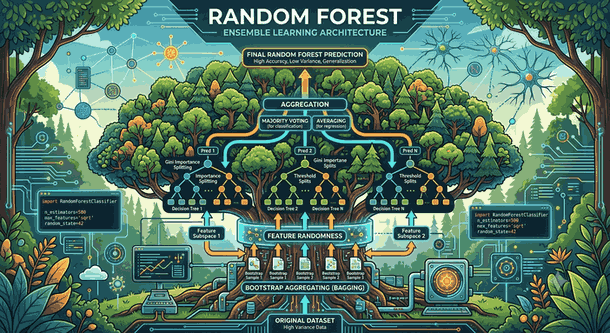
Technical Architecture and Implementation Principles of the Random Forest Algorithm

Random Forest is a powerful "Ensemble Learning" algorithm that achieves more stable and high-accuracy results by combining the predictions of numerous "Decision Tree" structures. By utilizing "Bagging" and "Feature Randomness" techniques, it minimizes the "overfitting" tendency of a single tree; thus, it is a "robust" model that exhibits high "generalization" success even with noisy data and does not require scaling.

ai machine-learning random-forest python decision-tree ensemble-learning supervised-learning feature-importance hyperparameter-tuning artificial-intelligence deep-learning ai-engineering

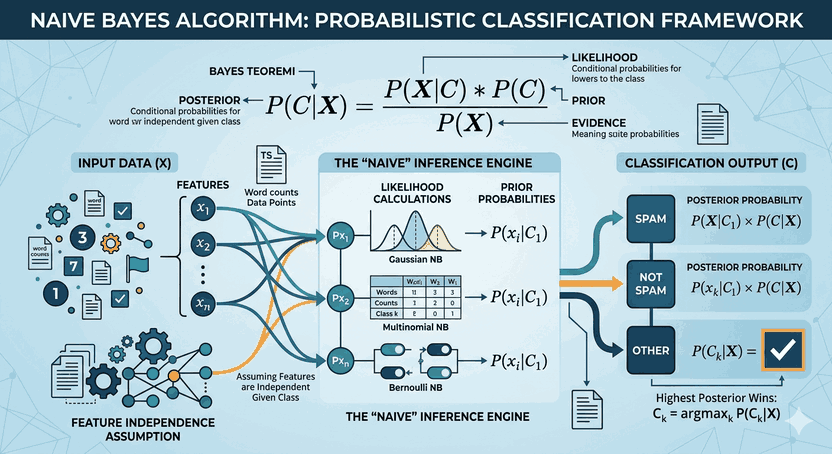
Theoretical Foundations and Application Strategies of the Naive Bayes Algorithm

Naive Bayes is a fast and effective probabilistic classification algorithm based on Bayes' Theorem that assumes full independence between features. It provides a strong foundation for problems such as text classification, spam filtering, and sentiment analysis, especially in high-dimensional datasets, with low computational cost.

ai naive-bayes bayes-theorem scikit-learn gaussian-naive-bayes multinomial-naive-bayes bernoulli-naive-bayes machine-learning deep-learning ai-engineering

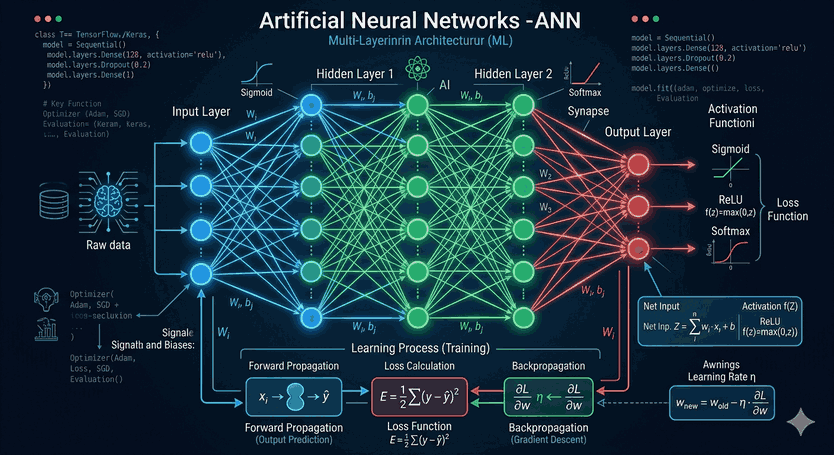
Artificial Neural Networks: A Journey from Biological Inspiration to Mathematical Architecture

A technical article detailing the biological foundations, advanced mathematical architecture, backpropagation algorithms, and deep learning optimization techniques of artificial neural networks, complete with Python code examples.

ai artificial-neural-networks deep-learning python ai-technologies nlp data-science machine-learning

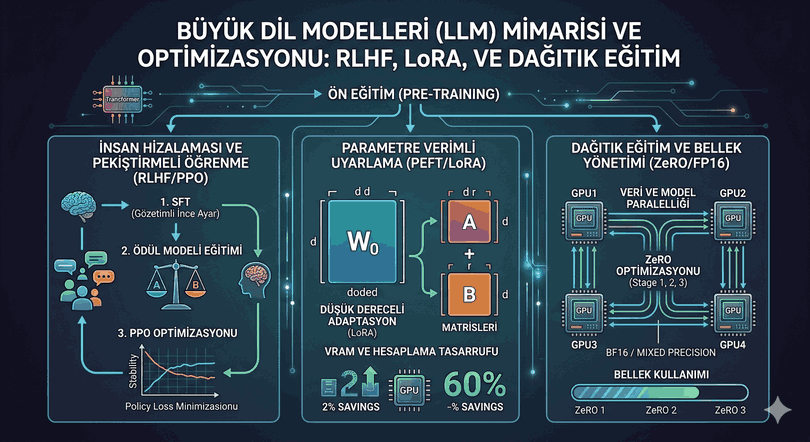
Architectural Depth of Large Language Models: Alignment, Optimization, and Efficient Adaptation

[-Veri Analiz Okulu, Notes 11-] A deep technical article covering the alignment of Large Language Models (LLMs) with human feedback, their efficient adaptation via Low-Rank Adaptation (LoRA), and their optimization in distributed hardware architectures.

ai veri-analizi-okulu vao python llm rlhf nlp lora deep-learning ai-engineering machine-learning

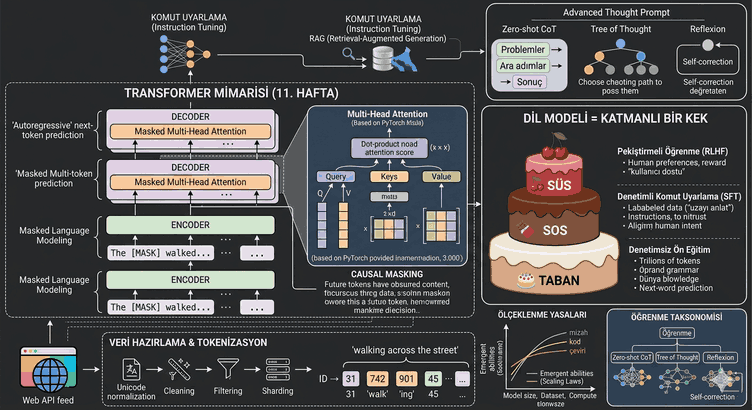
The Neural Architecture of Modern Language Models and Their Evolution from Token-Level to Reasoning

[-Veri Analiz Okulu, Notes 10-] This article is a comprehensive examination covering the mathematical foundations of the Transformer architecture, the vectorial operations of attention mechanisms, and the processes by which large language models (LLMs) derive meaning from data with technical depth.

ai veri-analizi-okulu vao python transformer-architecture nlp llm tokenization attention-mechanism neural-networks ai-alignment pytorch machine-learning

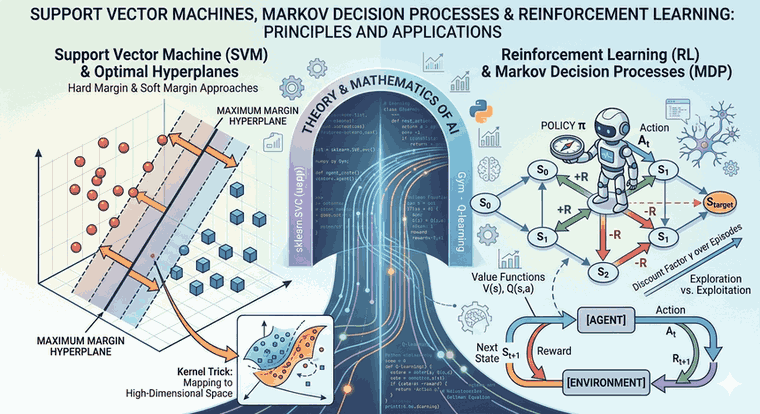
Delicate Balances and Strategic Approaches in Modern Machine Learning

[-Veri Analiz Okulu, Notes 8-] This article analyzes the geometric optimization strategies of Support Vector Machines, the reward-oriented decision-making mechanisms of Reinforcement Learning, and the mathematical foundations of Markov Decision Processes with technical depth.

ai veri-analizi-okulu vao python svm deep-learning reinforcement-learning algorithm-analysis machine-learning

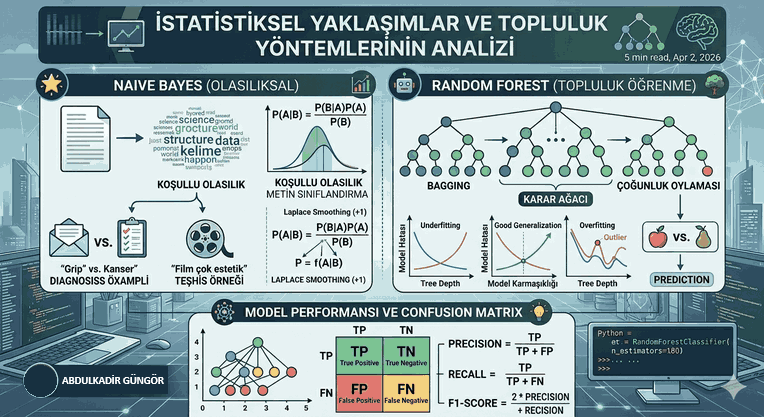
Engineering Analysis of Statistical Approaches and Ensemble Methods in Machine Learning

[-Veri Analiz Okulu, Notes 7-] A technical article analyzing the mathematical depth of Naive Bayes and Random Forest algorithms, based on Bayesian probability theory and ensemble learning methods, with model performance metrics.

ai veri-analizi-okulu vao python naive-bayes random-forest confusion-matrix python-coding statistical-learning algorithm-analysis machine-learning

Dimensionality Reduction Strategies and Algorithmic Depth in Machine Learning

[-Veri Analiz Okulu, Notes 6-] Examines PCA and LDA techniques used to reduce the complexity of high-dimensional data, covering their mathematical foundations, impact on classification performance, and in-depth Python-based technical implementation examples.

ai veri-analizi-okulu vao python dimensionality-reduction pca lda classification statistical-analysis data-science machine-learning

Modern Clustering and Classification Strategies in Machine Learning

[-Veri Analiz Okulu, Notes 5-] A comprehensive and technical article covering everything from linear classification models to K-means clustering algorithms, and from model optimization to regularization techniques that prevent overfitting.

ai veri-analizi-okulu vao python deep-learning kmeans clustering classification lloyd-algorithm data-science machine-learning

The Quest for Balance in Model Optimization: A Stability Analysis of Machine Learning from Underfitting to Overfitting

[-Veri Analiz Okulu, Notes 4-] This article examines the balance between model complexity and generalization capability in machine learning, exploring the concepts of underfitting and overfitting with technical depth.

ai veri-analizi-okulu vao python deep-learning model-fitting over-fitting under-fitting data-science machine-learning

Architectural Foundations and Algorithmic Strategies of Modern Artificial Intelligence

[-Veri Analiz Okulu, Notes 3-] A technical paper on the attention mechanism of the Transformer architecture, multimodal data integration, and the mathematical decision strategies of reinforcement learning.

ai veri-analizi-okulu vao python deep-learning transformer-architecture multi-modal-ai bellman-equation data-science machine-learning

The Layered Architecture and Algorithmic Depth of Machine Learning

[-Veri Analiz Okulu, Notes 2-] A technical and mathematical analysis of the hierarchical structure of machine learning, data processing layers, and fundamental learning paradigms (supervised, unsupervised, reinforcement).

ai veri-analizi-okulu vao python deep-learning reinforcement-learning data-science machine-learning

From Data Engineering to Cognitive Revolution: The Technical Anatomy of AI and Machine Learning

[-Veri Analiz Okulu, Notes 1-] This comprehensive technical review analyzes the evolutionary process of artificial intelligence, from rule-based expert systems to modern transformer architectures and generative networks, through biological analogies and practical application layers in the software world.

ai veri-analizi-okulu vao python deep-learning pytorch transformer data-science machine-learning

Advanced Analytical Modeling and Algorithmic Visualization Strategies in High-Dimensional Data Spaces

This is a technical guide for processing high-dimensional data with maximum efficiency using hardware-based memory optimization, advanced feature engineering, and algorithmic pipelines.

ai data-engineering big-data statistical-analysis data-mining algorithmic-visualization machine-learning

In-Depth Technical Analysis of AI Architecture and Development Processes

Explore AI development processes in-depth, from Transformer architecture to RAG systems, Onion Architecture integration, and Edge AI/TinyML optimizations. A comprehensive technical analysis supported by code examples and mathematical models.

ai data-engineering big-data ai-architecture transformer-architecture deep-learning machine-learning

The Digital Ontology of Data: A Deep Look from Binary Logic to Quantum Superposition

A technical examination of the transformation process of data from its raw form to strategic insight, viewed through the perspectives of deterministic systems, algorithmic depth, and computational social sciences.

ai data-science machine-learning computational-analysis quantum-computers nlp gis digital-transformation

Advanced Data Preprocessing and Engineering Architecture in Data Science

A technical examination of the transformation of data from raw form into a processed feature matrix in analytical modeling processes; a synthesis of statistical methodologies and computational techniques.

ai data-science machine-learning data-preprocessing feature-engineering statistical-analysis data-mining

Reinforcement Learning: Dynamic Decision Mechanisms and the Mathematics of Autonomous Systems

A technical guide detailing the mathematical foundations, deep architectures, and technical implementation methods of reinforcement learning, which optimizes optimal decision strategies through reward mechanisms in dynamic environments.

ai data-engineering big-data reinforcement-learning deep-learning python machine-learning

Engineering Architecture of Autonomous Systems: SLAM, Sensor Fusion, and Reinforcement Learning Processes

A comprehensive guide examining the technical depth of localization, data integration, and machine learning algorithms in robotic systems, along with C++ and Python implementations.

ai autonomous-systems big-data slam reinforcement-learning robotics robotics machine-learning

Modern Data Engineering: Scalable Pipeline Architectures and Analytical Transformation Strategies

A comprehensive guide to end-to-end high-performance data pipeline design, covering distributed computing engines, in-memory optimization techniques, and complex feature engineering processes.

ai data-engineering big-data statistical-analysis distributed-computing statistical-modeling machine-learning

In-Memory Computing and Low-Latency Data Processing Strategies in Modern Data Architectures

Optimizing performance at the hardware level in the data ecosystem: In-memory architectures, CPU cache hierarchy, and low-latency data processing techniques.

ai data-architecture memory-management low-latency system-design performance-optimization

Advanced Data Preprocessing and Algorithmic Optimization Strategies in Machine Learning Pipelines

A guide to maximizing model performance through advanced feature engineering, statistical imputation techniques, ensemble modeling strategies, and Bayesian optimization. Engineering discipline in data analytics using modern tools like SHAP and Isolation Forest.

ai data-engineering big-data data-analytics algorithm-optimization feature-engineering machine-learning

Advanced Data Science Strategies: Graph Analytics, Synthetic Data, and XAI Architectures

A comprehensive technical analysis of network theory, data generation techniques, and model transparency that provides depth in modern data analytics.

ai data-engineering big-data graph-analysis xai synthetic-data machine-learning

Unsupervised Learning: The Hidden Geometry of Data and Algorithmic Discovery Techniques

This article details methodologies used to extract meaningful patterns from unlabeled datasets, including clustering, dimensionality reduction, and anomaly detection, along with their mathematical foundations and modern software implementations.

ai data-engineering big-data unsupervised-learning pca clustering machine-learning

Mathematical Optimization and Applied Algorithm Strategies in Supervised Learning Architecture

A mathematical modeling method that learns a mapping function from labeled data consisting of input-output pairs, aiming to predict continuous or categorical values.

ai data-engineering supervised-learning algorithm python machine-learning