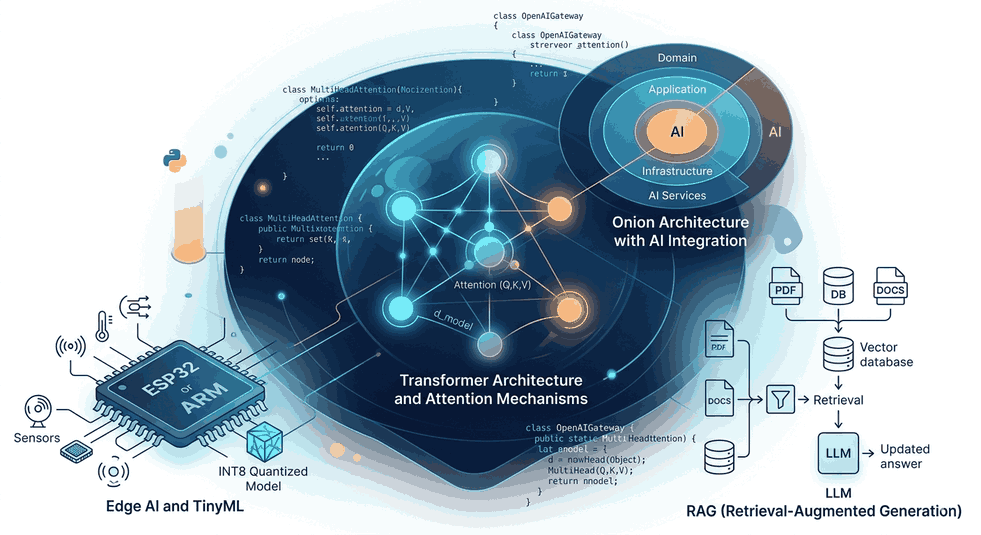
The Neural Architecture of Modern Language Models and Their Evolution from Token-Level to Reasoning

The greatest disruption in the artificial intelligence ecosystem over the last decade has occurred not just through the processing of data, but through the reconstruction of language in a geometric space. Modern Large Language Models (LLMs) are massive statistical machines that take raw text chunks and transform them into meaningful relationships within high-dimensional vector spaces. However, behind the appearance that these machines are “thinking” lies the mathematical elegance offered by the Transformer architecture and the emergent capabilities brought about by scaling laws.

The Neural Architecture of Modern Language Models and Their Evolution from Token-Level to Reasoning

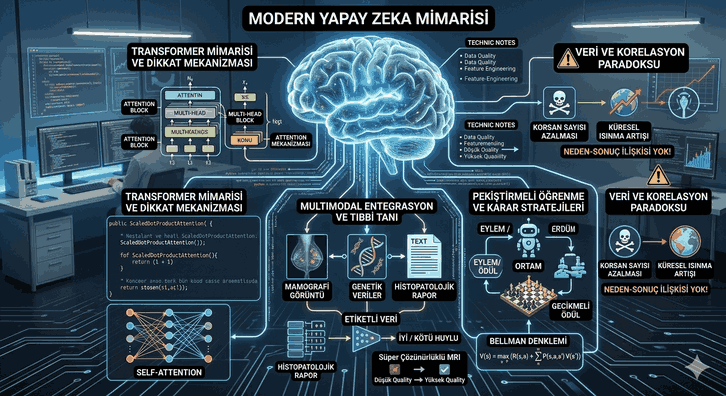
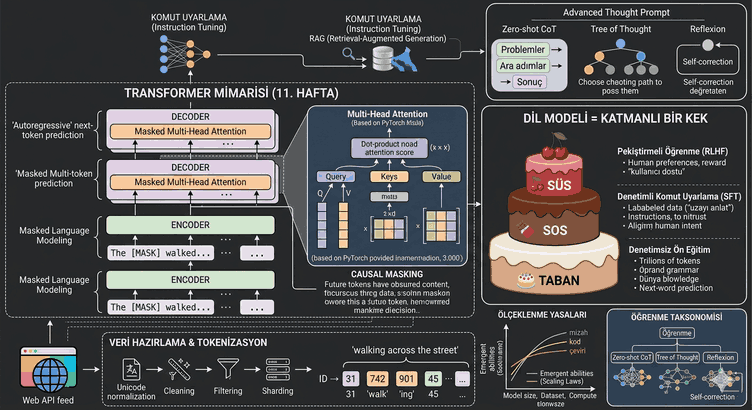
Figure 1: The Neural Architecture of Modern Language Models and Their Evolution from Token-Level to Reasoning.


1. Seeking Meaning in Vector Space: Tokenization and Embedding Layer

Language models cannot read text directly. The processing pipeline begins by breaking down the text into sub-units using a method called Tokenization. Algorithms widely used today, such as Byte Pair Encoding (BPE) or WordPiece, split words based on their rarity. For example, while the word “artificial” might be a single token, a complex structure like “are you one of those that we could not artificialize” is divided into many sub-units.

Tokens are then converted into $d_{model}$-dimensional (e.g., 4096 or more) dense vectors in the Embedding layer. These vectors determine the semantic position of the word. However, because the Transformer architecture is a “permutation-invariant” structure, Positional Encoding is added to teach the model the position of the word within the sentence.

$$PE_{(pos, 2i)} = \sin(pos / 10000^{2i/d_{model}})$$$$PE_{(pos, 2i+1)} = \cos(pos / 10000^{2i/d_{model}})$$

These trigonometric functions grant the model the ability to understand the relative distance between tokens.


2. Transformer Architecture: The Mathematical Foundation of the Attention Mechanism

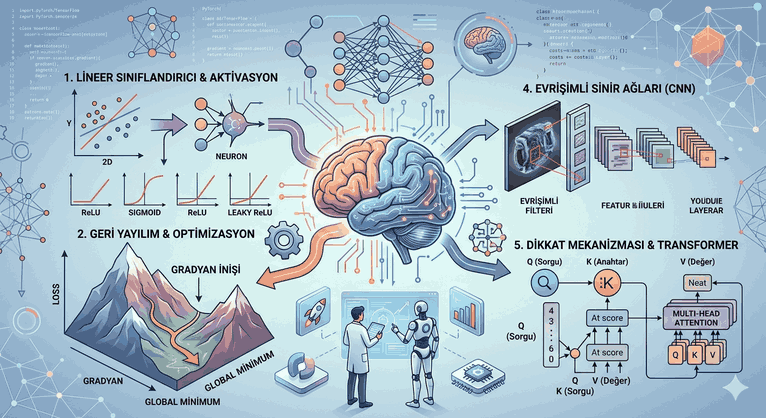
The heart of the Transformer is the Scaled Dot-Product Attention mechanism. The model’s “focusing” ability relies on three fundamental vectors created for each token: Query (Q), Key (K), and Value (V).

To understand how related a token is to other tokens, it multiplies its own Query vector with the Key vectors of others (dot product). This process creates a similarity score matrix:

$$\text{Attention}(Q, K, V) = \text{softmax}\left(\frac{QK^T}{\sqrt{d_k}}\right)V$$

The scaling factor $\sqrt{d_k}$ here prevents gradients from vanishing or exploding. Multi-Head Attention is the execution of this process in parallel under different “heads.” Each head learns a different linguistic feature (e.g., one learns subject-predicate relationships, while another learns tense suffixes).


3. Training Strategies: A Layered Learning Taxonomy

Building a modern language model is like preparing a layered cake. Each layer supports a higher level of the model’s cognitive ability.

A. Self-Supervised Pretraining

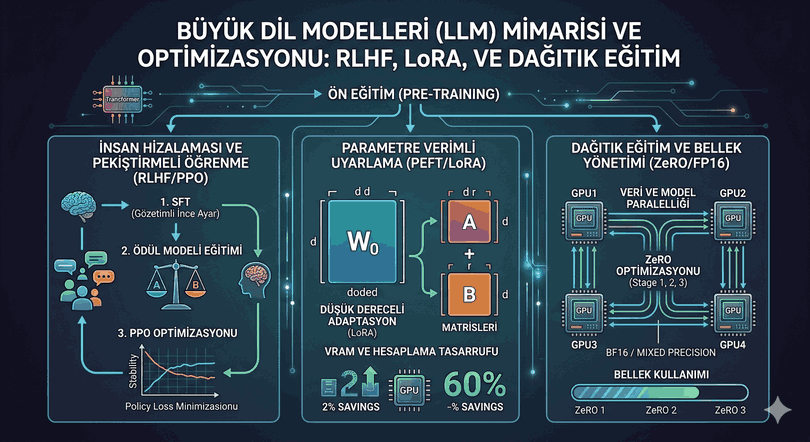
This is the stage where the model gains its “world knowledge.” Through trillions of words, the model seeks to answer the question: “What is the next word?” In the Causal Language Modeling (CLM) approach, the model cannot see the tokens that come after it. This is ensured during training by a Masking matrix.

B. Supervised Fine-Tuning (SFT - Instruction Tuning)

While a pretrained model is an “autocomplete” engine, it transforms into an “assistant” through SFT. Here, the model is trained with high-quality, human-written (Question-Answer) pairs.

C. RLHF (Reinforcement Learning from Human Feedback)

This is used to ensure the model’s safety and alignment with human preferences. Using PPO (Proximal Policy Optimization) or DPO (Direct Preference Optimization) algorithms, the responses generated by the model are scored by a Reward Model.


4. Technical Implementation: Transformer Block Structure and PyTorch Example

Examining the basic structure of a Transformer block at the code level is critical to understanding how the mechanism functions. The Python example below demonstrates how a simple Self-Attention layer can be constructed using the PyTorch library.

import torch
import torch.nn as nn
import torch.nn.functional as F

class SimpleSelfAttention(nn.Module):
    def __init__(self, embed_size, heads):
        super(SimpleSelfAttention, self).__init__()
        self.embed_size = embed_size
        self.heads = heads
        self.head_dim = embed_size // heads

        assert (self.head_dim * heads == embed_size), "Embedding size must be divisible by the number of heads."

        self.values = nn.Linear(self.head_dim, self.head_dim, bias=False)
        self.keys = nn.Linear(self.head_dim, self.head_dim, bias=False)
        self.queries = nn.Linear(self.head_dim, self.head_dim, bias=False)
        self.fc_out = nn.Linear(heads * self.head_dim, embed_size)

    def forward(self, values, keys, query, mask):
        N = query.shape[0]
        value_len, key_len, query_len = values.shape[1], keys.shape[1], query.shape[1]

        # Split vectors into heads
        values = values.reshape(N, value_len, self.heads, self.head_dim)
        keys = keys.reshape(N, key_len, self.heads, self.head_dim)
        queries = query.reshape(N, query_len, self.heads, self.head_dim)

        # Calculate energy (Dot-product)
        energy = torch.einsum("nqhd,nkhd->nhqk", [queries, keys])

        if mask is not None:
            energy = energy.masked_fill(mask == 0, float("-1e20"))

        # Attention weights
        attention = torch.softmax(energy / (self.embed_size ** (1/2)), dim=3)

        out = torch.einsum("nhql,nlhd->nqhd", [attention, values]).reshape(
            N, query_len, self.heads * self.head_dim
        )

        return self.fc_out(out)

5. Advanced Reasoning Techniques: CoT and ToT Approaches

Even after the model’s parameters are frozen, it is possible to increase its cognitive performance. While this is often called “Prompt Engineering,” the actual process is triggering the model’s In-Context Learning capability.

  • Chain of Thought (CoT): Guiding the model with the “Let’s think step by step” command, enabling it to break a complex problem into sub-parts. This allows the model to create “intermediate stops” during processing and reduces logical errors.
  • Tree of Thought (ToT): Instead of a single linear line of thought, the model branches out different possibilities like a tree structure and navigates the most logical path by evaluating the success of each branch.
  • Self-Consistency: The model generates 10 different responses to the same question, and the most consistent one is chosen via majority voting. This minimizes the margin of error, especially in mathematical operations.

6. Scaling Laws and Emergent Abilities

Research from giants like OpenAI and Google has proven that model performance depends on three fundamental variables: Compute, Data size, and Number of parameters.

When a certain threshold is exceeded (usually 7B+ parameters), models begin to spontaneously exhibit capabilities that were not directly targeted during training, such as “understanding humor,” “coding,” or “translation.” However, this growth also brings the risk of Hallucination. The goal of the model is not to tell the truth, but to select the token with the highest probability. Therefore, external data verification systems like RAG (Retrieval-Augmented Generation) have become indispensable in technical architecture for modern applications.


Conclusion: The Future of Neural Semantics

Today, language models have ceased to be just text-generating tools and serve as “processors” in every field, from software development processes to scientific research. The parallelization power brought by the Transformer architecture and the contextual depth offered by the Attention mechanism have enabled machines not only to imitate human language but to mathematically simulate the logical structure underlying it. In the future, models that consume less energy and have longer context windows will transform the concept of a digital assistant into fully autonomous agents.

Technical Note: On the memory management side, the KV Cache (Key-Value Caching) mechanism stores the Key and Value vectors calculated in previous steps to increase inference speed. This dramatically reduces the computational load on the GPU, especially during long text generation.

#ai #veri-analizi-okulu #vao #python #transformer-architecture #nlp #llm #tokenization #attention-mechanism #neural-networks #ai-alignment #pytorch #machine-learning

Related Contents

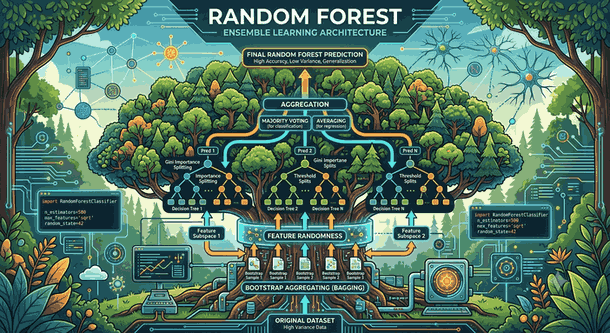
Technical Architecture and Implementation Principles of the Random Forest Algorithm

Random Forest is a powerful "Ensemble Learning" algorithm that achieves more stable and high-accuracy results by combining the predictions of numerous "Decision Tree" structures. By utilizing "Bagging" and "Feature Randomness" techniques, it minimizes the "overfitting" tendency of a single tree; thus, it is a "robust" model that exhibits high "generalization" success even with noisy data and does not require scaling.

ai machine-learning random-forest python decision-tree ensemble-learning supervised-learning feature-importance hyperparameter-tuning artificial-intelligence deep-learning ai-engineering

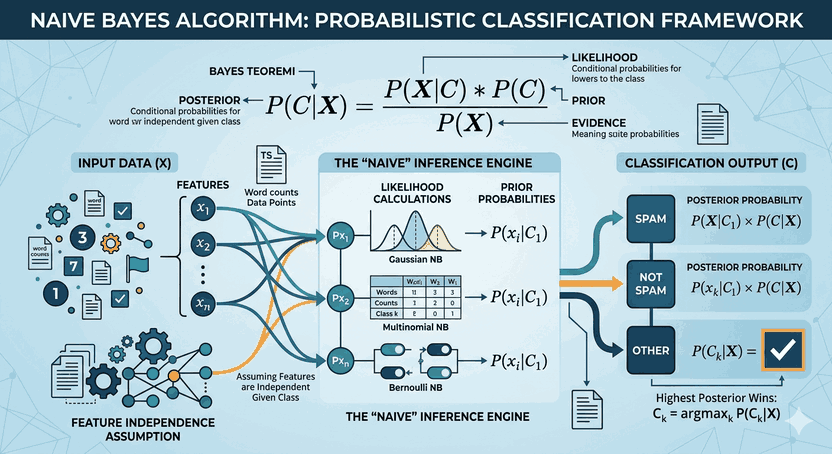
Theoretical Foundations and Application Strategies of the Naive Bayes Algorithm

Naive Bayes is a fast and effective probabilistic classification algorithm based on Bayes' Theorem that assumes full independence between features. It provides a strong foundation for problems such as text classification, spam filtering, and sentiment analysis, especially in high-dimensional datasets, with low computational cost.

ai naive-bayes bayes-theorem scikit-learn gaussian-naive-bayes multinomial-naive-bayes bernoulli-naive-bayes machine-learning deep-learning ai-engineering

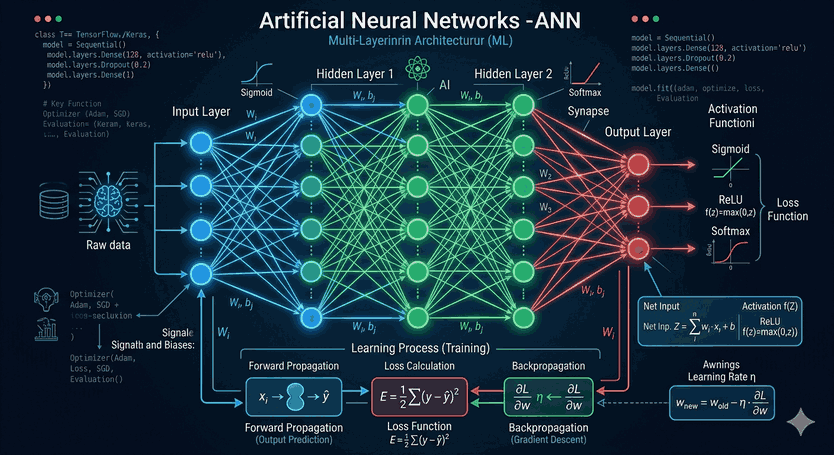
Artificial Neural Networks: A Journey from Biological Inspiration to Mathematical Architecture

A technical article detailing the biological foundations, advanced mathematical architecture, backpropagation algorithms, and deep learning optimization techniques of artificial neural networks, complete with Python code examples.

ai artificial-neural-networks deep-learning python ai-technologies nlp data-science machine-learning

Architectural Depth of Large Language Models: Alignment, Optimization, and Efficient Adaptation

[-Veri Analiz Okulu, Notes 11-] A deep technical article covering the alignment of Large Language Models (LLMs) with human feedback, their efficient adaptation via Low-Rank Adaptation (LoRA), and their optimization in distributed hardware architectures.

ai veri-analizi-okulu vao python llm rlhf nlp lora deep-learning ai-engineering machine-learning

The Anatomy of Modern Deep Learning: A Technical Journey from Gradients to Attention Mechanisms

[-Veri Analiz Okulu, Notes 9-] A technical article covering the mathematical background of backpropagation, CNNs, and attention mechanisms, which form the foundation of deep learning, along with optimization algorithms and modern architectural structures.

ai veri-analizi-okulu vao python back-propagation cnn transformer attention-mechanism pytorch machine-learning

Delicate Balances and Strategic Approaches in Modern Machine Learning

[-Veri Analiz Okulu, Notes 8-] This article analyzes the geometric optimization strategies of Support Vector Machines, the reward-oriented decision-making mechanisms of Reinforcement Learning, and the mathematical foundations of Markov Decision Processes with technical depth.

ai veri-analizi-okulu vao python svm deep-learning reinforcement-learning algorithm-analysis machine-learning

Engineering Analysis of Statistical Approaches and Ensemble Methods in Machine Learning

[-Veri Analiz Okulu, Notes 7-] A technical article analyzing the mathematical depth of Naive Bayes and Random Forest algorithms, based on Bayesian probability theory and ensemble learning methods, with model performance metrics.

ai veri-analizi-okulu vao python naive-bayes random-forest confusion-matrix python-coding statistical-learning algorithm-analysis machine-learning

Dimensionality Reduction Strategies and Algorithmic Depth in Machine Learning

[-Veri Analiz Okulu, Notes 6-] Examines PCA and LDA techniques used to reduce the complexity of high-dimensional data, covering their mathematical foundations, impact on classification performance, and in-depth Python-based technical implementation examples.

ai veri-analizi-okulu vao python dimensionality-reduction pca lda classification statistical-analysis data-science machine-learning

Modern Clustering and Classification Strategies in Machine Learning

[-Veri Analiz Okulu, Notes 5-] A comprehensive and technical article covering everything from linear classification models to K-means clustering algorithms, and from model optimization to regularization techniques that prevent overfitting.

ai veri-analizi-okulu vao python deep-learning kmeans clustering classification lloyd-algorithm data-science machine-learning

The Quest for Balance in Model Optimization: A Stability Analysis of Machine Learning from Underfitting to Overfitting

[-Veri Analiz Okulu, Notes 4-] This article examines the balance between model complexity and generalization capability in machine learning, exploring the concepts of underfitting and overfitting with technical depth.

ai veri-analizi-okulu vao python deep-learning model-fitting over-fitting under-fitting data-science machine-learning

Architectural Foundations and Algorithmic Strategies of Modern Artificial Intelligence

[-Veri Analiz Okulu, Notes 3-] A technical paper on the attention mechanism of the Transformer architecture, multimodal data integration, and the mathematical decision strategies of reinforcement learning.

ai veri-analizi-okulu vao python deep-learning transformer-architecture multi-modal-ai bellman-equation data-science machine-learning

The Layered Architecture and Algorithmic Depth of Machine Learning

[-Veri Analiz Okulu, Notes 2-] A technical and mathematical analysis of the hierarchical structure of machine learning, data processing layers, and fundamental learning paradigms (supervised, unsupervised, reinforcement).

ai veri-analizi-okulu vao python deep-learning reinforcement-learning data-science machine-learning

From Data Engineering to Cognitive Revolution: The Technical Anatomy of AI and Machine Learning

[-Veri Analiz Okulu, Notes 1-] This comprehensive technical review analyzes the evolutionary process of artificial intelligence, from rule-based expert systems to modern transformer architectures and generative networks, through biological analogies and practical application layers in the software world.

ai veri-analizi-okulu vao python deep-learning pytorch transformer data-science machine-learning

Advanced Analytical Modeling and Algorithmic Visualization Strategies in High-Dimensional Data Spaces

This is a technical guide for processing high-dimensional data with maximum efficiency using hardware-based memory optimization, advanced feature engineering, and algorithmic pipelines.

ai data-engineering big-data statistical-analysis data-mining algorithmic-visualization machine-learning

In-Depth Technical Analysis of AI Architecture and Development Processes

Explore AI development processes in-depth, from Transformer architecture to RAG systems, Onion Architecture integration, and Edge AI/TinyML optimizations. A comprehensive technical analysis supported by code examples and mathematical models.

ai data-engineering big-data ai-architecture transformer-architecture deep-learning machine-learning

The Digital Ontology of Data: A Deep Look from Binary Logic to Quantum Superposition

A technical examination of the transformation process of data from its raw form to strategic insight, viewed through the perspectives of deterministic systems, algorithmic depth, and computational social sciences.

ai data-science machine-learning computational-analysis quantum-computers nlp gis digital-transformation

Advanced Data Preprocessing and Engineering Architecture in Data Science

A technical examination of the transformation of data from raw form into a processed feature matrix in analytical modeling processes; a synthesis of statistical methodologies and computational techniques.

ai data-science machine-learning data-preprocessing feature-engineering statistical-analysis data-mining

Reinforcement Learning: Dynamic Decision Mechanisms and the Mathematics of Autonomous Systems

A technical guide detailing the mathematical foundations, deep architectures, and technical implementation methods of reinforcement learning, which optimizes optimal decision strategies through reward mechanisms in dynamic environments.

ai data-engineering big-data reinforcement-learning deep-learning python machine-learning

Engineering Architecture of Autonomous Systems: SLAM, Sensor Fusion, and Reinforcement Learning Processes

A comprehensive guide examining the technical depth of localization, data integration, and machine learning algorithms in robotic systems, along with C++ and Python implementations.

ai autonomous-systems big-data slam reinforcement-learning robotics robotics machine-learning

Modern Data Engineering: Scalable Pipeline Architectures and Analytical Transformation Strategies

A comprehensive guide to end-to-end high-performance data pipeline design, covering distributed computing engines, in-memory optimization techniques, and complex feature engineering processes.

ai data-engineering big-data statistical-analysis distributed-computing statistical-modeling machine-learning

In-Memory Computing and Low-Latency Data Processing Strategies in Modern Data Architectures

Optimizing performance at the hardware level in the data ecosystem: In-memory architectures, CPU cache hierarchy, and low-latency data processing techniques.

ai data-architecture memory-management low-latency system-design performance-optimization

Advanced Data Preprocessing and Algorithmic Optimization Strategies in Machine Learning Pipelines

A guide to maximizing model performance through advanced feature engineering, statistical imputation techniques, ensemble modeling strategies, and Bayesian optimization. Engineering discipline in data analytics using modern tools like SHAP and Isolation Forest.

ai data-engineering big-data data-analytics algorithm-optimization feature-engineering machine-learning

Advanced Data Science Strategies: Graph Analytics, Synthetic Data, and XAI Architectures

A comprehensive technical analysis of network theory, data generation techniques, and model transparency that provides depth in modern data analytics.

ai data-engineering big-data graph-analysis xai synthetic-data machine-learning

Unsupervised Learning: The Hidden Geometry of Data and Algorithmic Discovery Techniques

This article details methodologies used to extract meaningful patterns from unlabeled datasets, including clustering, dimensionality reduction, and anomaly detection, along with their mathematical foundations and modern software implementations.

ai data-engineering big-data unsupervised-learning pca clustering machine-learning

Mathematical Optimization and Applied Algorithm Strategies in Supervised Learning Architecture

A mathematical modeling method that learns a mapping function from labeled data consisting of input-output pairs, aiming to predict continuous or categorical values.

ai data-engineering supervised-learning algorithm python machine-learning