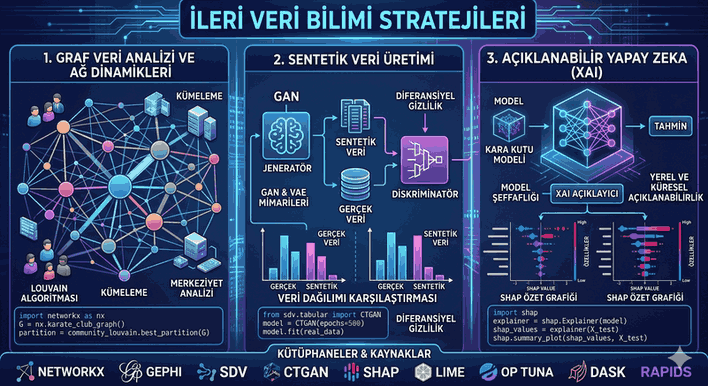
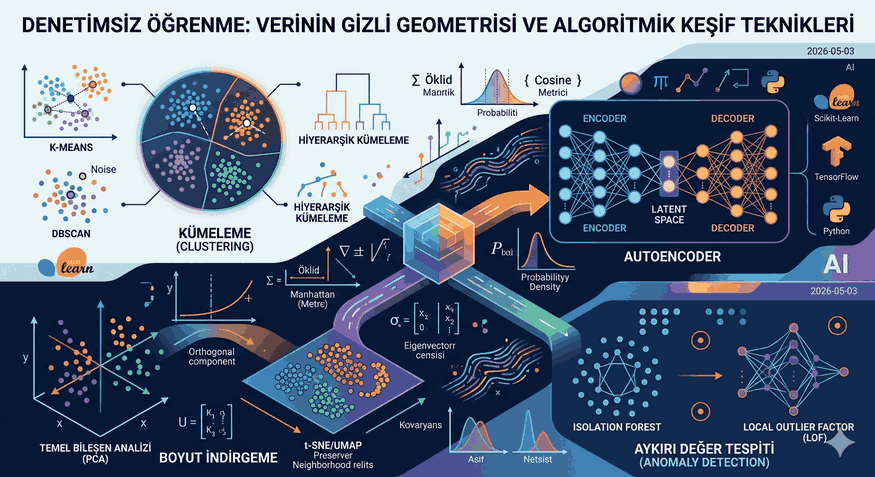
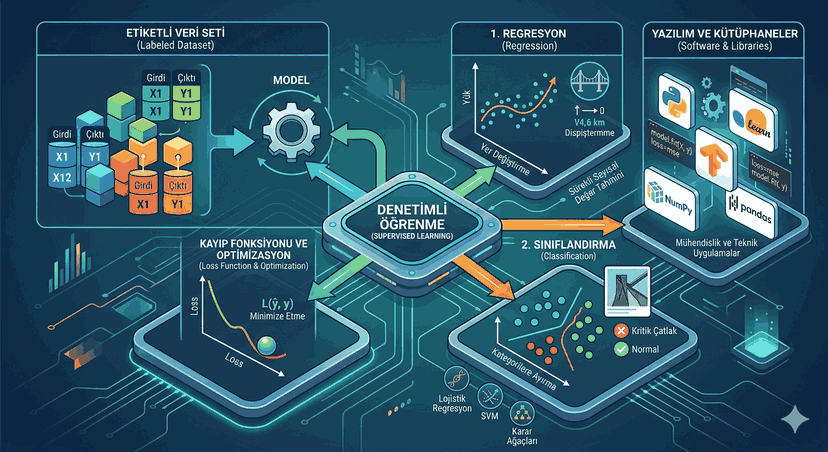
Architectural Foundations and Algorithmic Strategies of Modern Artificial Intelligence

The world of artificial intelligence has undergone a massive evolution from static rules to dynamic, learning structures. The success of models like ChatGPT today is not solely due to the volume of raw data, but the mathematical intelligence of the Transformer architecture that processes this data and the decision-making mechanisms optimized through Reinforcement Learning.

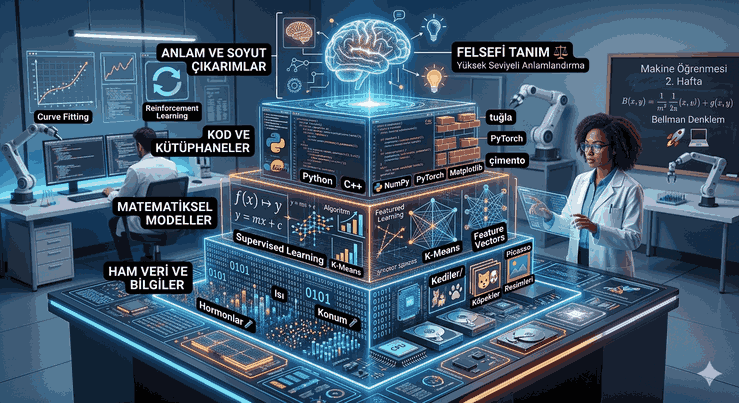
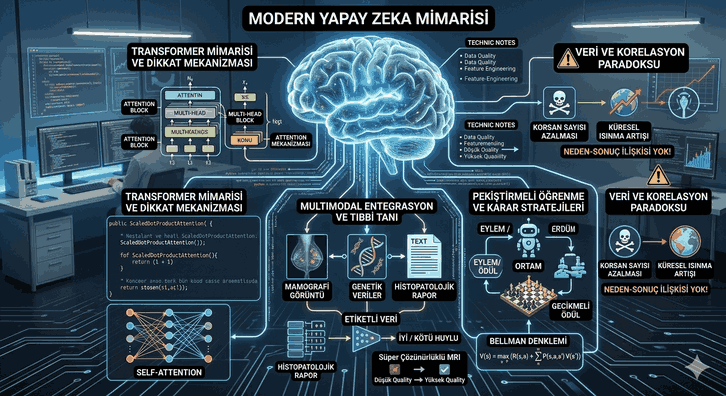
Architectural Foundations and Algorithmic Strategies of Modern Artificial Intelligence

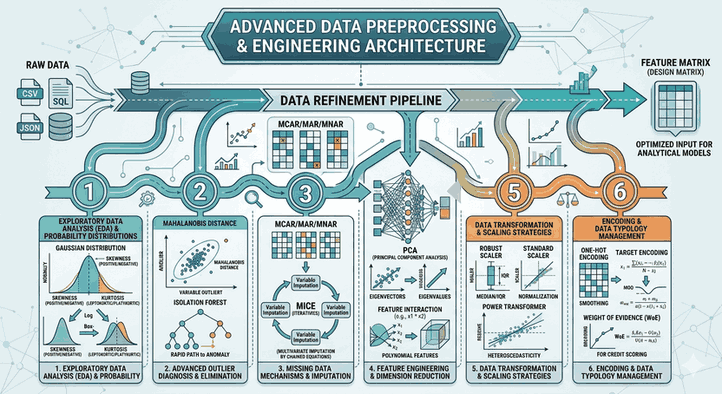
Figure 1: Architectural Foundations and Algorithmic Strategies of Modern Artificial Intelligence.


Transition from Rule-Based Systems to Learning Algorithms

Rule-based systems, which dominated the early days of artificial intelligence, were deterministic structures formulated as “If A happens, do B.” However, this method proved insufficient for modeling the complex world. Dependence on expert labor, lack of flexibility, and difficulties in protecting privacy necessitated a shift to machine learning models that allow systems to derive their own rules from data. Specifically, game theory concepts like the Nash Equilibrium demonstrated how systems stabilize in competitive environments and how they become more resilient through the factor of stochasticity.

Multimodal Artificial Intelligence and Medical Diagnosis Applications

While unimodal systems work with only a single type of data such as text or audio, modern architectures today have a Multimodal structure. This means the model can process different modalities like text, image, and audio simultaneously.

In critical areas such as breast cancer diagnosis, this structure is life-saving. A system analyzing mammography (image), genetic data (tabular), and histopathological reports (text) at the same time allows it to catch micro-patterns that the human eye might miss. Trained with supervised learning, these models reduce the workload of radiologists and create “automated triage” mechanisms. The conversion of low-resolution MRI data into high-quality versions (super-resolution) is also a result of these learning processes.

Transformer Architecture and Attention Mechanism

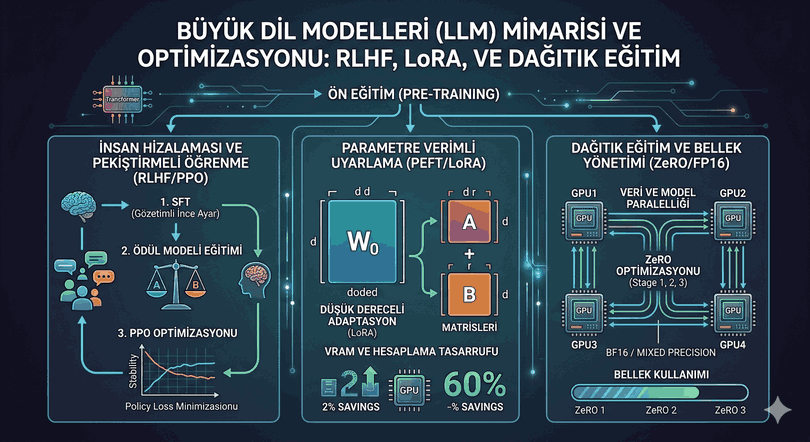
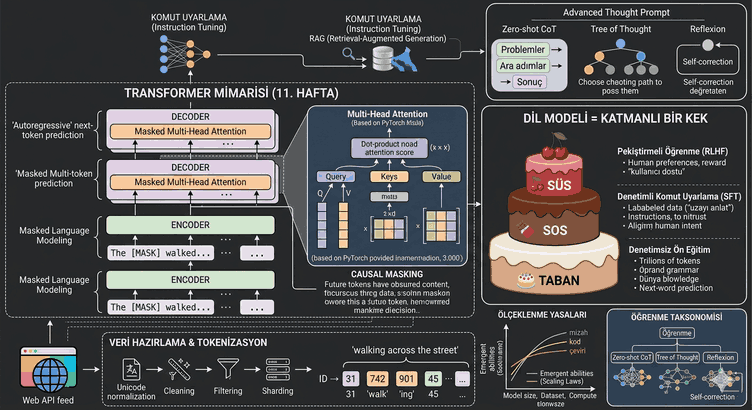
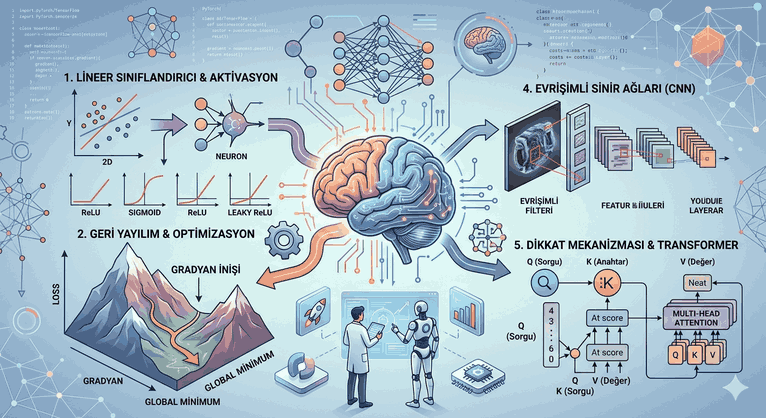
Transformer models have revolutionized text generation. Unlike traditional models, they can weight the relationship (context) between a word at the beginning of a sentence and one at the end while predicting a word, thanks to the “Attention” mechanism.

Models like GPT-3 have billions of parameters. These parameters are a massive stack of matrices representing the probabilistic distribution of language. When a word is generated, that word feeds back into the system’s input, and a circular prediction process begins.

import torch
import torch.nn as nn

# Simple representation of a Self-Attention mechanism
class ScaledDotProductAttention(nn.Module):
    def __init__(self):
        super(ScaledDotProductAttention, self).__init__()

    def forward(self, Q, K, V, mask=None):
        # Q: Query, K: Key, V: Value matrices
        d_k = Q.size(-1)
        # Calculate energy score: (Q * K^T) / sqrt(d_k)
        scores = torch.matmul(Q, K.transpose(-2, -1)) / torch.sqrt(torch.tensor(d_k, dtype=torch.float32))
        
        if mask is not None:
            scores = scores.masked_fill(mask == 0, -1e9)
        
        # Create probability distribution with Softmax
        attention_weights = torch.softmax(scores, dim=-1)
        # Weighting with Value matrix
        return torch.matmul(attention_weights, V), attention_weights

Unsupervised Learning and K-Means Algorithm

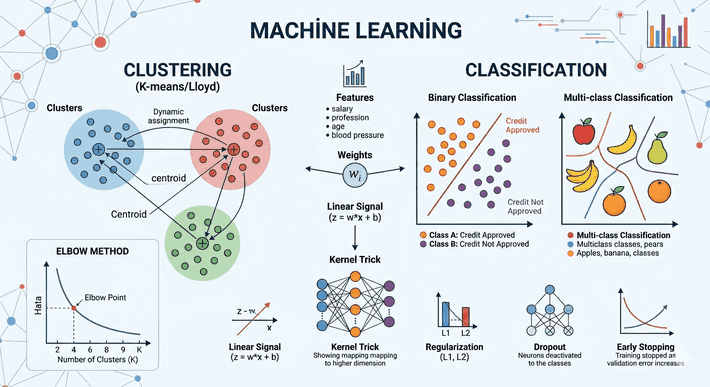
In scenarios where data is unlabeled, systems need to discover hidden structures in the data. When a robot needs to separate animals on a farm (chicken, sheep, cow) without predefined labels, clustering algorithms like K-Means come into play.

The algorithm follows these steps:

  1. Centroid Determination: $K$ random center points are selected.
  2. Assignment: Each data point is assigned to the nearest center using metrics such as Euclidean distance.
  3. Update: The centers of the clusters are recalculated based on the average of the assigned points.
  4. Convergence: The process continues until the centers no longer change.
from sklearn.cluster import KMeans
import numpy as np

# Sample animal data: [Weight, Height]
X = np.array([[2, 0.5], [1.5, 0.4], [50, 1.2], [45, 1.1], [200, 1.8]])
# Assume there are 3 different animal species
kmeans = KMeans(n_clusters=3, random_state=42)
kmeans.fit(X)

print("Cluster Centers:", kmeans.cluster_centers_)

Mathematics of Reinforcement Learning and Strategic Decisions

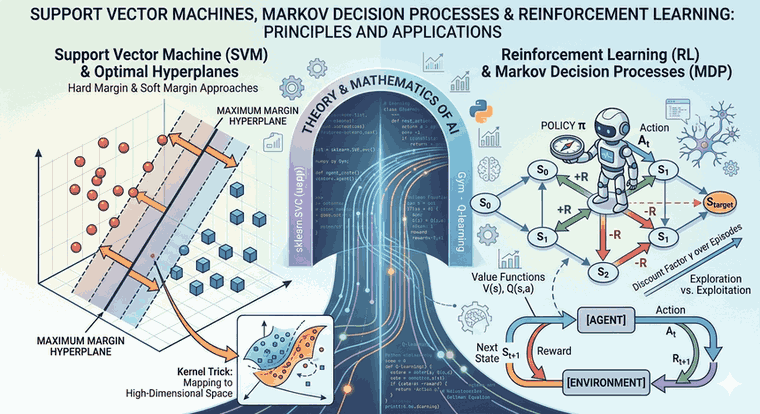
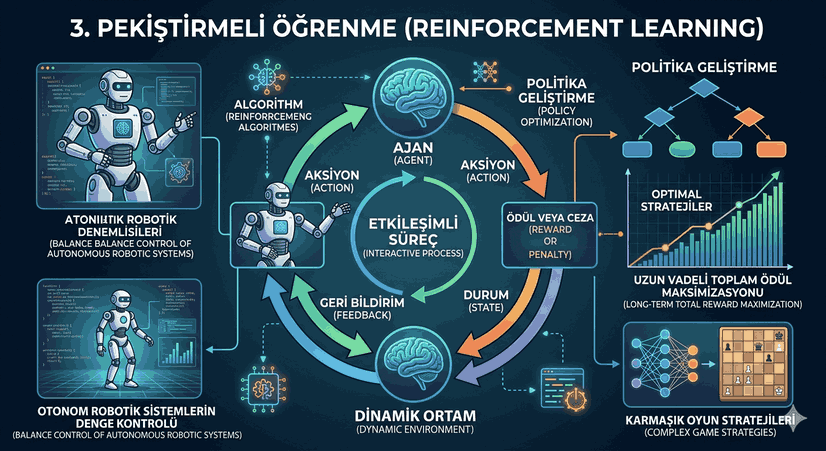
Reinforcement Learning (RL) is when an agent finds the optimal policy by interacting with the environment through a penalty and reward mechanism. Especially in multi-step problems like chess or flight simulators, the value of a move only becomes clear at the end of the game or flight (delayed reward).

At the heart of RL lies the Bellman Equation. The value of a state is not just the current reward, but the sum of future expected discounted rewards:

$$V(s) = \max_a (R(s,a) + \gamma \sum_{s'} P(s,a,s') V(s'))$$

Here, $\gamma$ (gamma) is the discount factor, determining the present value of future rewards. If $\gamma$ is low, the agent behaves “opportunistically”; if it is high, it develops long-term strategies.

Data and the Correlation Paradox

A common mistake in machine learning is confusing correlation with causality. There may be a negative correlation between the decrease in the number of pirates and the increase in global warming, but this does not mean that pirates cool the world. Data only tells us “what” is happening, not “why.” Therefore, domain expertise and logical hypotheses play a critical role when building models.

Notes:

  • Feature Engineering: Instead of feeding data directly into the model, extracting important features (such as corporate merger signals, like planes landing at the same airport) manually or algorithmically increases model success.
  • Web Scraping: In dynamic data collection processes, news feeds and social media data ensure the model remains up-to-date.

Understanding this technical architecture means grasping that artificial intelligence is not just a “black box,” but a massive probability machine built upon mathematical principles.


Technical Resources and Libraries:

  • Data Manipulation: NumPy, Pandas
  • Visualization: Matplotlib, Seaborn
  • Deep Learning: PyTorch, TensorFlow, Transformers (Hugging Face)
  • Clustering and Analysis: Scikit-Learn
#ai #veri-analizi-okulu #vao #python #deep-learning #transformer-architecture #multi-modal-ai #bellman-equation #data-science #machine-learning

Related Contents

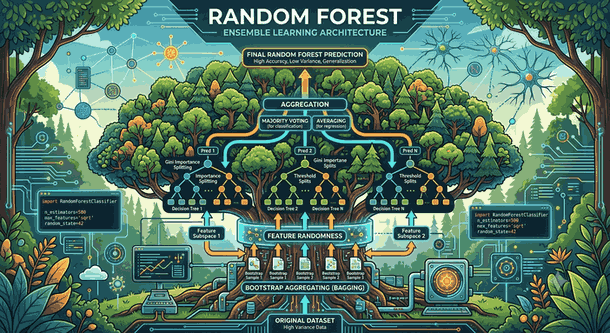
Technical Architecture and Implementation Principles of the Random Forest Algorithm

Random Forest is a powerful "Ensemble Learning" algorithm that achieves more stable and high-accuracy results by combining the predictions of numerous "Decision Tree" structures. By utilizing "Bagging" and "Feature Randomness" techniques, it minimizes the "overfitting" tendency of a single tree; thus, it is a "robust" model that exhibits high "generalization" success even with noisy data and does not require scaling.

ai machine-learning random-forest python decision-tree ensemble-learning supervised-learning feature-importance hyperparameter-tuning artificial-intelligence deep-learning ai-engineering

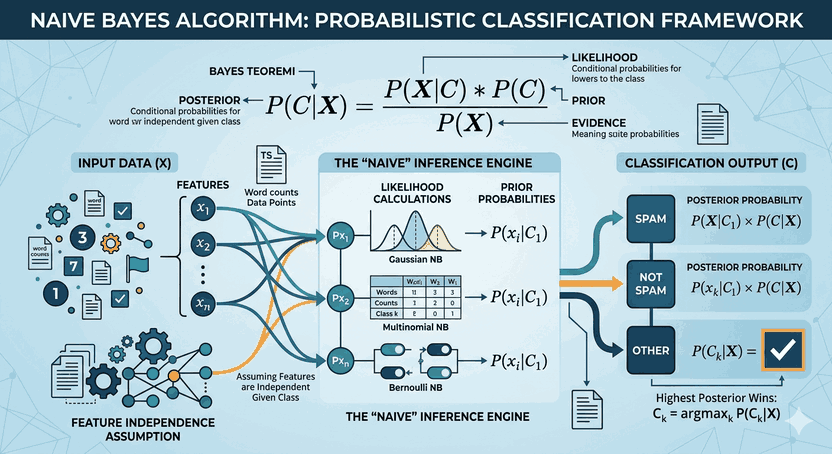
Theoretical Foundations and Application Strategies of the Naive Bayes Algorithm

Naive Bayes is a fast and effective probabilistic classification algorithm based on Bayes' Theorem that assumes full independence between features. It provides a strong foundation for problems such as text classification, spam filtering, and sentiment analysis, especially in high-dimensional datasets, with low computational cost.

ai naive-bayes bayes-theorem scikit-learn gaussian-naive-bayes multinomial-naive-bayes bernoulli-naive-bayes machine-learning deep-learning ai-engineering

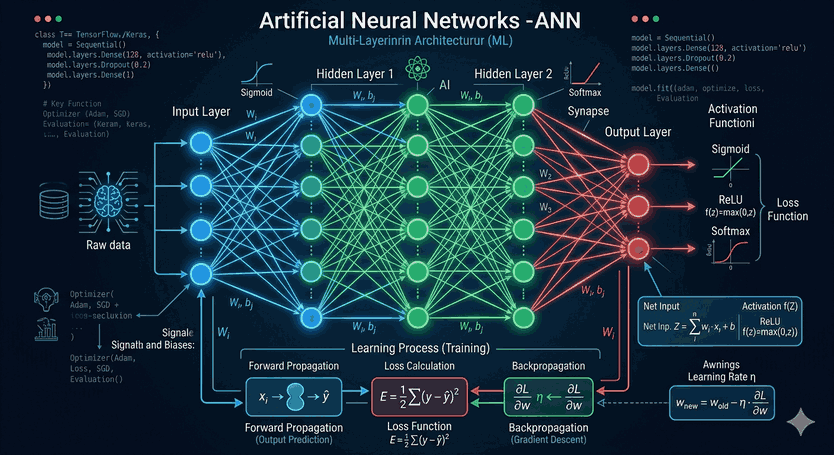
Artificial Neural Networks: A Journey from Biological Inspiration to Mathematical Architecture

A technical article detailing the biological foundations, advanced mathematical architecture, backpropagation algorithms, and deep learning optimization techniques of artificial neural networks, complete with Python code examples.

ai artificial-neural-networks deep-learning python ai-technologies nlp data-science machine-learning

Architectural Depth of Large Language Models: Alignment, Optimization, and Efficient Adaptation

[-Veri Analiz Okulu, Notes 11-] A deep technical article covering the alignment of Large Language Models (LLMs) with human feedback, their efficient adaptation via Low-Rank Adaptation (LoRA), and their optimization in distributed hardware architectures.

ai veri-analizi-okulu vao python llm rlhf nlp lora deep-learning ai-engineering machine-learning

The Neural Architecture of Modern Language Models and Their Evolution from Token-Level to Reasoning

[-Veri Analiz Okulu, Notes 10-] This article is a comprehensive examination covering the mathematical foundations of the Transformer architecture, the vectorial operations of attention mechanisms, and the processes by which large language models (LLMs) derive meaning from data with technical depth.

ai veri-analizi-okulu vao python transformer-architecture nlp llm tokenization attention-mechanism neural-networks ai-alignment pytorch machine-learning

The Anatomy of Modern Deep Learning: A Technical Journey from Gradients to Attention Mechanisms

[-Veri Analiz Okulu, Notes 9-] A technical article covering the mathematical background of backpropagation, CNNs, and attention mechanisms, which form the foundation of deep learning, along with optimization algorithms and modern architectural structures.

ai veri-analizi-okulu vao python back-propagation cnn transformer attention-mechanism pytorch machine-learning

Delicate Balances and Strategic Approaches in Modern Machine Learning

[-Veri Analiz Okulu, Notes 8-] This article analyzes the geometric optimization strategies of Support Vector Machines, the reward-oriented decision-making mechanisms of Reinforcement Learning, and the mathematical foundations of Markov Decision Processes with technical depth.

ai veri-analizi-okulu vao python svm deep-learning reinforcement-learning algorithm-analysis machine-learning

Engineering Analysis of Statistical Approaches and Ensemble Methods in Machine Learning

[-Veri Analiz Okulu, Notes 7-] A technical article analyzing the mathematical depth of Naive Bayes and Random Forest algorithms, based on Bayesian probability theory and ensemble learning methods, with model performance metrics.

ai veri-analizi-okulu vao python naive-bayes random-forest confusion-matrix python-coding statistical-learning algorithm-analysis machine-learning

Dimensionality Reduction Strategies and Algorithmic Depth in Machine Learning

[-Veri Analiz Okulu, Notes 6-] Examines PCA and LDA techniques used to reduce the complexity of high-dimensional data, covering their mathematical foundations, impact on classification performance, and in-depth Python-based technical implementation examples.

ai veri-analizi-okulu vao python dimensionality-reduction pca lda classification statistical-analysis data-science machine-learning

Modern Clustering and Classification Strategies in Machine Learning

[-Veri Analiz Okulu, Notes 5-] A comprehensive and technical article covering everything from linear classification models to K-means clustering algorithms, and from model optimization to regularization techniques that prevent overfitting.

ai veri-analizi-okulu vao python deep-learning kmeans clustering classification lloyd-algorithm data-science machine-learning

The Quest for Balance in Model Optimization: A Stability Analysis of Machine Learning from Underfitting to Overfitting

[-Veri Analiz Okulu, Notes 4-] This article examines the balance between model complexity and generalization capability in machine learning, exploring the concepts of underfitting and overfitting with technical depth.

ai veri-analizi-okulu vao python deep-learning model-fitting over-fitting under-fitting data-science machine-learning

The Layered Architecture and Algorithmic Depth of Machine Learning

[-Veri Analiz Okulu, Notes 2-] A technical and mathematical analysis of the hierarchical structure of machine learning, data processing layers, and fundamental learning paradigms (supervised, unsupervised, reinforcement).

ai veri-analizi-okulu vao python deep-learning reinforcement-learning data-science machine-learning

From Data Engineering to Cognitive Revolution: The Technical Anatomy of AI and Machine Learning

[-Veri Analiz Okulu, Notes 1-] This comprehensive technical review analyzes the evolutionary process of artificial intelligence, from rule-based expert systems to modern transformer architectures and generative networks, through biological analogies and practical application layers in the software world.

ai veri-analizi-okulu vao python deep-learning pytorch transformer data-science machine-learning

Advanced Analytical Modeling and Algorithmic Visualization Strategies in High-Dimensional Data Spaces

This is a technical guide for processing high-dimensional data with maximum efficiency using hardware-based memory optimization, advanced feature engineering, and algorithmic pipelines.

ai data-engineering big-data statistical-analysis data-mining algorithmic-visualization machine-learning

In-Depth Technical Analysis of AI Architecture and Development Processes

Explore AI development processes in-depth, from Transformer architecture to RAG systems, Onion Architecture integration, and Edge AI/TinyML optimizations. A comprehensive technical analysis supported by code examples and mathematical models.

ai data-engineering big-data ai-architecture transformer-architecture deep-learning machine-learning

The Digital Ontology of Data: A Deep Look from Binary Logic to Quantum Superposition

A technical examination of the transformation process of data from its raw form to strategic insight, viewed through the perspectives of deterministic systems, algorithmic depth, and computational social sciences.

ai data-science machine-learning computational-analysis quantum-computers nlp gis digital-transformation

Advanced Data Preprocessing and Engineering Architecture in Data Science

A technical examination of the transformation of data from raw form into a processed feature matrix in analytical modeling processes; a synthesis of statistical methodologies and computational techniques.

ai data-science machine-learning data-preprocessing feature-engineering statistical-analysis data-mining

Reinforcement Learning: Dynamic Decision Mechanisms and the Mathematics of Autonomous Systems

A technical guide detailing the mathematical foundations, deep architectures, and technical implementation methods of reinforcement learning, which optimizes optimal decision strategies through reward mechanisms in dynamic environments.

ai data-engineering big-data reinforcement-learning deep-learning python machine-learning

Engineering Architecture of Autonomous Systems: SLAM, Sensor Fusion, and Reinforcement Learning Processes

A comprehensive guide examining the technical depth of localization, data integration, and machine learning algorithms in robotic systems, along with C++ and Python implementations.

ai autonomous-systems big-data slam reinforcement-learning robotics robotics machine-learning

Modern Data Engineering: Scalable Pipeline Architectures and Analytical Transformation Strategies

A comprehensive guide to end-to-end high-performance data pipeline design, covering distributed computing engines, in-memory optimization techniques, and complex feature engineering processes.

ai data-engineering big-data statistical-analysis distributed-computing statistical-modeling machine-learning

In-Memory Computing and Low-Latency Data Processing Strategies in Modern Data Architectures

Optimizing performance at the hardware level in the data ecosystem: In-memory architectures, CPU cache hierarchy, and low-latency data processing techniques.

ai data-architecture memory-management low-latency system-design performance-optimization

Advanced Data Preprocessing and Algorithmic Optimization Strategies in Machine Learning Pipelines

A guide to maximizing model performance through advanced feature engineering, statistical imputation techniques, ensemble modeling strategies, and Bayesian optimization. Engineering discipline in data analytics using modern tools like SHAP and Isolation Forest.

ai data-engineering big-data data-analytics algorithm-optimization feature-engineering machine-learning

Advanced Data Science Strategies: Graph Analytics, Synthetic Data, and XAI Architectures

A comprehensive technical analysis of network theory, data generation techniques, and model transparency that provides depth in modern data analytics.

ai data-engineering big-data graph-analysis xai synthetic-data machine-learning

Unsupervised Learning: The Hidden Geometry of Data and Algorithmic Discovery Techniques

This article details methodologies used to extract meaningful patterns from unlabeled datasets, including clustering, dimensionality reduction, and anomaly detection, along with their mathematical foundations and modern software implementations.

ai data-engineering big-data unsupervised-learning pca clustering machine-learning

Mathematical Optimization and Applied Algorithm Strategies in Supervised Learning Architecture

A mathematical modeling method that learns a mapping function from labeled data consisting of input-output pairs, aiming to predict continuous or categorical values.

ai data-engineering supervised-learning algorithm python machine-learning