We use cookies and other tracking technologies to improve your browsing experience on our website, to show you personalized content and targeted ads, to analyze our website traffic, and to understand where our visitors are coming from.
⚠️
GDPR & Cookie Policy Notice
In accordance with data protection regulations; the use of mandatory cookies is required for the core functions of our website to operate, ensure data security, and perform analytics. If you reject the use of cookies, it is not possible to benefit from the services on our website due to technical limitations and data synchronization interruptions. You must consent to the use of cookies to access the content on our site.
Artificial Neural Networks: A Journey from Biological Inspiration to Mathematical Architecture
Artificial Neural Networks (ANN) are computational models at the heart of modern artificial intelligence that possess the ability to extract patterns from complex datasets by mimicking the neurophysiological structure of the human brain. While traditional algorithms are based on specific rule sets, neural networks learn by experiencing data.
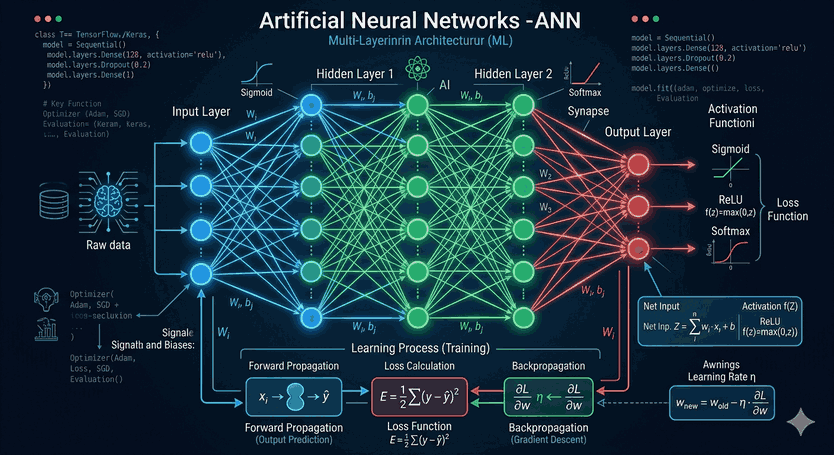
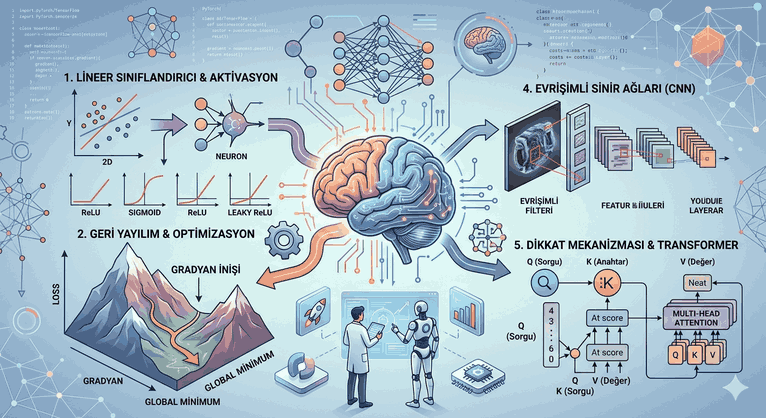
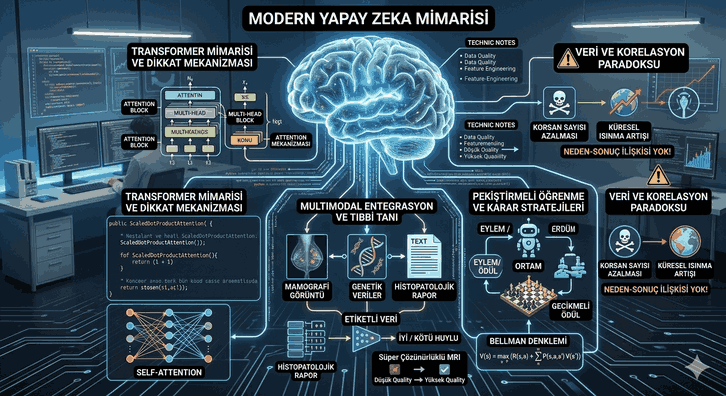
Figure 1: Artificial Neural Networks: A Journey from Biological Inspiration to Mathematical Architecture.
1. Architectural Components of Artificial Neural Networks
An artificial neural network consists of interconnected layers and nodes (neurons) within these layers. This structure can be thought of as a “directed graph” that manages the flow and transformation of information.
Layer Structures
Input Layer: The point where data enters the network. The number of neurons here is equal to the number of features in the dataset.
Hidden Layers: The layers where the network performs the actual “learning” process and where non-linear transformations on the input data are executed. As the number of layers increases, the network becomes “deeper” (Deep Learning).
Output Layer: The layer where the network produces its final prediction. In regression problems, there is typically a single neuron, while in classification problems, there are as many neurons as the number of classes.
2. Mathematics of a Single Neuron
An artificial neuron weights the incoming signals and subjects them to a summation process. This process is expressed with the following formula:
$$z = \sum_{i=1}^{n} (w_i \cdot x_i) + b$$
Where;
$x_i$: Input signal,
$w_i$: Weight (the degree of importance of the signal),
$b$: Bias (a constant value that increases the model’s flexibility),
$z$: The net input sum.
Activation Functions: The Power of Non-Linearity
If there were no activation functions, a neural network, no matter how many layers it had, would remain just a linear regression model. Activation functions provide the network with the ability to learn complex structures.
Sigmoid: Compresses the output between $[0, 1]$. It is rarely preferred in modern deep networks due to the vanishing gradient problem.
$$\sigma(z) = \frac{1}{1 + e^{-z}}$$
ReLU (Rectified Linear Unit): The standard for modern networks. It zeroes out negative values and passes positive values as they are. Its computational cost is low.
$$f(z) = \max(0, z)$$
Softmax: Used in the output layer for multi-class classification problems. It provides a probabilistic distribution by equating the sum of the outputs to 1.
3. Training Process: Forward and Backpropagation
Training a neural network is the process of finding the weight ($w$) and bias ($b$) values that will minimize the Loss Function.
Forward Propagation
Data enters through the input layer, is multiplied by weights, passes through activation functions, and reaches the output layer. A prediction ($\hat{y}$) is produced here.
Loss Calculation
The difference between the predicted value and the actual value is calculated. Popular functions include:
MSE (Mean Squared Error): For regression.
Cross-Entropy Loss: For classification.
Backpropagation and Gradient Descent
The error is distributed from the end of the network to the beginning using the chain rule. The contribution of each weight to the error (derivative/gradient) is calculated.
Here, $\eta$ (learning rate) represents the speed of learning.
4. Technical Implementation with Python: MNIST Digit Classification
The following code block represents a deep neural network architecture that trains on the MNIST dataset consisting of 60,000 handwritten digits using the TensorFlow/Keras library.
import tensorflow as tf
from tensorflow.keras import layers, models
defbuild_deep_model():
# Defining the model architecture model = models.Sequential([
# Flattening 28x28 pixel image (784 inputs) layers.Flatten(input_shape=(28, 28)),
# First hidden layer: 128 neurons, ReLU activation layers.Dense(128, activation='relu'),
# Dropout to prevent overfitting (randomly disabling neurons) layers.Dropout(0.2),
# Second hidden layer: 64 neurons layers.Dense(64, activation='relu'),
# Output layer: Softmax for 10 digits (0-9) layers.Dense(10, activation='softmax')
])
# Compiling the model (Optimizer and Loss selection) model.compile(optimizer='adam',
loss='sparse_categorical_crossentropy',
metrics=['accuracy'])
return model
# Loading the dataset(x_train, y_train), (x_test, y_test) = tf.keras.datasets.mnist.load_data()
x_train, x_test = x_train /255.0, x_test /255.0# Normalizationmodel = build_deep_model()
# Training processmodel.fit(x_train, y_train, epochs=10, batch_size=32, validation_split=0.1)
# Performance evaluationtest_loss, test_acc = model.evaluate(x_test, y_test)
print(f"Test Accuracy: {test_acc:.4f}")
5. Natural Language Processing (NLP) and Sentiment Analysis
Text data is unstructured by nature. ANNs use Word Embeddings techniques to process text, which convert words into high-dimensional vectors.
Advanced Techniques That Increase Success in NLP
Tokenization & Lemmatization: Breaking down text into parts and reducing words to their roots.
Recurrent Neural Networks (RNN) & LSTM: Used to preserve the sequential structure (sentence flow) in data. Thanks to memory cells, they do not lose the meaning connection in long sentences.
Attention Mechanism: Allows the model to focus on the most important words within a sentence.
6. Strategies for Optimizing Model Performance
A professional AI engineer applies the following techniques to ensure that the model is successful not only on training data but also on real-world data:
Hyperparameter Optimization
Learning Rate: If it is too high, it causes the model to diverge from the target; if it is too low, the training may not finish.
Batch Size: The amount of data presented to the model in each update. Usually chosen as 32, 64, or 128.
Regularization
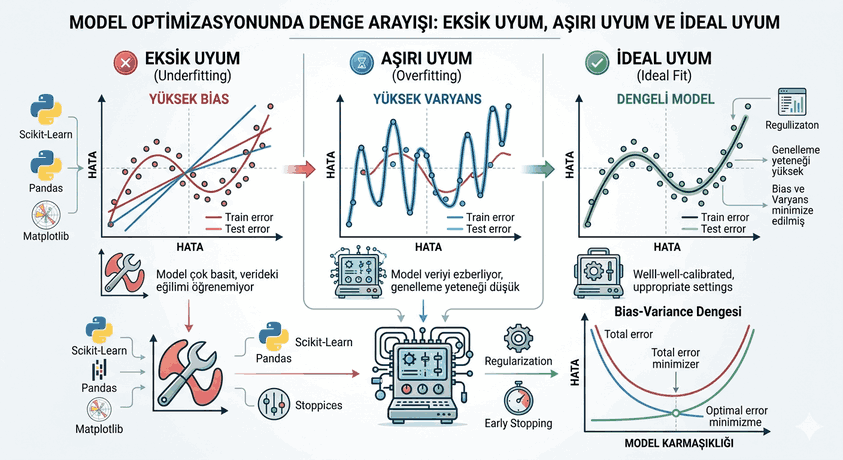
Used to prevent the network from memorizing the training data (Overfitting):
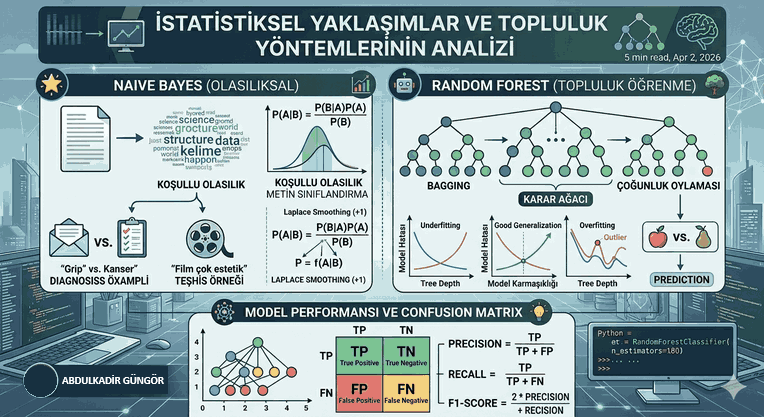
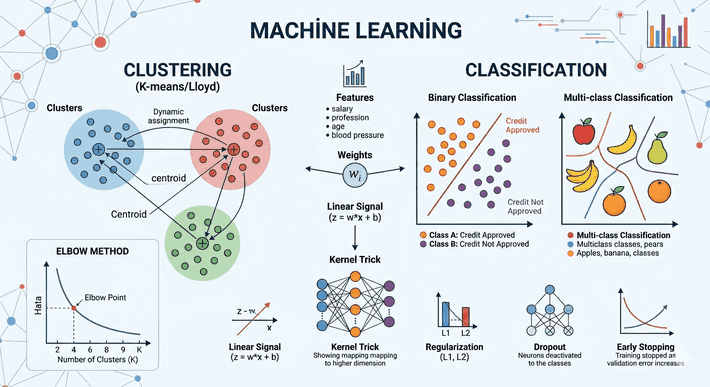
L1/L2 Regularization: Penalizes large weight values.
Dropout: Disconnects randomly selected neurons during training so the network does not depend on specific neurons.
Early Stopping: Automatically stops training when the validation error starts to increase.
7. Real-World Applications and Industrial Use
Computer Vision: Object detection in autonomous vehicles, tumor diagnosis in medical imaging (MRI, X-ray). CNN (Convolutional Neural Networks) architectures are typically used here.
Financial Forecasting: Analysis of stock market movements and credit risk scoring.
Recommendation Systems: Presenting content based on user behavior on e-commerce and streaming platforms (Netflix, Amazon).
Biometric Security: Face recognition and fingerprint matching systems.
Technical Notes
Note 1: Deep learning models can be trained 10 to 100 times faster than on a CPU by performing parallel computing on a GPU (Graphics Processing Unit).
Note 2: Data normalization (scaling to the range $[0, 1]$ or $[-1, 1]$) allows the gradient descent algorithm to converge much faster.
Note 3: With the Transfer Learning technique, you can save time and resources by customizing pre-trained models on massive datasets (like ImageNet) for your own small dataset.
Artificial neural networks are not just a pile of mathematical formulas, but a dynamic architecture that discovers the hidden hierarchy within data. Today’s simple ANN structures are the fundamental building block on the road to tomorrow’s artificial general intelligence (AGI).