Reinforcement Learning: Dynamic Decision Mechanisms and the Mathematics of Autonomous Systems

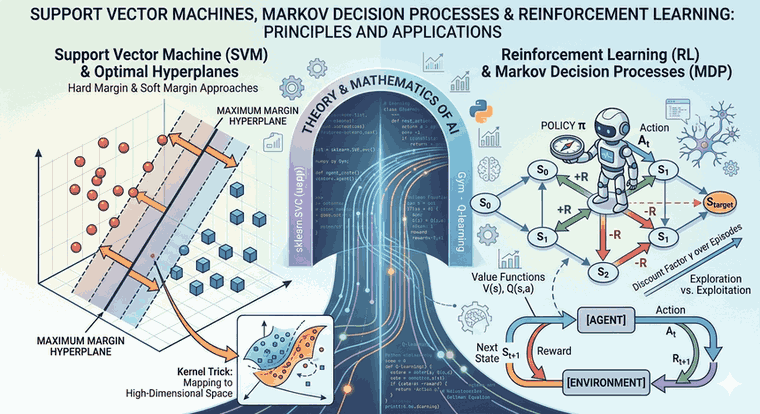
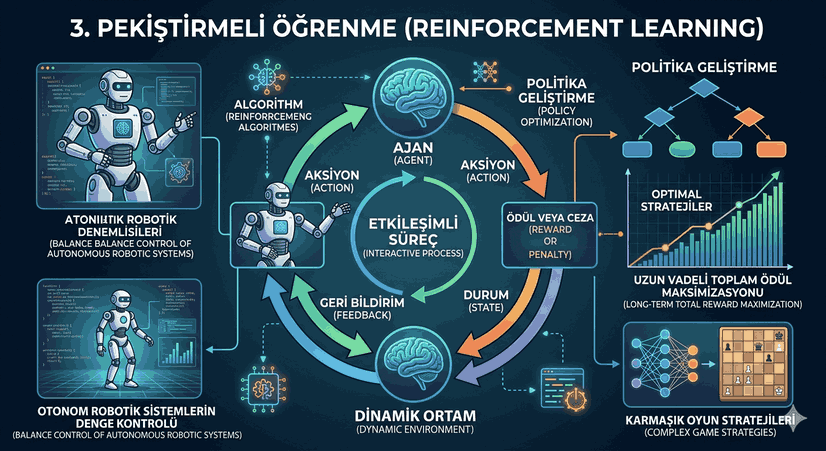
Reinforcement Learning (RL) is a discipline in the machine learning hierarchy that is sharply distinguished from supervised and unsupervised learning, based on the “trial-and-error” mechanism in behavioral psychology. Rather than recognizing patterns in static datasets, RL optimizes the sequence of actions an agent takes in an uncertain environment to maximize cumulative reward.

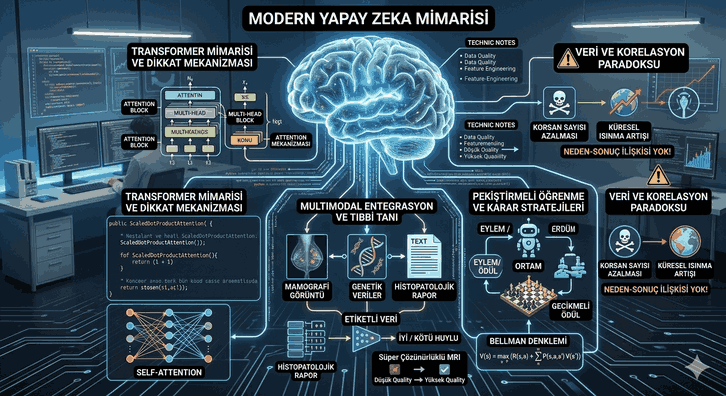
Reinforcement Learning: Dynamic Decision Mechanisms and the Mathematics of Autonomous Systems

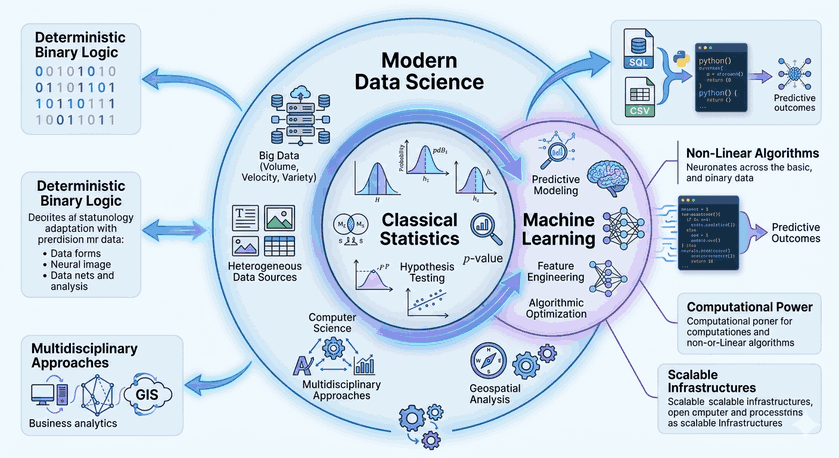
Figure 1: Reinforcement Learning: Dynamic Decision Mechanisms and the Mathematics of Autonomous Systems.


RL Fundamentals and Markov Decision Processes (MDP)

The mathematical skeleton of reinforcement learning is formed by Markov Decision Processes (MDP). An RL problem is generally defined by a quintuple $(S, A, P, R, \gamma)$:

  • S (State Space): The set of all possible states the agent can be in.
  • A (Action Space): All actions the agent can perform in a state.
  • P (Transition Probability): The probability of transitioning to state $s'$ when taking action $a$ in state $s$, denoted as $P(s' | s, a)$.
  • R (Reward Function): The immediate feedback received after a transition, $R(s, a, s')$.
  • $\gamma$ (Discount Factor): The coefficient determining the present value of future rewards ($0 \le \gamma \le 1$).

The agent’s primary goal is to develop a Policy ($\pi$) that dictates which action is best for every state. In this process, Value Functions ($V$) and Action-Value Functions ($Q$) are used to estimate the agent’s long-term success.

Policy Optimization and Gradient Methods

In the RL world, solutions generally fall into two main branches: Value-based and Policy-based methods. Policy optimization aims to model the agent’s behavior directly through a set of parameters ($\theta$).

The core logic here is to find the values of $\theta$ that maximize the expected total reward $J(\theta)$. Policy Gradient algorithms update parameters by calculating the gradient of this function:

$$\nabla_{\theta} J(\theta) = E_{\pi_{\theta}} [\nabla_{\theta} \log \pi_{\theta}(a|s) Q^{\pi_{\theta}}(s, a)]$$

This approach yields much more stable results in continuous action spaces (e.g., the precise angle of a robotic arm) compared to traditional Q-Learning methods.


Deep Reinforcement Learning (Deep RL) and Architectural Structures

Traditional RL methods encounter the “curse of dimensionality” when the state space grows. In modern systems, this is overcome by using Convolutional Neural Networks (CNN) or Recurrent Neural Networks (RNN) as function approximators.

Deep Q-Networks (DQN)

DQN combines the classic Q-Learning algorithm with deep neural networks. It uses two critical techniques to ensure training stability:

  1. Experience Replay: The agent stores its past experiences in a memory pool and trains by sampling randomly.
  2. Target Network: The network used to calculate target Q-values is updated at regular intervals.

Actor-Critic Models

This hybrid architecture features two different structures:

  • Actor: Updates the policy (decides which action to take).
  • Critic: Estimates the value of the taken action (evaluates the action).

Modern algorithms such as PPO (Proximal Policy Optimization) and SAC (Soft Actor-Critic) have become the standard in autonomous driving and robotic balance control by using this structure.


Software Ecosystem and Implementation Libraries

Libraries that have become industry standards for developing RL projects include:

  1. OpenAI Gymnasium: Standard API for environment interfaces.
  2. Stable Baselines3: Reliable RL algorithm implementations based on PyTorch.
  3. Ray Rllib: Production-level tools for scalable, distributed RL training.
  4. PyBullet / MuJoCo: Physics-based simulation engines.

Technical Implementation: A Basic Q-Learning Algorithm (Python)

Below is the raw Python implementation of a Q-Learning mechanism that enables an agent to find the optimal route in a simple environment (GridWorld):

import numpy as np
import random

class QLearningAgent:
    def __init__(self, states_n, actions_n, lr=0.1, gamma=0.95, epsilon=0.1):
        # Initialization of the Q-table (State x Action)
        self.q_table = np.zeros((states_n, actions_n))
        self.lr = lr          # Learning rate (Alpha)
        self.gamma = gamma    # Discount factor
        self.epsilon = epsilon # Exploration rate

    def choose_action(self, state):
        # Epsilon-greedy strategy
        if random.uniform(0, 1) < self.epsilon:
            return random.randint(0, self.q_table.shape[1] - 1) # Exploration
        else:
            return np.argmax(self.q_table[state]) # Exploitation

    def learn(self, state, action, reward, next_state):
        # Updating the Q-value according to the Bellman Equation
        old_value = self.q_table[state, action]
        next_max = np.max(self.q_table[next_state])
        
        # Q(s,a) = (1-alpha)*Q(s,a) + alpha*(R + gamma * max Q(s',a'))
        new_value = (1 - self.lr) * old_value + self.lr * (reward + self.gamma * next_max)
        self.q_table[state, action] = new_value

# Example usage scenario (Pseudo-Environment)
states_count = 16 # 4x4 Grid
actions_count = 4 # Up, Down, Right, Left
agent = QLearningAgent(states_count, actions_count)

# Training Loop (Episode Loop)
for episode in range(1000):
    state = 0 # Starting point
    done = False
    while not done:
        action = agent.choose_action(state)
        # Responses from the environment (Simulated)
        next_state = random.randint(0, 15) 
        reward = 1 if next_state == 15 else -0.1
        done = True if next_state == 15 else False
        
        agent.learn(state, action, reward, next_state)
        state = next_state

Balance Control and Robotics in Autonomous Systems

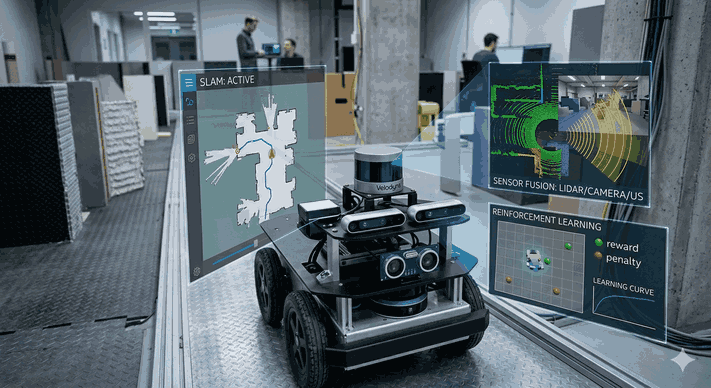
Reinforcement learning plays a critical role in high-degree-of-freedom (DoF) systems where classical control theory (such as PID or LQR) is insufficient.

  • Inverted Pendulum: The RL agent learns to keep the system balanced by adjusting torque values through continuous data streams.
  • Bipedal Walking: The relationship between joint angles, ground friction, and center of gravity of the robot is optimized with millions of simulation steps (massively parallel simulation).

Important Note: The “Sim-to-Real” problem is the biggest obstacle in transferring RL models to real physical hardware. Domain Randomization techniques are used to bridge the gap between perfect physics in simulation and sensor noise in the real world.


Advanced Concepts: Exploration vs. Exploitation Dilemma

One of the greatest challenges of RL is the balance between whether the agent should follow the best path it knows (Exploitation) or try new things in the hope of finding a better path (Exploration).

  • Upper Confidence Bound (UCB): Incorporates uncertainty into the reward function to encourage the agent to visit less-frequented states.
  • Entropy Regularization: An entropy term is added to the cost function to prevent the policy from collapsing into a single action at too early a stage.

The Dynamic Nature of Data Flow

In static deep learning, the dataset is fixed and training iterates over this data. In RL, however, Data is Generated by the Agent’s Own Policy. If the agent follows a poor policy, the data it collects will also be of poor quality. This “positive feedback loop” makes the training of RL systems quite sensitive and sometimes unstable. Therefore, hyperparameter optimization (learning rate, discount factor, batch size) is the key to success in RL projects.

Conclusion and Future Projection

Reinforcement learning is transforming artificial intelligence from being merely a “prediction tool” into a “decision-making” actor. The successes we see today in game strategies (AlphaGo, Dota 2 OpenAI Five) will form the basis for the management of energy grids, high-frequency financial transactions, and autonomous surgical robots tomorrow. As technical depth increases, issues such as sample efficiency and safe RL will remain the focus of research.

#ai #data-engineering #big-data #reinforcement-learning #deep-learning #python #machine-learning

Related Contents

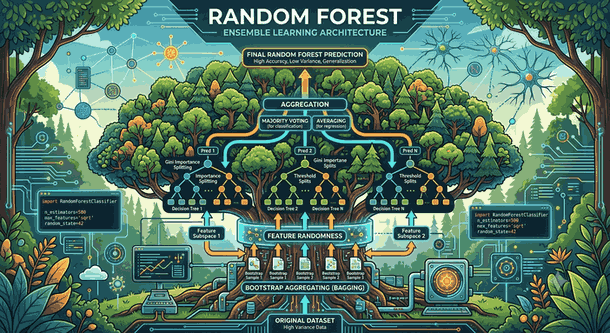
Technical Architecture and Implementation Principles of the Random Forest Algorithm

Random Forest is a powerful "Ensemble Learning" algorithm that achieves more stable and high-accuracy results by combining the predictions of numerous "Decision Tree" structures. By utilizing "Bagging" and "Feature Randomness" techniques, it minimizes the "overfitting" tendency of a single tree; thus, it is a "robust" model that exhibits high "generalization" success even with noisy data and does not require scaling.

ai machine-learning random-forest python decision-tree ensemble-learning supervised-learning feature-importance hyperparameter-tuning artificial-intelligence deep-learning ai-engineering

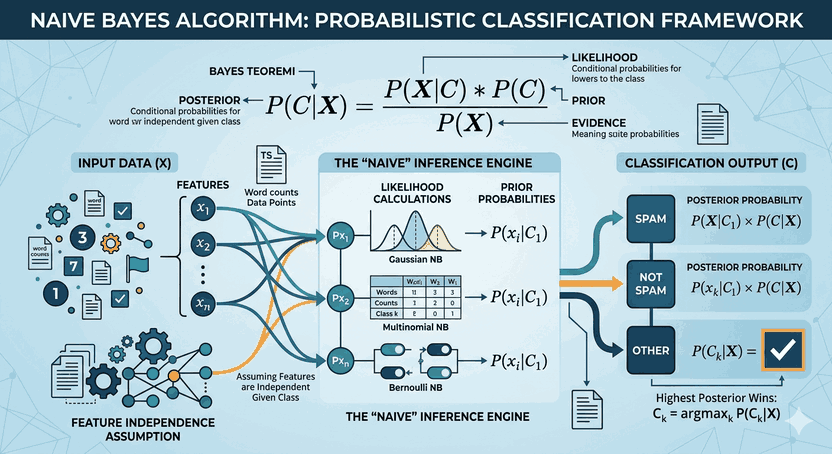
Theoretical Foundations and Application Strategies of the Naive Bayes Algorithm

Naive Bayes is a fast and effective probabilistic classification algorithm based on Bayes' Theorem that assumes full independence between features. It provides a strong foundation for problems such as text classification, spam filtering, and sentiment analysis, especially in high-dimensional datasets, with low computational cost.

ai naive-bayes bayes-theorem scikit-learn gaussian-naive-bayes multinomial-naive-bayes bernoulli-naive-bayes machine-learning deep-learning ai-engineering

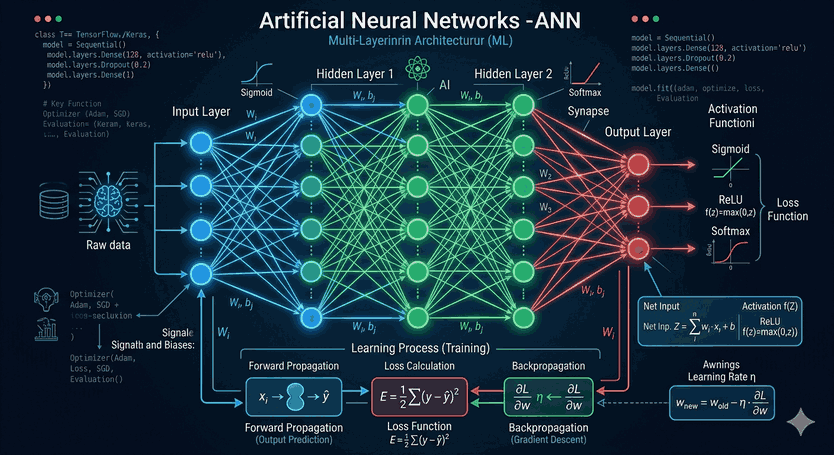
Artificial Neural Networks: A Journey from Biological Inspiration to Mathematical Architecture

A technical article detailing the biological foundations, advanced mathematical architecture, backpropagation algorithms, and deep learning optimization techniques of artificial neural networks, complete with Python code examples.

ai artificial-neural-networks deep-learning python ai-technologies nlp data-science machine-learning

Architectural Depth of Large Language Models: Alignment, Optimization, and Efficient Adaptation

[-Veri Analiz Okulu, Notes 11-] A deep technical article covering the alignment of Large Language Models (LLMs) with human feedback, their efficient adaptation via Low-Rank Adaptation (LoRA), and their optimization in distributed hardware architectures.

ai veri-analizi-okulu vao python llm rlhf nlp lora deep-learning ai-engineering machine-learning

The Neural Architecture of Modern Language Models and Their Evolution from Token-Level to Reasoning

[-Veri Analiz Okulu, Notes 10-] This article is a comprehensive examination covering the mathematical foundations of the Transformer architecture, the vectorial operations of attention mechanisms, and the processes by which large language models (LLMs) derive meaning from data with technical depth.

ai veri-analizi-okulu vao python transformer-architecture nlp llm tokenization attention-mechanism neural-networks ai-alignment pytorch machine-learning

The Anatomy of Modern Deep Learning: A Technical Journey from Gradients to Attention Mechanisms

[-Veri Analiz Okulu, Notes 9-] A technical article covering the mathematical background of backpropagation, CNNs, and attention mechanisms, which form the foundation of deep learning, along with optimization algorithms and modern architectural structures.

ai veri-analizi-okulu vao python back-propagation cnn transformer attention-mechanism pytorch machine-learning

Delicate Balances and Strategic Approaches in Modern Machine Learning

[-Veri Analiz Okulu, Notes 8-] This article analyzes the geometric optimization strategies of Support Vector Machines, the reward-oriented decision-making mechanisms of Reinforcement Learning, and the mathematical foundations of Markov Decision Processes with technical depth.

ai veri-analizi-okulu vao python svm deep-learning reinforcement-learning algorithm-analysis machine-learning

Engineering Analysis of Statistical Approaches and Ensemble Methods in Machine Learning

[-Veri Analiz Okulu, Notes 7-] A technical article analyzing the mathematical depth of Naive Bayes and Random Forest algorithms, based on Bayesian probability theory and ensemble learning methods, with model performance metrics.

ai veri-analizi-okulu vao python naive-bayes random-forest confusion-matrix python-coding statistical-learning algorithm-analysis machine-learning

Dimensionality Reduction Strategies and Algorithmic Depth in Machine Learning

[-Veri Analiz Okulu, Notes 6-] Examines PCA and LDA techniques used to reduce the complexity of high-dimensional data, covering their mathematical foundations, impact on classification performance, and in-depth Python-based technical implementation examples.

ai veri-analizi-okulu vao python dimensionality-reduction pca lda classification statistical-analysis data-science machine-learning

Modern Clustering and Classification Strategies in Machine Learning

[-Veri Analiz Okulu, Notes 5-] A comprehensive and technical article covering everything from linear classification models to K-means clustering algorithms, and from model optimization to regularization techniques that prevent overfitting.

ai veri-analizi-okulu vao python deep-learning kmeans clustering classification lloyd-algorithm data-science machine-learning

The Quest for Balance in Model Optimization: A Stability Analysis of Machine Learning from Underfitting to Overfitting

[-Veri Analiz Okulu, Notes 4-] This article examines the balance between model complexity and generalization capability in machine learning, exploring the concepts of underfitting and overfitting with technical depth.

ai veri-analizi-okulu vao python deep-learning model-fitting over-fitting under-fitting data-science machine-learning

Architectural Foundations and Algorithmic Strategies of Modern Artificial Intelligence

[-Veri Analiz Okulu, Notes 3-] A technical paper on the attention mechanism of the Transformer architecture, multimodal data integration, and the mathematical decision strategies of reinforcement learning.

ai veri-analizi-okulu vao python deep-learning transformer-architecture multi-modal-ai bellman-equation data-science machine-learning

The Layered Architecture and Algorithmic Depth of Machine Learning

[-Veri Analiz Okulu, Notes 2-] A technical and mathematical analysis of the hierarchical structure of machine learning, data processing layers, and fundamental learning paradigms (supervised, unsupervised, reinforcement).

ai veri-analizi-okulu vao python deep-learning reinforcement-learning data-science machine-learning

From Data Engineering to Cognitive Revolution: The Technical Anatomy of AI and Machine Learning

[-Veri Analiz Okulu, Notes 1-] This comprehensive technical review analyzes the evolutionary process of artificial intelligence, from rule-based expert systems to modern transformer architectures and generative networks, through biological analogies and practical application layers in the software world.

ai veri-analizi-okulu vao python deep-learning pytorch transformer data-science machine-learning

Advanced Analytical Modeling and Algorithmic Visualization Strategies in High-Dimensional Data Spaces

This is a technical guide for processing high-dimensional data with maximum efficiency using hardware-based memory optimization, advanced feature engineering, and algorithmic pipelines.

ai data-engineering big-data statistical-analysis data-mining algorithmic-visualization machine-learning

In-Depth Technical Analysis of AI Architecture and Development Processes

Explore AI development processes in-depth, from Transformer architecture to RAG systems, Onion Architecture integration, and Edge AI/TinyML optimizations. A comprehensive technical analysis supported by code examples and mathematical models.

ai data-engineering big-data ai-architecture transformer-architecture deep-learning machine-learning

The Digital Ontology of Data: A Deep Look from Binary Logic to Quantum Superposition

A technical examination of the transformation process of data from its raw form to strategic insight, viewed through the perspectives of deterministic systems, algorithmic depth, and computational social sciences.

ai data-science machine-learning computational-analysis quantum-computers nlp gis digital-transformation

Advanced Data Preprocessing and Engineering Architecture in Data Science

A technical examination of the transformation of data from raw form into a processed feature matrix in analytical modeling processes; a synthesis of statistical methodologies and computational techniques.

ai data-science machine-learning data-preprocessing feature-engineering statistical-analysis data-mining

Engineering Architecture of Autonomous Systems: SLAM, Sensor Fusion, and Reinforcement Learning Processes

A comprehensive guide examining the technical depth of localization, data integration, and machine learning algorithms in robotic systems, along with C++ and Python implementations.

ai autonomous-systems big-data slam reinforcement-learning robotics robotics machine-learning

Modern Data Engineering: Scalable Pipeline Architectures and Analytical Transformation Strategies

A comprehensive guide to end-to-end high-performance data pipeline design, covering distributed computing engines, in-memory optimization techniques, and complex feature engineering processes.

ai data-engineering big-data statistical-analysis distributed-computing statistical-modeling machine-learning

In-Memory Computing and Low-Latency Data Processing Strategies in Modern Data Architectures

Optimizing performance at the hardware level in the data ecosystem: In-memory architectures, CPU cache hierarchy, and low-latency data processing techniques.

ai data-architecture memory-management low-latency system-design performance-optimization

Advanced Data Preprocessing and Algorithmic Optimization Strategies in Machine Learning Pipelines

A guide to maximizing model performance through advanced feature engineering, statistical imputation techniques, ensemble modeling strategies, and Bayesian optimization. Engineering discipline in data analytics using modern tools like SHAP and Isolation Forest.

ai data-engineering big-data data-analytics algorithm-optimization feature-engineering machine-learning

Advanced Data Science Strategies: Graph Analytics, Synthetic Data, and XAI Architectures

A comprehensive technical analysis of network theory, data generation techniques, and model transparency that provides depth in modern data analytics.

ai data-engineering big-data graph-analysis xai synthetic-data machine-learning

Unsupervised Learning: The Hidden Geometry of Data and Algorithmic Discovery Techniques

This article details methodologies used to extract meaningful patterns from unlabeled datasets, including clustering, dimensionality reduction, and anomaly detection, along with their mathematical foundations and modern software implementations.

ai data-engineering big-data unsupervised-learning pca clustering machine-learning

Mathematical Optimization and Applied Algorithm Strategies in Supervised Learning Architecture

A mathematical modeling method that learns a mapping function from labeled data consisting of input-output pairs, aiming to predict continuous or categorical values.

ai data-engineering supervised-learning algorithm python machine-learning