Technical Architecture and Implementation Principles of the Random Forest Algorithm

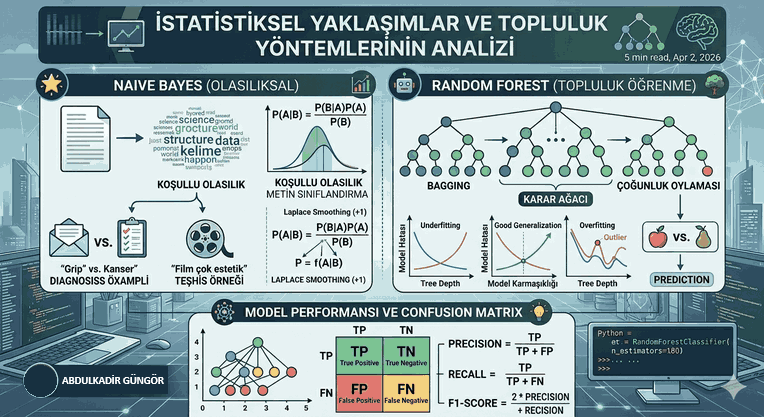
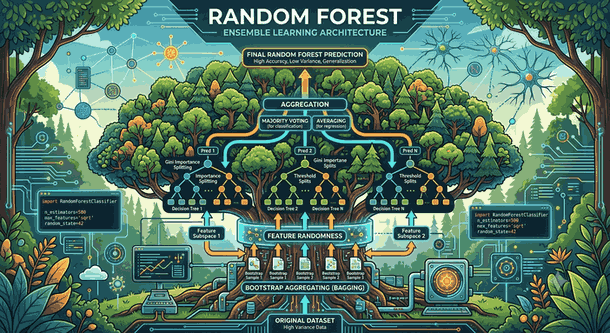
Within the “Ensemble Learning” framework of machine learning literature, Random Forest is a “supervised learning” algorithm that demonstrates high “generalization” capacity in both “classification” and “regression” tasks. The algorithm basically builds a forest of “Decision Trees.” However, this forest is not just a collection of ordinary trees; it is a statistically low-correlation structure where each tree is trained on different subsets of data and different “feature” groups.

Technical Architecture and Implementation Principles of the Random Forest Algorithm

Figure 1: Technical Architecture and Implementation Principles of the Random Forest Algorithm.


Transition from Decision Tree Structure to Ensemble Architecture

A single “Decision Tree” is quite vulnerable to variance in the dataset; that is, small changes in the training data can lead to dramatic fractures in the model’s structure. Random Forest minimizes this “high variance” problem with two fundamental statistical methods:

  1. Bootstrap Aggregating (Bagging): Different “subsets” are created by taking samples with replacement from the training dataset. This allows the model to gain a “robust” structure by being trained on different data.
  2. Feature Randomness (Feature Subspace): The “splitting” process to be performed at each “node” of each tree is done not over all “features,” but over a randomly selected “subspace.” This reduces the “correlation” between trees and increases the forest’s total predictive power.

Mathematical Framework and Variance Reduction

The power of the Random Forest algorithm is fixed by statistical laws. If we have $N$ number of “Decision Trees” and each has a variance of $\sigma^2$, the theoretical variance when these trees are averaged is:

$$\text{Var}(\text{Forest}) = \rho \sigma^2 + \frac{1 - \rho}{N} \sigma^2$$

Here, $\rho$ is the “correlation coefficient” between the trees. Random Forest minimizes the total variance by reducing the $\rho$ value through “feature randomness.” As the number of “estimators” ($N$) increases, the variance decreases, but after a point, due to the law of “diminishing returns,” the computational cost exceeds the performance gain.


Technical Application and Implementation with Python

In modern “data science” processes, the scikit-learn library offers this algorithm with high performance through the RandomForestClassifier and RandomForestRegressor classes. The code block below demonstrates the structuring of the model on a high-dimensional dataset and the basis of the “hyperparameter tuning” process.

import numpy as np
from sklearn.ensemble import RandomForestClassifier
from sklearn.model_selection import train_test_split

# Preparation of training data
# n_estimators: Number of trees in the forest
# criterion: 'gini' or 'entropy' (information gain criterion)
# max_features: Maximum number of features to be evaluated at each node
rf_model = RandomForestClassifier(
    n_estimators=500,
    criterion='gini',
    max_depth=None,
    min_samples_split=2,
    min_samples_leaf=1,
    max_features='sqrt',
    bootstrap=True,
    n_jobs=-1,  # Parallel processor usage
    random_state=42
)

# Training the model
rf_model.fit(X_train, y_train)

# Prediction performance of the model
accuracy = rf_model.score(X_test, y_test)
print(f"Model Accuracy: {accuracy:.4f}")

Hyperparameter Optimization and Model Dynamics

The success of the Random Forest algorithm depends on the correct configuration of “hyperparameter” values. The most critical settings are as follows:

  • n_estimators: The number of trees. It is generally chosen between 100 and 1000. More trees increase “training” time linearly but improve the “stability” rate of the model.
  • max_features: The number of “features” selected to split a “node.” It is recommended to start with $\sqrt{\text{total\_features}}$ for “classification” and generally $\text{total\_features}/3$ for “regression.”
  • min_samples_leaf: The minimum number of samples that must be in the leaves. Increasing this value prevents the model from focusing on details (“noise”), thereby reducing the risk of “overfitting” (regularization effect).

Feature Importance

One area where Random Forest provides “white-box” like transparency is the degree of importance of variables. The algorithm calculates how effective each “feature” value is on the target variable by summing the “Gini impurity” drops at the nodes of each tree.

import pandas as pd
import matplotlib.pyplot as plt

# Extracting importance degrees
importances = rf_model.feature_importances_
indices = np.argsort(importances)[::-1]

# Visualization
plt.figure(figsize=(10, 6))
plt.title("Feature Importances")
plt.bar(range(X_train.shape[1]), importances[indices])
plt.show()

Operational Advantages and Limitations

The Random Forest algorithm owes the reasons it is widely preferred at an industrial scale to its low “preprocessing” requirement.

Important Note: Random Forest does not require a “scaling” (Normalization/Standardization) process for data. This is because “Decision Tree” structures fundamentally make decisions based on “threshold” values according to “if-else” logic; the distribution of the data does not directly affect this logic.

Feature Technical Impact
Outlier Resilience Since it is tree-based, it is minimally affected by extreme values.
Non-linearity It successfully captures non-linear relationships in data with “node” splits.
Memory Complexity A large number of trees can lead to high RAM consumption.
Inference Latency A large number of trees can cause slowness in the “inference” stage.

Conclusion

Random Forest successfully establishes the balance between “bias” and “variance” thanks to the “Bagging” strategy. However, today, “Gradient Boosting”-based algorithms such as XGBoost, LightGBM, and CatBoost have pushed the performance limits of Random Forest further. Nevertheless, the model’s level of “interpretability” and high tolerance for “noisy data” make it an indispensable “baseline” model in “data science pipeline” structures.

#ai #machine-learning #random-forest #python #decision-tree #ensemble-learning #supervised-learning #feature-importance #hyperparameter-tuning #artificial-intelligence #deep-learning #ai-engineering

Related Contents

Theoretical Foundations and Application Strategies of the Naive Bayes Algorithm

Naive Bayes is a fast and effective probabilistic classification algorithm based on Bayes' Theorem that assumes full independence between features. It provides a strong foundation for problems such as text classification, spam filtering, and sentiment analysis, especially in high-dimensional datasets, with low computational cost.

ai naive-bayes bayes-theorem scikit-learn gaussian-naive-bayes multinomial-naive-bayes bernoulli-naive-bayes machine-learning deep-learning ai-engineering

Artificial Neural Networks: A Journey from Biological Inspiration to Mathematical Architecture

A technical article detailing the biological foundations, advanced mathematical architecture, backpropagation algorithms, and deep learning optimization techniques of artificial neural networks, complete with Python code examples.

ai artificial-neural-networks deep-learning python ai-technologies nlp data-science machine-learning

Architectural Depth of Large Language Models: Alignment, Optimization, and Efficient Adaptation

[-Veri Analiz Okulu, Notes 11-] A deep technical article covering the alignment of Large Language Models (LLMs) with human feedback, their efficient adaptation via Low-Rank Adaptation (LoRA), and their optimization in distributed hardware architectures.

ai veri-analizi-okulu vao python llm rlhf nlp lora deep-learning ai-engineering machine-learning

The Neural Architecture of Modern Language Models and Their Evolution from Token-Level to Reasoning

[-Veri Analiz Okulu, Notes 10-] This article is a comprehensive examination covering the mathematical foundations of the Transformer architecture, the vectorial operations of attention mechanisms, and the processes by which large language models (LLMs) derive meaning from data with technical depth.

ai veri-analizi-okulu vao python transformer-architecture nlp llm tokenization attention-mechanism neural-networks ai-alignment pytorch machine-learning

The Anatomy of Modern Deep Learning: A Technical Journey from Gradients to Attention Mechanisms

[-Veri Analiz Okulu, Notes 9-] A technical article covering the mathematical background of backpropagation, CNNs, and attention mechanisms, which form the foundation of deep learning, along with optimization algorithms and modern architectural structures.
ai veri-analizi-okulu vao python back-propagation cnn transformer attention-mechanism pytorch machine-learning

Delicate Balances and Strategic Approaches in Modern Machine Learning

[-Veri Analiz Okulu, Notes 8-] This article analyzes the geometric optimization strategies of Support Vector Machines, the reward-oriented decision-making mechanisms of Reinforcement Learning, and the mathematical foundations of Markov Decision Processes with technical depth.

ai veri-analizi-okulu vao python svm deep-learning reinforcement-learning algorithm-analysis machine-learning

Engineering Analysis of Statistical Approaches and Ensemble Methods in Machine Learning

[-Veri Analiz Okulu, Notes 7-] A technical article analyzing the mathematical depth of Naive Bayes and Random Forest algorithms, based on Bayesian probability theory and ensemble learning methods, with model performance metrics.

ai veri-analizi-okulu vao python naive-bayes random-forest confusion-matrix python-coding statistical-learning algorithm-analysis machine-learning

Dimensionality Reduction Strategies and Algorithmic Depth in Machine Learning

[-Veri Analiz Okulu, Notes 6-] Examines PCA and LDA techniques used to reduce the complexity of high-dimensional data, covering their mathematical foundations, impact on classification performance, and in-depth Python-based technical implementation examples.

ai veri-analizi-okulu vao python dimensionality-reduction pca lda classification statistical-analysis data-science machine-learning

Modern Clustering and Classification Strategies in Machine Learning

[-Veri Analiz Okulu, Notes 5-] A comprehensive and technical article covering everything from linear classification models to K-means clustering algorithms, and from model optimization to regularization techniques that prevent overfitting.

ai veri-analizi-okulu vao python deep-learning kmeans clustering classification lloyd-algorithm data-science machine-learning

The Quest for Balance in Model Optimization: A Stability Analysis of Machine Learning from Underfitting to Overfitting

[-Veri Analiz Okulu, Notes 4-] This article examines the balance between model complexity and generalization capability in machine learning, exploring the concepts of underfitting and overfitting with technical depth.

ai veri-analizi-okulu vao python deep-learning model-fitting over-fitting under-fitting data-science machine-learning

Architectural Foundations and Algorithmic Strategies of Modern Artificial Intelligence

[-Veri Analiz Okulu, Notes 3-] A technical paper on the attention mechanism of the Transformer architecture, multimodal data integration, and the mathematical decision strategies of reinforcement learning.

ai veri-analizi-okulu vao python deep-learning transformer-architecture multi-modal-ai bellman-equation data-science machine-learning

The Layered Architecture and Algorithmic Depth of Machine Learning

[-Veri Analiz Okulu, Notes 2-] A technical and mathematical analysis of the hierarchical structure of machine learning, data processing layers, and fundamental learning paradigms (supervised, unsupervised, reinforcement).

ai veri-analizi-okulu vao python deep-learning reinforcement-learning data-science machine-learning

From Data Engineering to Cognitive Revolution: The Technical Anatomy of AI and Machine Learning

[-Veri Analiz Okulu, Notes 1-] This comprehensive technical review analyzes the evolutionary process of artificial intelligence, from rule-based expert systems to modern transformer architectures and generative networks, through biological analogies and practical application layers in the software world.

ai veri-analizi-okulu vao python deep-learning pytorch transformer data-science machine-learning

Advanced Analytical Modeling and Algorithmic Visualization Strategies in High-Dimensional Data Spaces

This is a technical guide for processing high-dimensional data with maximum efficiency using hardware-based memory optimization, advanced feature engineering, and algorithmic pipelines.

ai data-engineering big-data statistical-analysis data-mining algorithmic-visualization machine-learning

In-Depth Technical Analysis of AI Architecture and Development Processes

Explore AI development processes in-depth, from Transformer architecture to RAG systems, Onion Architecture integration, and Edge AI/TinyML optimizations. A comprehensive technical analysis supported by code examples and mathematical models.

ai data-engineering big-data ai-architecture transformer-architecture deep-learning machine-learning

The Digital Ontology of Data: A Deep Look from Binary Logic to Quantum Superposition

A technical examination of the transformation process of data from its raw form to strategic insight, viewed through the perspectives of deterministic systems, algorithmic depth, and computational social sciences.

ai data-science machine-learning computational-analysis quantum-computers nlp gis digital-transformation

Advanced Data Preprocessing and Engineering Architecture in Data Science

A technical examination of the transformation of data from raw form into a processed feature matrix in analytical modeling processes; a synthesis of statistical methodologies and computational techniques.

ai data-science machine-learning data-preprocessing feature-engineering statistical-analysis data-mining

Reinforcement Learning: Dynamic Decision Mechanisms and the Mathematics of Autonomous Systems

A technical guide detailing the mathematical foundations, deep architectures, and technical implementation methods of reinforcement learning, which optimizes optimal decision strategies through reward mechanisms in dynamic environments.

ai data-engineering big-data reinforcement-learning deep-learning python machine-learning

Engineering Architecture of Autonomous Systems: SLAM, Sensor Fusion, and Reinforcement Learning Processes

A comprehensive guide examining the technical depth of localization, data integration, and machine learning algorithms in robotic systems, along with C++ and Python implementations.

ai autonomous-systems big-data slam reinforcement-learning robotics robotics machine-learning

Modern Data Engineering: Scalable Pipeline Architectures and Analytical Transformation Strategies

A comprehensive guide to end-to-end high-performance data pipeline design, covering distributed computing engines, in-memory optimization techniques, and complex feature engineering processes.

ai data-engineering big-data statistical-analysis distributed-computing statistical-modeling machine-learning

In-Memory Computing and Low-Latency Data Processing Strategies in Modern Data Architectures

Optimizing performance at the hardware level in the data ecosystem: In-memory architectures, CPU cache hierarchy, and low-latency data processing techniques.

ai data-architecture memory-management low-latency system-design performance-optimization

Advanced Data Preprocessing and Algorithmic Optimization Strategies in Machine Learning Pipelines

A guide to maximizing model performance through advanced feature engineering, statistical imputation techniques, ensemble modeling strategies, and Bayesian optimization. Engineering discipline in data analytics using modern tools like SHAP and Isolation Forest.

ai data-engineering big-data data-analytics algorithm-optimization feature-engineering machine-learning

Advanced Data Science Strategies: Graph Analytics, Synthetic Data, and XAI Architectures

A comprehensive technical analysis of network theory, data generation techniques, and model transparency that provides depth in modern data analytics.

ai data-engineering big-data graph-analysis xai synthetic-data machine-learning

Unsupervised Learning: The Hidden Geometry of Data and Algorithmic Discovery Techniques

This article details methodologies used to extract meaningful patterns from unlabeled datasets, including clustering, dimensionality reduction, and anomaly detection, along with their mathematical foundations and modern software implementations.

ai data-engineering big-data unsupervised-learning pca clustering machine-learning

Mathematical Optimization and Applied Algorithm Strategies in Supervised Learning Architecture

A mathematical modeling method that learns a mapping function from labeled data consisting of input-output pairs, aiming to predict continuous or categorical values.

ai data-engineering supervised-learning algorithm python machine-learning