AI Content Watermarks: SynthID, C2PA, AudioSeal, and the Provenance Verification Ecosystem

Between 2023 and 2026, generative AI reached a level of maturity — spanning everything from text synthesis to photorealistic video generation — that has shaken the authenticity of digital media across the board. The distinction between output produced by AI models (e.g., Imagen or advanced voice-cloning systems) and content created by human hands has become too blurred to detect through sensory observation alone.

In response to this verification crisis, the technology sector has focused on two complementary security architectures: invisible watermarking and cryptographic provenance recording. This work examines prominent standards and technologies — SynthID, C2PA, AudioSeal, SynthID-Text, and Digimarc — within the framework of their architectural layers, mathematical foundations, and data-integrity algorithms.

AI Content Watermarks: SynthID, C2PA, AudioSeal, and the Provenance Verification Ecosystem

Figure 1: AI Content Watermarks — Watermarking and Provenance Architectures.

Below is a revised version of the text covering AI content verification, watermarking, and digital provenance tracking systems — with improved flow, preserved technical depth, and clearer structure:


1. Two Different Approaches: Watermarking vs. Provenance

There are two fundamental concepts that are frequently confused in the process of marking and verifying AI-generated content:

  • Watermarking (Statistical Signature): A statistical signal embedded directly into the pixel, sound wave, or token structure during content generation, imperceptible to the human eye or ear. It continues to persist with the content even if the file format changes, a screenshot is taken, the image is cropped, or it is recompressed.
  • Provenance (Cryptographic Origin): A manifest (declaration) file attached to the content and protected by a digital signature. It maintains a chain of signatures recording who produced the content, with which model or tool, and what edits it has undergone. Because it is stored at the file level, this data can be lost when a screenshot is taken or metadata is stripped.

As of 2026, rather than relying on a single method, the industry uses both technologies together in a layered security structure. An image can carry both a SynthID watermark and a C2PA manifest at the same time.


2. Google DeepMind SynthID: Multimodal Watermarking Standards

SynthID, developed by Google DeepMind, is the most widely used watermarking family, covering image, video, audio, and text formats. First announced with Imagen in 2023, the technology has since been integrated into Gemini (text), Veo (video), Lyria, and NotebookLM (audio/podcast) models.

2.1. Image, Video, and Audio Integration

During image and video generation, SynthID embeds an imperceptible statistical pattern into pixel values. This signature, which does not affect visual quality, is resistant to cropping, filtering, frame-rate changes, and lossy compression. On the audio side, the same principle is applied in the frequency domain and carried over into AI-generated music and speech content.

2.2. SynthID-Text for Text: Tournament Sampling

Because text consists of discrete token sequences, text watermarking works differently than it does for pixels. SynthID-Text solves this by embedding a signal into the sampling process without distorting the model’s probability distribution.

When choosing the next token after each word, the model selects among several plausible options. SynthID-Text ties this natural uncertainty to a hidden key, working through the following steps (Nature, 2024):

  1. At each position $t$, the previous $n-1$ tokens are passed through a hash function to obtain a seed: $h_t = H(x_{t-n+1:t-1})$.
  2. The seed initializes $m$ pseudo-random g-functions ($g_1, g_2, \dots, g_m$) that assign a score of 0 or 1 to tokens in the vocabulary.
  3. $2^m$ candidate tokens are drawn from the model’s original probability distribution.
  4. These candidates compete in an $m$-layer tournament structure: the token with the higher g-score advances to the next round.
  5. The token that wins the tournament is produced as output.

An alternative mathematical formulation that directly reweights the distribution:

$$p_t^k(u) = p_t^{k-1}(u)\left[1 + G_t(u,k) - \sum_{v \in \Sigma} p_t^k(v)\, G_t(v,k)\right]$$

This is a distortion-free method. It embeds the signal into generated content without disrupting the text’s natural flow, coherence, or quality. On the detection side, a Bayesian detector provides a probabilistic score indicating whether the text was AI-generated.

# SynthID-Text Tournament Sampling (Conceptual Python Draft)
import hashlib

def g_function(token: str, seed: int) -> int:
    """Generates a pseudo-random binary (Bernoulli) score: 0 or 1."""
    h = hashlib.sha256(f"{seed}-{token}".encode()).hexdigest()
    return int(h, 16) % 2

def tournament_sample(candidates: list[str], context_seed: int, n_layers: int = 4) -> str:
    pool = candidates
    for layer in range(n_layers):
        if len(pool) == 1:
            break
        next_round = []
        for i in range(0, len(pool) - 1, 2):
            a, b = pool[i], pool[i + 1]
            score_a = g_function(a, context_seed + layer)
            score_b = g_function(b, context_seed + layer)
            winner = a if score_a >= score_b else b
            next_round.append(winner)
        pool = next_round
    return pool[0]

2.3. Ecosystem Adoption

Google has released the SynthID-Text component as open source (integrated with Hugging Face Transformers 4.46.0+). The image, video, and audio modules, however, remain proprietary.

According to May 2026 data, major players such as OpenAI (ChatGPT, OpenAI API) and NVIDIA (Cosmos models) have also adopted SynthID standards and C2PA processes for content verification. Platform-wide, more than 10 billion pieces of content are reported to have been signed with SynthID.


3. C2PA / Content Credentials: Cryptographic Provenance Chain

C2PA (Coalition for Content Provenance and Authenticity) is a cryptographically signed provenance metadata system attached to content. Founded and led by Adobe, Microsoft, BBC, and Intel, the coalition has grown to more than 6,000 members.

3.1. Manifest Architecture and Ecosystem

The C2PA manifest verifies the device that produced the content, the software used, the edits made, and the chain of signatures via Public Key Infrastructure (PKI). Each time a new edit is added to a file, a new manifest link is appended.

  • Hardware Layer: Manufacturers such as Leica, Sony, Nikon, Canon, and Samsung (Galaxy S26 series) offer hardware support that adds a C2PA signature directly at the moment of capture.
  • Platform Layer: Meta, X, LinkedIn, and TikTok can read C2PA signatures in content and display “AI Info” or similar content labels to users.
  • Publishing: Media organizations such as BBC, NYT, Reuters, AP, and The Wall Street Journal actively sign the content they publish.

3.2. Limitations

Email clients, social media platforms, or messaging apps may strip or compress metadata during upload. This breaks the signature chain. Additionally, the absence of a C2PA tag on an image does not definitively mean it is fake or human-made.


4. Meta AudioSeal: Sample-Level Localized Audio Watermarking

AudioSeal (San Roman et al., ICML 2024), developed by Meta AI, is an open-source audio watermarking system built for detecting cloned voices and synthetic speech.

4.1. Generator–Detector Architecture

The system consists of a generator and a detector model:

  • Generator: Embeds a watermark into the audio waveform in real time with a precision of 1/16,000th of a second (an optional 16-bit hidden message can also be added).
  • Detector: Estimates the probability of a watermark being present at every time step of the given audio.

While traditional methods label an entire audio file as either “synthetic” or “real,” AudioSeal can temporally detect even a few seconds of synthetic manipulation within a long audio recording (localized detection).

4.2. Robustness and Flexibility

AudioSeal embeds the watermark without degrading audio quality, thanks to auditory masking techniques. One of its biggest advantages is that it can be applied post-hoc (after generation). It can be integrated directly into any existing audio stream or API output without needing to retrain the generative model.


5. Overall Comparison

System Developer Scope Working Principle Key Limitation
SynthID Google DeepMind Image, Video, Audio Embedding statistical signal into pixel and frequency domains Proprietary structure (dependent on Google/partner servers)
SynthID-Text Google DeepMind Text Tournament-based sampling (token distribution manipulation) Detection accuracy drops for very short texts
C2PA C2PA Coalition All Formats Cryptographically signed manifest chain Can be lost during format conversion or screenshots
AudioSeal Meta AI Audio / Speech Sample-level localized generator-detector architecture May be vulnerable to white-box (open model) attacks
Digimarc Digimarc Corp. Image Proprietary digital watermarking Closed-source commercial infrastructure

6. Security, Transparency, and Future Outlook

No single technical marking system guarantees 100% accuracy on its own. A successful verification approach requires the following layers to be evaluated together:

  1. Statistical Robustness: The survival of the signal embedded in an image or audio against compression (SynthID, AudioSeal).
  2. Open Verifiability: Mathematical verification of the content’s source (C2PA).
  3. Contextual Review: The channel through which the content was published, publisher identity, and editorial control processes.

Technological developments and regulatory frameworks (such as the EU AI Act) are pushing producers and platforms toward standardized marking methods. The future of content security depends on the integrated operation of cryptographic provenance tracking that begins at the hardware level, together with unbreakable watermarks maintained at the content level.

#ai #synthid #c2pa #water-marking #provenance #deep-fake #llm #ai-safety #ai-engineering

Related Contents

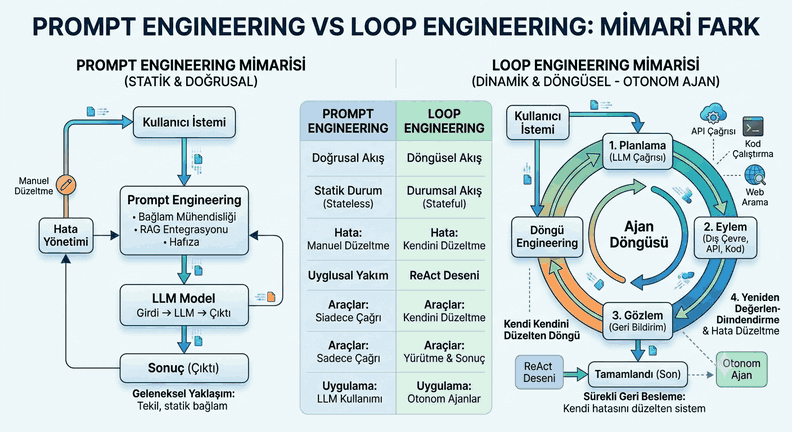
Prompt Engineering vs Loop Engineering: From Single-Shot Answers to Self-Improving Loops in AI

A detailed blog post for developers and AI users covering the difference between prompt engineering and loop (feedback-loop) engineering, actor-critic architectures, multi-agent systems, and test-time compute approaches.

ai prompt-engineering loop-engineering llm ai-agents automation artificial-intelligence ai-engineering machine-learning

Technical Architecture and Implementation Principles of the Random Forest Algorithm

Random Forest is a powerful "Ensemble Learning" algorithm that achieves more stable and high-accuracy results by combining the predictions of numerous "Decision Tree" structures. By utilizing "Bagging" and "Feature Randomness" techniques, it minimizes the "overfitting" tendency of a single tree; thus, it is a "robust" model that exhibits high "generalization" success even with noisy data and does not require scaling.

ai machine-learning random-forest python decision-tree ensemble-learning supervised-learning feature-importance hyperparameter-tuning artificial-intelligence deep-learning ai-engineering

Theoretical Foundations and Application Strategies of the Naive Bayes Algorithm

Naive Bayes is a fast and effective probabilistic classification algorithm based on Bayes' Theorem that assumes full independence between features. It provides a strong foundation for problems such as text classification, spam filtering, and sentiment analysis, especially in high-dimensional datasets, with low computational cost.

ai naive-bayes bayes-theorem scikit-learn gaussian-naive-bayes multinomial-naive-bayes bernoulli-naive-bayes machine-learning deep-learning ai-engineering

Artificial Neural Networks: A Journey from Biological Inspiration to Mathematical Architecture

A technical article detailing the biological foundations, advanced mathematical architecture, backpropagation algorithms, and deep learning optimization techniques of artificial neural networks, complete with Python code examples.

ai artificial-neural-networks deep-learning python ai-technologies nlp data-science machine-learning

Architectural Depth of Large Language Models: Alignment, Optimization, and Efficient Adaptation

[-Veri Analiz Okulu, Notes 11-] A deep technical article covering the alignment of Large Language Models (LLMs) with human feedback, their efficient adaptation via Low-Rank Adaptation (LoRA), and their optimization in distributed hardware architectures.

ai veri-analizi-okulu vao python llm rlhf nlp lora deep-learning ai-engineering machine-learning

The Neural Architecture of Modern Language Models and Their Evolution from Token-Level to Reasoning

[-Veri Analiz Okulu, Notes 10-] This article is a comprehensive examination covering the mathematical foundations of the Transformer architecture, the vectorial operations of attention mechanisms, and the processes by which large language models (LLMs) derive meaning from data with technical depth.

ai veri-analizi-okulu vao python transformer-architecture nlp llm tokenization attention-mechanism neural-networks ai-alignment pytorch machine-learning

The Anatomy of Modern Deep Learning: A Technical Journey from Gradients to Attention Mechanisms

[-Veri Analiz Okulu, Notes 9-] A technical article covering the mathematical background of backpropagation, CNNs, and attention mechanisms, which form the foundation of deep learning, along with optimization algorithms and modern architectural structures.

ai veri-analizi-okulu vao python back-propagation cnn transformer attention-mechanism pytorch machine-learning

Delicate Balances and Strategic Approaches in Modern Machine Learning

[-Veri Analiz Okulu, Notes 8-] This article analyzes the geometric optimization strategies of Support Vector Machines, the reward-oriented decision-making mechanisms of Reinforcement Learning, and the mathematical foundations of Markov Decision Processes with technical depth.

ai veri-analizi-okulu vao python svm deep-learning reinforcement-learning algorithm-analysis machine-learning

Engineering Analysis of Statistical Approaches and Ensemble Methods in Machine Learning

[-Veri Analiz Okulu, Notes 7-] A technical article analyzing the mathematical depth of Naive Bayes and Random Forest algorithms, based on Bayesian probability theory and ensemble learning methods, with model performance metrics.

ai veri-analizi-okulu vao python naive-bayes random-forest confusion-matrix python-coding statistical-learning algorithm-analysis machine-learning

Dimensionality Reduction Strategies and Algorithmic Depth in Machine Learning

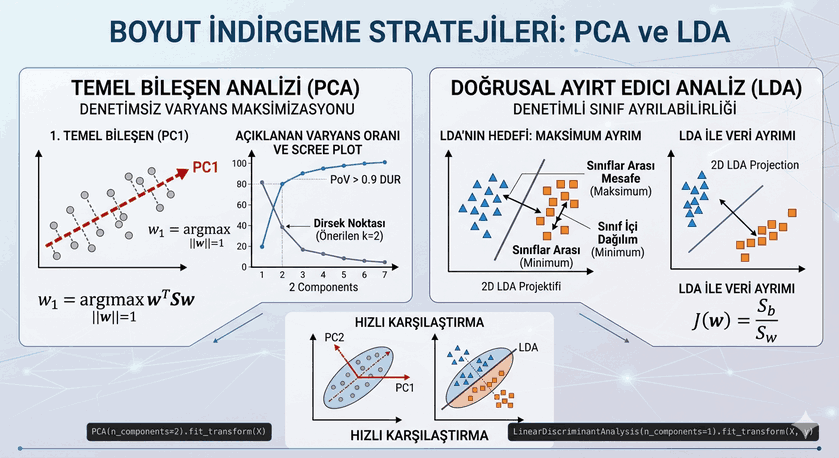
[-Veri Analiz Okulu, Notes 6-] Examines PCA and LDA techniques used to reduce the complexity of high-dimensional data, covering their mathematical foundations, impact on classification performance, and in-depth Python-based technical implementation examples.

ai veri-analizi-okulu vao python dimensionality-reduction pca lda classification statistical-analysis data-science machine-learning

Modern Clustering and Classification Strategies in Machine Learning

[-Veri Analiz Okulu, Notes 5-] A comprehensive and technical article covering everything from linear classification models to K-means clustering algorithms, and from model optimization to regularization techniques that prevent overfitting.

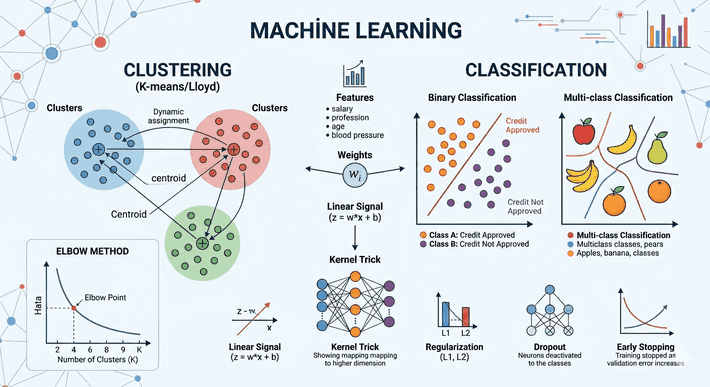
ai veri-analizi-okulu vao python deep-learning kmeans clustering classification lloyd-algorithm data-science machine-learning

The Quest for Balance in Model Optimization: A Stability Analysis of Machine Learning from Underfitting to Overfitting

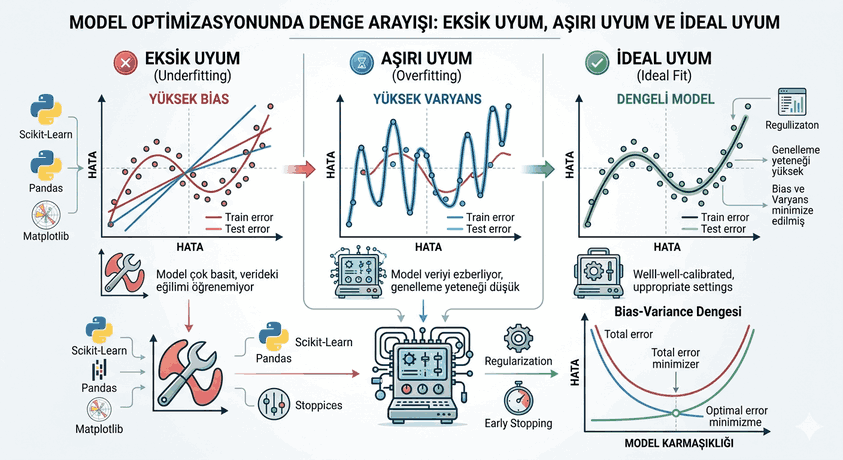
[-Veri Analiz Okulu, Notes 4-] This article examines the balance between model complexity and generalization capability in machine learning, exploring the concepts of underfitting and overfitting with technical depth.

ai veri-analizi-okulu vao python deep-learning model-fitting over-fitting under-fitting data-science machine-learning

Architectural Foundations and Algorithmic Strategies of Modern Artificial Intelligence

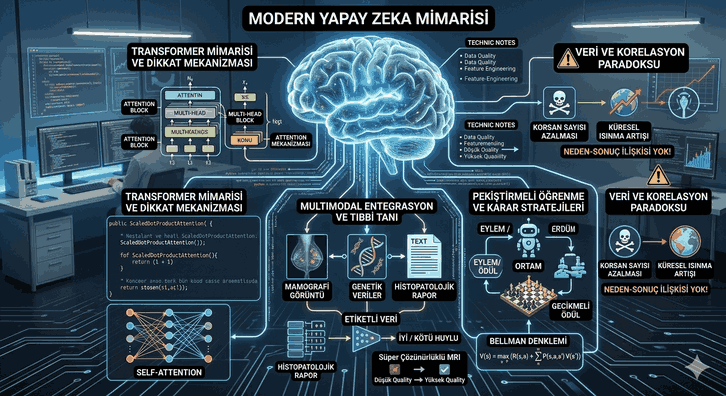
[-Veri Analiz Okulu, Notes 3-] A technical paper on the attention mechanism of the Transformer architecture, multimodal data integration, and the mathematical decision strategies of reinforcement learning.

ai veri-analizi-okulu vao python deep-learning transformer-architecture multi-modal-ai bellman-equation data-science machine-learning

The Layered Architecture and Algorithmic Depth of Machine Learning

[-Veri Analiz Okulu, Notes 2-] A technical and mathematical analysis of the hierarchical structure of machine learning, data processing layers, and fundamental learning paradigms (supervised, unsupervised, reinforcement).

ai veri-analizi-okulu vao python deep-learning reinforcement-learning data-science machine-learning

From Data Engineering to Cognitive Revolution: The Technical Anatomy of AI and Machine Learning

[-Veri Analiz Okulu, Notes 1-] This comprehensive technical review analyzes the evolutionary process of artificial intelligence, from rule-based expert systems to modern transformer architectures and generative networks, through biological analogies and practical application layers in the software world.

ai veri-analizi-okulu vao python deep-learning pytorch transformer data-science machine-learning

Advanced Analytical Modeling and Algorithmic Visualization Strategies in High-Dimensional Data Spaces

This is a technical guide for processing high-dimensional data with maximum efficiency using hardware-based memory optimization, advanced feature engineering, and algorithmic pipelines.

ai data-engineering big-data statistical-analysis data-mining algorithmic-visualization machine-learning

In-Depth Technical Analysis of AI Architecture and Development Processes

Explore AI development processes in-depth, from Transformer architecture to RAG systems, Onion Architecture integration, and Edge AI/TinyML optimizations. A comprehensive technical analysis supported by code examples and mathematical models.

ai data-engineering big-data ai-architecture transformer-architecture deep-learning machine-learning

The Digital Ontology of Data: A Deep Look from Binary Logic to Quantum Superposition

A technical examination of the transformation process of data from its raw form to strategic insight, viewed through the perspectives of deterministic systems, algorithmic depth, and computational social sciences.

ai data-science machine-learning computational-analysis quantum-computers nlp gis digital-transformation

Advanced Data Preprocessing and Engineering Architecture in Data Science

A technical examination of the transformation of data from raw form into a processed feature matrix in analytical modeling processes; a synthesis of statistical methodologies and computational techniques.

ai data-science machine-learning data-preprocessing feature-engineering statistical-analysis data-mining

Reinforcement Learning: Dynamic Decision Mechanisms and the Mathematics of Autonomous Systems

A technical guide detailing the mathematical foundations, deep architectures, and technical implementation methods of reinforcement learning, which optimizes optimal decision strategies through reward mechanisms in dynamic environments.

ai data-engineering big-data reinforcement-learning deep-learning python machine-learning

Engineering Architecture of Autonomous Systems: SLAM, Sensor Fusion, and Reinforcement Learning Processes

A comprehensive guide examining the technical depth of localization, data integration, and machine learning algorithms in robotic systems, along with C++ and Python implementations.

ai autonomous-systems big-data slam reinforcement-learning robotics robotics machine-learning

Modern Data Engineering: Scalable Pipeline Architectures and Analytical Transformation Strategies

A comprehensive guide to end-to-end high-performance data pipeline design, covering distributed computing engines, in-memory optimization techniques, and complex feature engineering processes.

ai data-engineering big-data statistical-analysis distributed-computing statistical-modeling machine-learning

In-Memory Computing and Low-Latency Data Processing Strategies in Modern Data Architectures

Optimizing performance at the hardware level in the data ecosystem: In-memory architectures, CPU cache hierarchy, and low-latency data processing techniques.

ai data-architecture memory-management low-latency system-design performance-optimization

Advanced Data Preprocessing and Algorithmic Optimization Strategies in Machine Learning Pipelines

A guide to maximizing model performance through advanced feature engineering, statistical imputation techniques, ensemble modeling strategies, and Bayesian optimization. Engineering discipline in data analytics using modern tools like SHAP and Isolation Forest.

ai data-engineering big-data data-analytics algorithm-optimization feature-engineering machine-learning

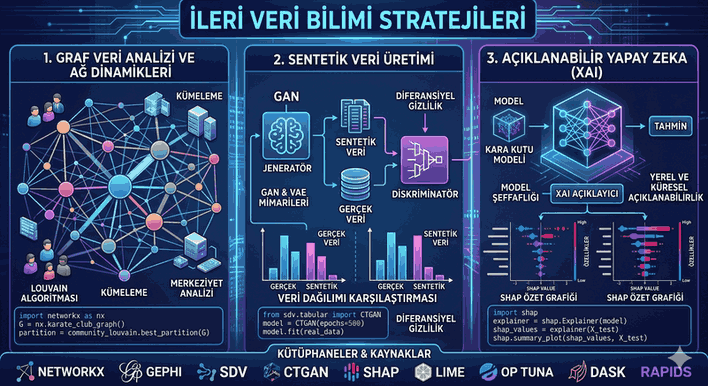
Advanced Data Science Strategies: Graph Analytics, Synthetic Data, and XAI Architectures

A comprehensive technical analysis of network theory, data generation techniques, and model transparency that provides depth in modern data analytics.

ai data-engineering big-data graph-analysis xai synthetic-data machine-learning

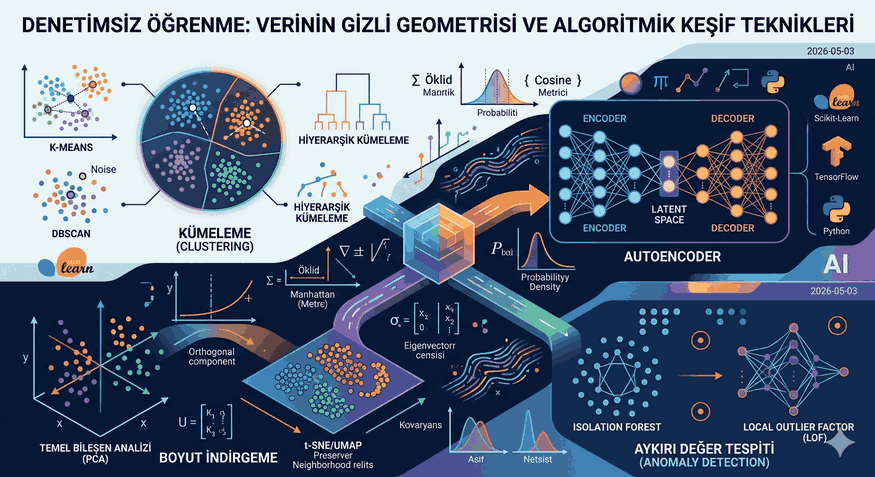
Unsupervised Learning: The Hidden Geometry of Data and Algorithmic Discovery Techniques

This article details methodologies used to extract meaningful patterns from unlabeled datasets, including clustering, dimensionality reduction, and anomaly detection, along with their mathematical foundations and modern software implementations.

ai data-engineering big-data unsupervised-learning pca clustering machine-learning

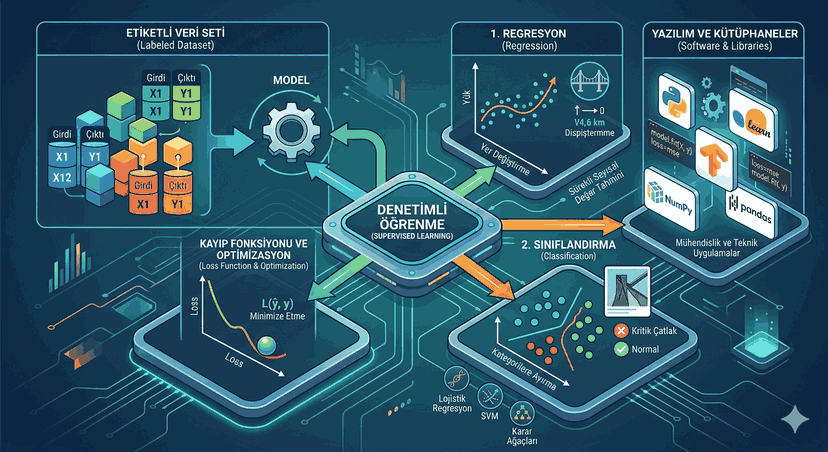
Mathematical Optimization and Applied Algorithm Strategies in Supervised Learning Architecture

A mathematical modeling method that learns a mapping function from labeled data consisting of input-output pairs, aiming to predict continuous or categorical values.

ai data-engineering supervised-learning algorithm python machine-learning