Topological Approaches in Data Science and Graph Theory-Based Network Analysis with Gephi

In today’s data ecosystem, identifying relational patterns between the units that make up the data is of strategic importance rather than just the size of the raw data. Traditional relational databases and row-column-based analysis methods are insufficient to express the phenomenon of “connectivity.” This is where Graph Theory comes into play. This discipline, which models complex systems through nodes and edges, transforms into a massive analytical power that uncovers hidden topologies in big data sets when combined with open-source tools like Gephi.

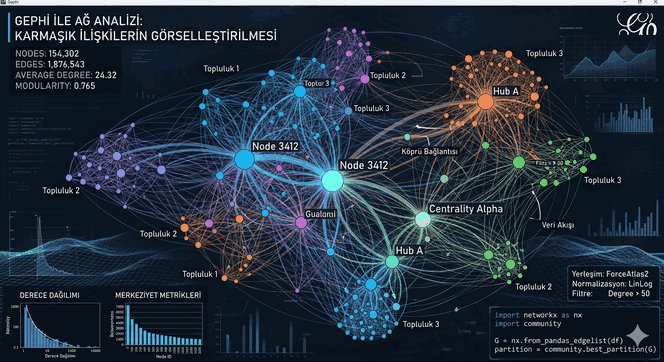
Topological Approaches in Data Science and Graph Theory-Based Network Analysis with Gephi

Figure 1: Topological Approaches in Data Science and Graph Theory-Based Network Analysis with Gephi.


1. Mathematical and Technical Foundations of Network Analysis

A network analysis process begins mathematically with the construction of a graph $G = (V, E)$, where $V$ (Vertices) represents the actors constituting the system, and $E$ (Edges) represents the interactions between these actors. Gephi uses a Java-based engine to process this mathematical structure and converts topological distances into physical coordinates using various Layout Algorithms while visualizing the data.

Mastering fundamental metrics in network analysis is essential to make inferences beyond visualization:

  • Degree Centrality: The total number of edges connected to a node. In directed graphs, it is divided into “In-degree” and “Out-degree.”
  • Betweenness Centrality: The frequency with which a node lies on the shortest paths between all other node pairs in the network. These nodes act as “bridges” in the network and control the flow of information.
  • Closeness Centrality: The average distance from a node to all other nodes in the network. It indicates how central a node is within the network.
  • Modularity: Measures the community structure of the network. A high modularity score indicates that the network is divided into sub-groups that are densely connected within themselves but sparsely connected to the outside.

2. Data Preparation and ETL Processes for Gephi

Before importing data into Gephi, it must be cleaned and converted into appropriate formats (CSV, GDF, GEXF). In large datasets, this process is usually performed using Python libraries such as Pandas and NetworkX.

Below is an example Python script that converts a dataset into “Nodes” and “Edges” tables that Gephi can read:

import pandas as pd
import networkx as nx

# Loading the raw dataset (e.g., Social media interactions)
raw_data = pd.read_csv('interaction_log.csv')

# Defining source and target
# df structure: source_user, target_user, weight
edges = raw_data[['source_user', 'target_user', 'weight']]

# Creating a NetworkX object
G = nx.from_pandas_edgelist(edges, source='source_user', target='target_user', edge_attr='weight')

# Creating the node list (along with attributes)
nodes = pd.DataFrame(G.nodes(), columns=['ID'])
nodes['Label'] = nodes['ID']

# Exporting in Gephi format
nodes.to_csv('nodes_table.csv', index=False)
edges.to_csv('edges_table.csv', index=False)

The most critical point to pay attention to at this stage is the cleaning of noise in the dataset. Isolated nodes or edges with very low weights can cause a “hairball” effect in visualization, making analysis impossible.

3. Dynamic Layout Algorithms and Force-Directed Visualization

The heart of Gephi beats in the layout tab. These algorithms, which transform static data into a living organism, are based on physical force simulations.

  • ForceAtlas2: A non-linear algorithm optimized for large networks. It positions nodes with repulsion force and edges with attraction force. This algorithm clarifies structural gaps by pushing communities away from each other.
  • Fruchterman-Reingold: Treats nodes like atoms and tries to minimize the energy between them. It offers more aesthetic and balanced distributions but has a high computational cost for very large datasets.
  • OpenOrd: Used to quickly detect clusters in very large-scale networks (millions of nodes).

Technical Note: When working with large datasets, increasing the Gravity parameter prevents nodes from dispersing, while the Scaling parameter opens up the distance between clusters, providing the opportunity for detailed examination.

4. Statistical Calculations and Filtering Techniques

After visualization, the “Statistics” tools on the right panel of Gephi should be run. Specifically, running the Modularity algorithm generates “Class” data for coloring the nodes.

In the filtering phase, the network should be simplified using Topology filters. For example, showing only nodes with a Degree value greater than 5 allows focusing on the core structure of the network. The Giant Component filter makes it possible to work on the main structure by eliminating small groups detached from the network.

5. Software Ecosystem and Library Integration

Network analysis is not limited to Gephi. In complex projects, while Gephi is used as a “visual inspection” layer, different libraries play a role in the computational layer:

  • NetworkX (Python): Standard for prototyping and basic analytical calculations.
  • iGraph (C/C++/R/Python): Preferred for high-performance calculations and complex algorithms (e.g., Walktrap, InfoMap).
  • Graph-tool (C++ / Python): Thanks to OpenMP support, it can analyze massive networks in seconds on multi-core processors.
  • Sigma.js / D3.js: JavaScript libraries used to publish analyses prepared in Gephi interactively in web environments.

6. Network Topology in Cybersecurity and Malware Analysis

Beyond data science, network analysis plays a critical role in cybersecurity. The relationships between API calls of a malware sample in a system can be modeled as a graph.

For instance, the functions imported by a Windows PE file and the sequence in which these functions call each other create a directed graph. In analyses conducted with Gephi, the “functional signatures” (behavioral analysis instead of signature-based detection) of malicious software can be detected through the topological similarities of these graphs. Similarly, in network traffic analysis (PCAP data), traffic density between IP addresses can be imported into Gephi to visualize botnet structures or DDoS attack centers in seconds.

7. Conclusion and Strategic Inferences

Network analysis with Gephi is a methodology of exploratory data analysis (EDA) rather than just a data visualization process. By bringing order to the chaos within complex systems, this tool presents decision-makers with the system’s weak points, most influential actors, and hidden sub-groups.

Important Notes:

  • Data Format: Always prefer the .gexf format; because this format supports hierarchical structures and dynamic (time-dependent) data.
  • Scalability: Gephi is a RAM-based tool. Remember to increase Java memory settings (the Xmx value from the gephi.conf file) for analyses on 100,000+ nodes.
  • Interpretation: A graph alone means nothing. Be sure to support the visualization with centrality metrics and statistical tests (p-value, distribution analyses).

Network analysis allows us to see the “context” within data. Gephi is the most powerful instrument that turns this context into a work of art and a strategic report. By using software resources correctly and remaining loyal to mathematical foundations, even the most complex relationships can become solvable.

#blog #gephi #network-analysis #data-visualization #graph-theory #network-analysis #python #data-science #centrality-metrics #complex-systems

Related Contents

Modern Rechargeable Battery Technologies and Electrochemical Performance Analysis

This blog post, which details modern battery technologies and the electrochemical operating principles of these systems, examines the technical specifications, performance metrics, and usage advantages of Li-ion, LiFePO4, NiMH, Ni-Cd, and lead-acid batteries from an engineering perspective.

blog electronics battery-technologies lithium-ion li-ion battery-performance lifepo4 nickel-metal-hydride rechargeable-batteries battery-management-systems ni-cd ni-mh energy-systems battery-analysis

Post-Exploitation Strategies and In-Depth Analysis in Internal Network Penetration Tests

This article analyzes post-exploitation techniques in internal network penetration tests, including privilege escalation methods, persistence mechanisms, and lateral movement processes within Active Directory with technical code examples. Professional tools such as Mimikatz, Impacket, and BloodHound are covered.

blog cyber-security network-security information-security cloud-security network privilege-escalation penetration-testing red-team post-exploitation active-directory lateral-movement intranet internal-network local-network

OWASP Top 10 Security Strategies in .NET 8 Projects

A critical guide for secure coding in .NET 8 projects! Discover how to protect your application using tools like EF Core, Data Protection API, and policy-based authorization against OWASP Top 10 threats with technical examples. Learn fundamental strategies for secure software architecture.

blog cyber-security dotnet owasp network-security information-security cloud-security

Modern Network Strategies with Zero Trust Architecture

Zero Trust architecture is a modern security strategy that dismantles the 'default trust' paradigm in today's hybrid world, where network boundaries have become increasingly blurred. This approach treats every user, device, and service as a potential risk factor—whether inside or outside the network—by subjecting access requests to continuous, contextual, and rigorous verification.

blog cyber-security zero-trust network-security information-security cloud-security

Veri Analizi Okulu: Data Science and Artificial Intelligence Training

Operating under the coordination of Yükseköğretim Kurumu (YÖK), the Veri Analizi Okulu (VAO) combines theoretical knowledge with practice through modules in Basic Statistics, Computational Social Sciences, Panel Data Analysis, Artificial Intelligence, Digital Humanities, and Psychometrics. Check out our blog post for both a high-quality education and your career.

blog veri-analizi-okulu vao basic-statistics computational-social-sciences panel-data-analysis artificial-intelligence ai-and-facilitating-tools ai ai-and-machine-learning digital-humanities psychometrics

Nur-o-link: Remote-Controlled Robotic Arm and Vehicle System

The Nur-o-link project is an innovative robotics study that combines remote-controllable robotic arm and autonomous vehicle features, highlighting the interaction between hardware and software.

blog robotic robotic-arm robotik iot embedded cplusplus arduino esp32 remote-control software-hardware rex-8in1-v2 electronic

Gungor-robot-car: ESP32 Camera-Controlled Robot Car

A robotic vehicle project capable of live video streaming via WiFi and remote control through a browser-based interface, powered by the ESP32-WROVER module.

blog robotics robotic iot embedded cplusplus arduino esp32 esp32-cam esp32-camera remote-control robotic-car electronic electronics software-hardware

Engineering Fundamentals and Mechanical Analysis of Flexible Structures in Soft Robotic Systems

A high-technical-depth blog post focusing on control algorithms and material mechanics, exploring the transformation of traditional rigid robotic systems through flexible elastomers and bio-mimetic approaches.

blog robotics soft-robotics mechatronics control-systems simulation engineering

Collective Intelligence and Dynamic Task Allocation in Swarm Robotic Systems

A technical blog post examining the technical foundations, algorithmic approaches, and software libraries for collective intelligence, dynamic task sharing, and distributed control mechanisms in swarm robotic systems.

blog robotics autonomous swarm-robotics multi-agent-systems task-allocation ros2 collective-decision-making distributed-systems swarm-intelligence intelligent-robots

The Evolution of Robotic Systems and Modern Migration Strategies to the ROS 2 Ecosystem

This blog post addresses the architectural changes in the transition process from ROS 1 to ROS 2, the technical advantages of the DDS-based communication layer, and system modernization strategies using modern software libraries in a technical language.

blog robotic robotics autonomous ros2 dds industrial-automation real-time-systems control-systems microservices

Agriculture 4.0 and Next-Generation Approaches in Autonomous Robotic Systems

A blog post covering navigation strategies for autonomous vehicles in the Agriculture 4.0 ecosystem, deep learning-based crop monitoring algorithms, and ROS 2-based software architectures.

blog robotics autonomous agriculture-4-0 path-planning crop-monitoring ros2 smart-farming precision-agriculture ai lidar image-processing sensor-fusion edge-computing

Deep Learning-Based Object Detection and Manipulation Techniques in Autonomous Robotic Systems

A technical review and software integration of modern robotic systems equipped with deep learning architectures, 6-DoF grasping strategies, and real-time object recognition algorithms.

blog robotics autonomous ai python pytorch ros2 yolo opencv autonomous-robots deep-learning machine-learning

Deep Dive into the Fundamental Building Blocks of Electronic Design: Engineering Foundations of Passive Component Selection

This blog post covers the non-ideal parasitic parameters, frequency-dependent behaviors, and modern engineering selection criteria for capacitors and inductors, which are critical in electronic circuit design, along with Python-based analysis methods.

blog electronics passive-components capacitor-selection inductor-parameters esr esl frequency-analysis circuit-simulation

Advanced Spatial Analysis and Data Science Integration in Modern Geographic Information Systems

A blog post covering data mining in the ArcGIS ecosystem, Python-based automation processes, and spatial statistics methods to transform raw location data into strategic decision support mechanisms.

blog arcgis spatial-analysis geographic-information-systems python arcpy mapping spatial-statistics data-science big-data

Superposition Theorem and Analytical Investigation of Multi-Source Linear Circuits

A blog post examining the theoretical foundations, mathematical modeling, and Python-based simulation approaches of the Superposition Theorem, which analyzes the effect of each source individually and combines them in linear circuits containing multiple independent sources.

blog electric electronics superposition-theorem circuit-analysis linear-systems circuit-solution kirchhoff-laws

Mathematical Architecture of Complex Circuits and Nodal Analysis Method

Theoretical analysis of the nodal analysis method based on Kirchhoff's Current Law, the supernode concept, and modeling of circuit solutions with computational engineering approaches using the NumPy library.

blog electric electronic circuit-analysis kirchhoff-laws nodal-analysis numpy circuit-simulation circuit-theory supernode

Joule Heating and Advanced Thermal Management Strategies in Modern Electronics

A blog post covering the physical foundations of Joule heating, advanced PCB design techniques for optimizing thermal management in modern circuits, PID-based cooling algorithms, and embedded software control mechanisms.

blog electricity electronics joule joule-heating thermal-management heat-distribution power-electronics

Engineering Analysis and Selection Strategies for Resistor Parameters in Circuit Design

A technical blog post examining critical resistor parameters beyond Ohm's Law in real-world circuit designs, including parasitic effects and engineering calculations.

blog electrical electronics ohms-law circuit-analysis electronic-design resistor-selection engineering

Reduction Methods and Numerical Analysis Approaches in Linear Circuit Analysis

This article examines methods for simplifying complex electrical circuits using Thevenin and Norton theorems, mathematical analysis steps, and Python-based numerical analysis techniques from a detailed engineering perspective.

blog electric electrical-circuits circuit-analysis thevenin-theorem norton-theorem circuit-reduction linear-circuits

Professional Debugging Strategies and In-Depth Analysis Techniques in Embedded Systems Development

A technical article covering professional debugging processes in embedded systems under hardware constraints and real-time requirements, using critical methods such as JTAG/SWD analysis, memory management, and signal integrity.

blog electronics embedded-systems debugging troubleshooting jtag rtos microcontroller hardware

Communication Layers and Protocol Analysis in Modern Smart Home Ecosystems

An in-depth analysis of the technical architectures of Wi-Fi, BLE, and Zigbee protocols, mesh network structures, and software integration processes in smart home ecosystems.

blog iot zigbee wi-fi bluetooth bluetooth-ble communication-protocols electronics mesh-network

Power Management and Efficiency Strategies in Arduino Projects

A comprehensive technical article on reducing energy consumption to the microampere level in Arduino projects through hardware interventions, deep sleep modes, and the use of low-power regulators.

blog electronics arduino power-optimization embedded-systems deep-sleep battery-life avr

Raspberry Pi and Hardware Integration in Industrial Systems

A comprehensive article examining the use of Raspberry Pi in industrial automation, covering technical details from hardware isolation to RTOS kernel optimization and Modbus/MQTT communication protocols.

blog electronics raspberry-pi iiot iot industrial-automation mqtt rtos plc sensor-data-processing python

Architectural Decision Processes in IoT Projects: A Technical Analysis of ESP32 and ESP8266 Microcontrollers

A comprehensive guide providing an optimized selection strategy for IoT projects by technically analyzing the architectural differences, connectivity capabilities, and hardware features of ESP32 and ESP8266 microcontrollers.

blog iot esp32 esp8266 arduino free-rtos microcontroller electronics wi-fi bluetooth