We use cookies and other tracking technologies to improve your browsing experience on our website, to show you personalized content and targeted ads, to analyze our website traffic, and to understand where our visitors are coming from.
⚠️
GDPR & Cookie Policy Notice
In accordance with data protection regulations; the use of mandatory cookies is required for the core functions of our website to operate, ensure data security, and perform analytics. If you reject the use of cookies, it is not possible to benefit from the services on our website due to technical limitations and data synchronization interruptions. You must consent to the use of cookies to access the content on our site.
Modern Network Strategies with Zero Trust Architecture
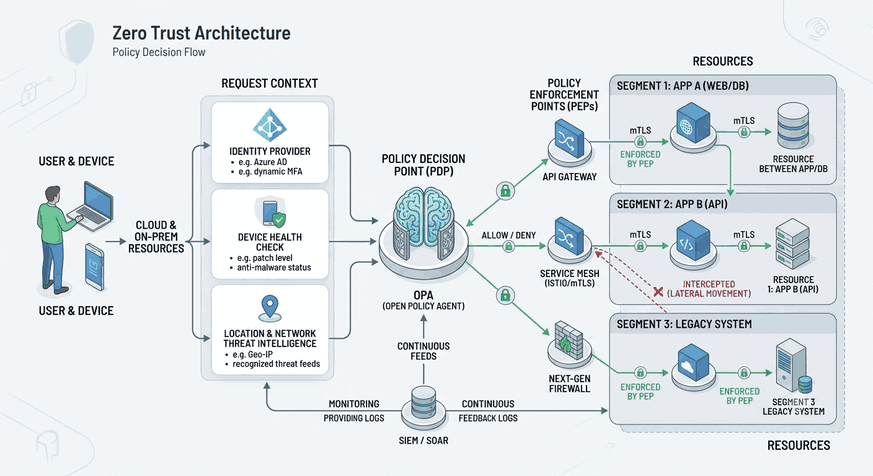
Traditional network security approaches relied on the “castle-and-moat” mentality for many years. In this approach, everything outside the network was considered untrusted, while everything inside was considered trustworthy. However, with the proliferation of cloud computing, remote work, and mobile devices, the network no longer has a clear boundary. Zero Trust architecture completely replaces this old paradigm with the principle of “never trust, always verify.”
Figure 1: Modern Network Strategies with Zero Trust Architecture.
Misconceptions About Zero Trust Architecture
Zero Trust has become a concept that is often misunderstood or fallen victim to marketing strategies. Here are the fundamental misconceptions in this field:
Misconception 1: Zero Trust is a product or software: Zero Trust is not a box or a license you can buy; it is a security strategy and architectural framework.
Misconception 2: Users inside the network are trustworthy: One of the biggest attack vectors is compromised internal users (insider threats). Zero Trust approaches traffic originating from within with the same level of suspicion.
Misconception 3: VPN is sufficient for Zero Trust: A VPN grants a user access to the network and typically provides them with too much authorization. Zero Trust, on the other hand, follows the “least privilege” principle, ensuring the user only accesses the resources they need.
Implementation Steps and Technical Requirements
Transitioning to Zero Trust is not an overnight process but a cycle of continuous improvement. The steps below provide a technical roadmap.
1. Asset Discovery
You cannot protect data, applications, and services without knowing where they are. All “Critical Data Assets” (CDA) must be listed.
2. Implementing Micro-Segmentation
Divide the network into small, isolated pieces (micro-perimeters). If a server is compromised, the attacker’s ability to move laterally is prevented.
3. Identity and Access Management (IAM)
Identity is the heart of Zero Trust. Multi-factor authentication (MFA) must be standard, and access decisions must be “context-aware.”
Note: When making access decisions, parameters such as the user’s location, the device’s health status (patch level), the application being used, and the time of day must be subjected to a scoring system.
Technical Implementation: Code and Architecture
During the phase of implementing a Zero Trust architecture, the concepts of Policy Decision Point (PDP) and Policy Enforcement Point (PEP) are of critical importance.
Example Scenario: Access Control (with Python / Flask)
In an API gateway, we can establish simple logic that verifies every incoming request.
from flask import Flask, request, jsonify
import jwt # PyJWT libraryapp = Flask(__name__)
# Zero Trust: JWT and context check are performed on every requestdefverify_request(token, context):
try:
# JWT verification payload = jwt.decode(token, 'SECRET_KEY', algorithms=['HS256'])
# Contextual check (e.g., Is the device secure?)ifnot context.get('is_device_compliant'):
returnFalse, "Device is non-compliant."returnTrue, payload
exceptExceptionas e:
returnFalse, str(e)
@app.route('/api/data', methods=['GET'])
defget_sensitive_data():
token = request.headers.get('Authorization')
context = {'is_device_compliant': True} # In a real application, this is queried via a service authorized, result = verify_request(token, context)
if authorized:
return jsonify({"data": "Access to sensitive data granted."}), 200else:
return jsonify({"error": "Access denied: "+ str(result)}), 403if __name__ =='__main__':
app.run(port=8080)
Software Resources and Libraries
Modern tools and standards should be leveraged to make the Zero Trust architecture scalable:
Open Policy Agent (OPA): The industry standard for the “Policy as Code” approach. It centralizes decision mechanisms (PDP).
SPIFFE/SPIRE: An open-source tool used for authentication between microservices. It ensures the security of services to one another.
Istio (Service Mesh): Ideal for managing micro-segmentation and “mTLS” (Mutual TLS) traffic in Kubernetes environments.
HashiCorp Vault: Indispensable for dynamic secret management and identity-based access control.
Continuous Monitoring and Analysis
Zero Trust is not a static structure. SIEM (Security Information and Event Management) and SOAR (Security Orchestration, Automation, and Response) platforms should be used to monitor every anomaly on the network.
Logging: It is not enough to log just logins and logouts; the data that users access and the queries they run must also be logged.
Automated Response: When a user account exhibits abnormal behavior (e.g., unexpected data exfiltration in the middle of the night), the system should automatically restrict access and issue an alert.
Technical Summary and Conclusion
Zero Trust is a process. To achieve success:
Designate identity as the single key.
Divide the network into logical layers (micro-segmentation).
Make access context-based.
Minimize manual errors with automation tools (like OPA, Istio).
Zero Trust is designed not to disrupt user productivity, but to increase network resilience. The greatest challenge in transitioning to this architecture is not technical; it is cultural. When you accept that trust is not an assumption but a dynamic variable that must be earned, you will have laid the foundation for modern network security.