We use cookies and other tracking technologies to improve your browsing experience on our website, to show you personalized content and targeted ads, to analyze our website traffic, and to understand where our visitors are coming from.
⚠️
GDPR & Cookie Policy Notice
In accordance with data protection regulations; the use of mandatory cookies is required for the core functions of our website to operate, ensure data security, and perform analytics. If you reject the use of cookies, it is not possible to benefit from the services on our website due to technical limitations and data synchronization interruptions. You must consent to the use of cookies to access the content on our site.
Post-Exploitation Strategies and In-Depth Analysis in Internal Network Penetration Tests
Internal network penetration tests derive their true value from the “post-exploitation” process that begins the moment defensive perimeters are breached. Penetrating the outer shell of a network is merely opening the door; the real challenge lies in deepening one’s presence within the network, escalating privileges, and reaching final objectives (Domain Admin rights, critical databases, backup servers). This phase is characterized by the attacker concealing their tracks, establishing persistence, and performing lateral movement.
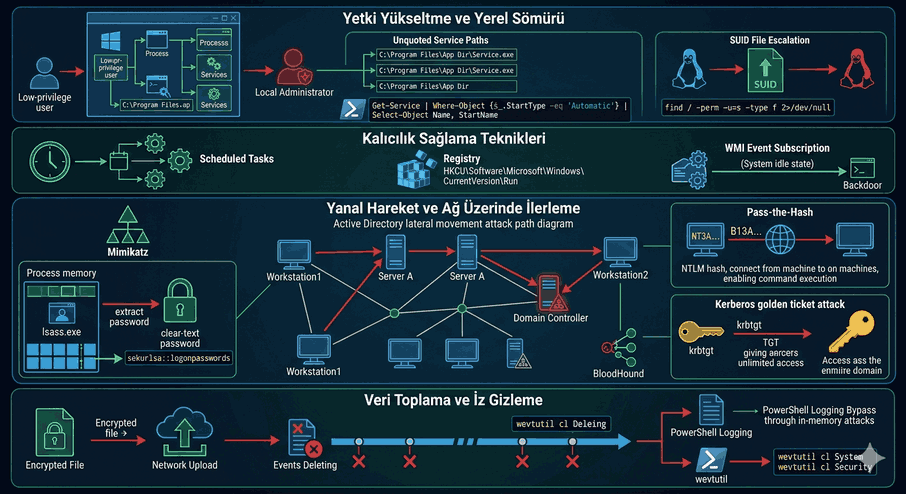
Figure 1: Post-Exploitation Strategies and In-Depth Analysis in Internal Network Penetration Tests.
Privilege Escalation and Local Exploitation
Initial system access is typically gained via a low-privileged user account. The primary goal is to elevate privileges to the “Local Administrator” or “NT AUTHORITY\SYSTEM” level.
Privilege Escalation in Windows Environments
In modern Windows systems, the most frequently used methods involve misconfigured services, weak permissions, or kernel vulnerabilities.
Unquoted Service Paths: If an executable path for a service contains spaces and is not enclosed in quotation marks, the system may attempt to execute incorrect directories.
Kernel Exploits: Tools like winPEAS or Metasploit suggester, used particularly on unpatched systems, detect potential kernel vulnerabilities within the system.
# Querying service permissions with a simple PowerShell commandGet-Service | Where-Object {$_.StartType -eq'Automatic'} | Select-Object Name, StartName
Privilege Escalation in Linux Environments
In the Linux world, SUID bits and sudo configuration errors are gold mines. Files with SUID permissions are searched using the find command:
find / -perm -u=s -type f 2>/dev/null
If tools such as nmap or vim are among these files, root access can be obtained by utilizing the “shell escape” features of these tools.
Persistence Techniques
Once a system is compromised, persistence must be established to ensure access is not lost after reboots or connection drops.
Scheduled Tasks: The most classic method. A task is created that triggers a backdoor every time the system starts or at a specific time.
Registry Manipulation: A payload added to the HKCU\Software\Microsoft\Windows\CurrentVersion\Run key in Windows will execute as soon as a user logs in.
WMI (Windows Management Instrumentation) Event Subscription: A stealthier method. WMI objects are created that trigger when a specific system event occurs (for example, the system being idle for 300 seconds).
Lateral Movement and Network Progression
Moving from one system to another within a network is called “lateral movement.” The main goal here is to obtain the credentials of Domain Admin accounts.
Mimikatz and Memory Analysis
Mimikatz is a standard tool for stealing clear-text passwords, NTLM hashes, or Kerberos tickets from memory by targeting the lsass.exe process.
# Extracting all passwords from memory using Mimikatzsekurlsa::logonpasswords
Pass-the-Hash (PtH) and Pass-the-Ticket (PtT)
You do not need to know the password. You can gain access to other machines using only the NTLM hash you have captured, utilizing PsExec or WMI. Seizing Kerberos tickets (Golden Ticket or Silver Ticket attacks) is one of the most dangerous methods that makes your network privilege permanent.
Data Collection and Log Clearing
The final step of the post-exploitation process is the exfiltration of strategic data and clearing all actions from logs.
PowerShell Logging: If the ScriptBlockLogging feature is active, your commands are recorded. Therefore, In-Memory attacks should be preferred whenever possible. Reflective DLL Injection is a key technique in this regard.
Log Clearing: Deleting Windows Event Logs is suspicious; therefore, only the logs of the relevant session should be cleared using wevtutil:
wevtutil cl System
wevtutil cl Security
Toolsets and Libraries Used
In such operations, professional frameworks are used alongside manual methods:
Cobalt Strike: Provides full control within the network thanks to its Beacon structure. It is a pioneer of C2 (Command & Control) architecture.
Empire / Starkiller: A modular post-exploitation framework based on PowerShell and Python.
BloodHound: Analyzes the Active Directory environment graphically. It calculates which user can become an admin with the least effort and in the shortest time using “Path to Domain Admin” queries.
Impacket: A Python library. It is indispensable for manipulating protocols such as SMB, MSRPC, and MSSQL. Specifically, the psexec.py, wmiexec.py, and secretsdump.py scripts are the cornerstones of penetration tests.
Note: All of these techniques should only be used within the scope of authorized penetration testing activities. Defending network security requires knowing how these techniques work and what traces they leave behind. All unauthorized actions are considered cybercrimes.
Defensive Perspective
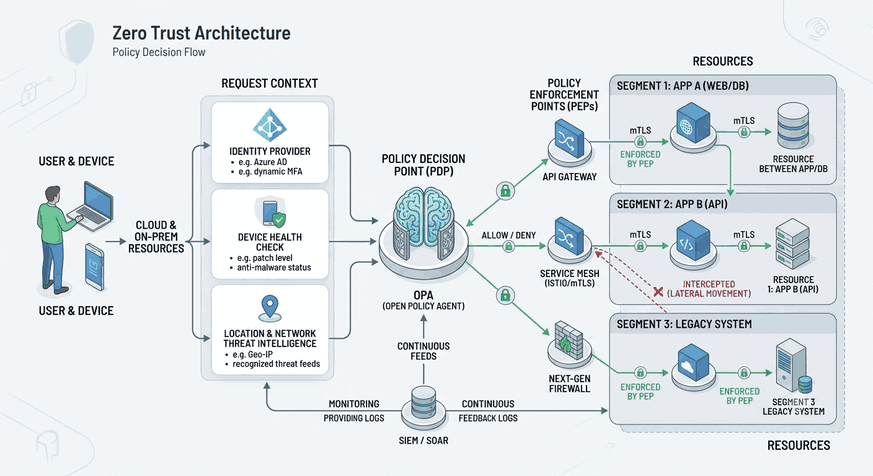
To stop attackers:
Least Privilege: Users should only be granted the rights they need.
Tiered Administration: Domain Admin privileges should only be used on the most secure servers and never on user machines.
EDR Solutions: Advanced Endpoint Detection & Response (EDR) systems capable of detecting in-memory attacks and unusual process interactions should be used.
Each of these processes is a game of chess based on finding the weak link of a network and bringing down the entire system from that link. Alongside technical knowledge, the ability to analyze the network structure (topology) is the most important feature that distinguishes a penetration testing expert from others.