Superposition Theorem and Analytical Investigation of Multi-Source Linear Circuits

The Superposition Theorem, one of the cornerstones of electrical and electronics engineering, is a mathematical approach that reduces complex circuit networks into solvable parts. Especially in linear circuits containing multiple independent voltage or current sources, isolating the individual effect of each source on the system is of critical importance in design and analysis processes.

Superposition Theorem and Analytical Investigation of Multi-Source Linear Circuits

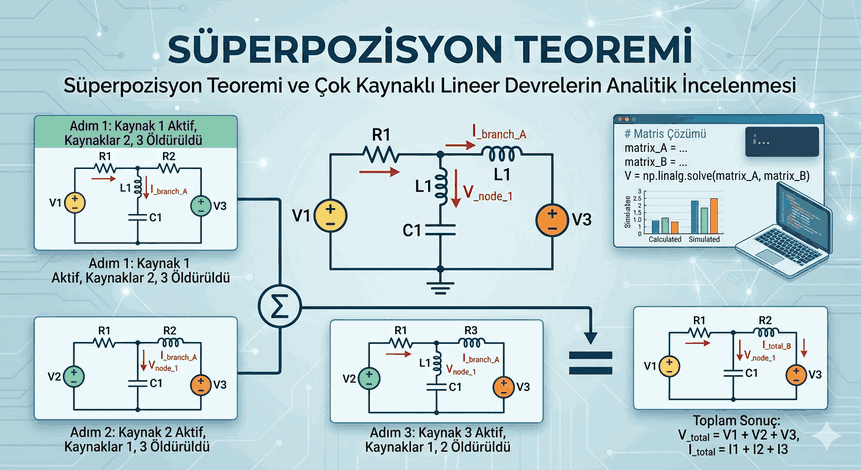
Figure 1: Superposition Theorem and Analytical Investigation of Multi-Source Linear Circuits.


1. Theoretical Foundations of Linearity and Superposition

The Superposition Theorem is only valid in linear circuits. For a circuit to be considered linear, it must satisfy the properties of additivity and homogeneity. Mathematically, if $x$ is the input and $y$ is the output of a system, the equality $f(ax_1 + bx_2) = af(x_1) + bf(x_2)$ must hold.

In this context, passive components such as resistors, capacitors, and inductors are considered linear elements (under ideal conditions). However, in circuits containing non-linear elements such as diodes and transistors, this theorem cannot be applied directly; in this case, linearization must be performed using small-signal models.

Fundamental Principle

In a circuit with multiple independent sources, the current in any branch or the voltage between any two points is equal to the algebraic sum of the currents or voltages produced by each source acting alone (while other sources are killed).


2. Passivization (Killing) of Sources

The most critical step when applying the theorem is to neutralize all independent sources other than the one being analyzed. During this process, the topological structure of the circuit must be preserved, and only the internal resistances of the sources should be considered:

  • Voltage Sources: The internal resistance of an ideal voltage source is zero. Therefore, it is short-circuited when passivized.
  • Current Sources: The internal resistance of an ideal current source is infinite. Therefore, it is open-circuited when passivized.
  • Dependent Sources: Since these sources depend on a variable at another point in the circuit, they are never killed. They must remain active throughout the analysis.

3. Application Steps and Methodology

For a systematic analysis, the following algorithm must be followed:

  1. Source Selection: One of the independent sources in the circuit is selected.
  2. Passivizing Others: All independent voltage sources other than the selected one are short-circuited, and current sources are open-circuited.
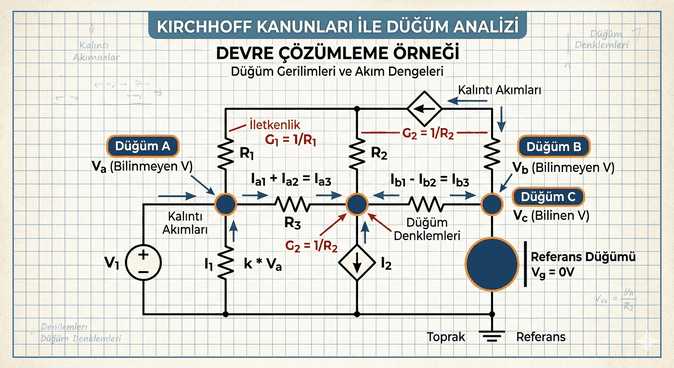
  3. Partial Analysis: The circuit is solved for the single selected source using standard methods (Ohm’s Law, Kirchhoff’s Laws, Nodal/Mesh Analysis). The current ($i_1, i_2, ...$) or voltage ($v_1, v_2, ...$) values in the relevant branch are recorded, paying attention to their directions.
  4. Repetition: This process is repeated separately for each independent source in the circuit.
  5. Algebraic Sum: All partial results obtained are summed according to the reference directions determined at the beginning.

Important Note: Power ($P = I^2 \cdot R$ or $P = V^2 / R$) is not a linear function. For this reason, superposition cannot be applied directly in power calculations. If the total power is to be found, the total current or total voltage must be found first, and then the power formula should be applied.


4. Programming and Numerical Simulation Approaches

In modern engineering, these calculations are validated through software as well as being done by hand. Especially for solving large-scale circuit matrices, languages like Python and MATLAB are widely used.

Circuit Analysis with Python: Using SciPy and NumPy

The following code example is an approach that solves nodal voltages in a circuit consisting of two voltage sources and resistors using the matrix method (Nodal Analysis). To manually simulate superposition, we can reset the sources and run them in a loop.

import numpy as np

def solve_circuit(sources, resistances):
    """
    Nodal equations solution for a simple two-mesh circuit.
    sources: [V1, V2] voltage values
    resistances: [R1, R2, R3] resistance values
    """
    # G1, G2, G3 conductance values (1/R)
    G = [1/r for r in resistances]
    
    # Matrix Form: G * V = I
    # Assuming an example bridge circuit or parallel node structure
    matrix_A = np.array([
        [G[0] + G[2], -G[2]],
        [-G[2], G[1] + G[2]]
    ])
    
    matrix_B = np.array([sources[0] * G[0], sources[1] * G[1]])
    
    try:
        node_voltages = np.linalg.solve(matrix_A, matrix_B)
        return node_voltages
    except np.linalg.LinAlgError:
        return "Matrix is singular, no solution."

# Superposition Experiment
R = [100, 200, 150] # Ohm
V_total = [12, 5]    # Volt

# 1. Source active, 2. Source off (0V)
result_1 = solve_circuit([12, 0], R)
# 2. Source active, 1. Source off (0V)
result_2 = solve_circuit([0, 5], R)

# Total Result
total_result = result_1 + result_2

print(f"Partial Voltages (V1 active): {result_1}")
print(f"Partial Voltages (V2 active): {result_2}")
print(f"Total Nodal Voltages: {total_result}")

Software Libraries and Tools

  • Spice (LTspice, PSpice): These industry-standard tools allow you to analyze superposition using the .step command or by resetting sources.
  • PySpice: Ideal for creating and solving netlists of complex circuits using the Ngspice engine via Python.
  • SciPy (Optimize & LinAlg): The fundamental library for matrix solutions and optimization operations.

5. Technical Details to Consider in Precision Calculations

The reason the superposition theorem is described as “precise” is that it provides the ability to model the error margin (tolerance) and temperature coefficient of each source separately.

Error Analysis and Tolerances

Production tolerances on resistors ($\pm \%1, \pm \%5$) play a critical role in high-precision medical or military devices. With the superposition method, it can be determined which source is more sensitive to tolerance changes (sensitivity analysis).

Frequency Domain Analysis (AC Circuits)

When applying superposition in AC circuits, the frequencies of the sources may differ. If there are sources with different frequencies, circuit impedances ($Z_L = j\omega L$, $Z_C = 1/j\omega C$) must be recalculated for each frequency. The results are summed in the time domain ($t$) to obtain complex waveforms.


6. Boundary Conditions and Disadvantages

Although it is a powerful tool, the Superposition Theorem is not the most efficient path in every scenario:

  1. Computational Intensity: As the number of sources increases (e.g., a network with 10 sources), 10 separate circuit analyses must be performed. In this case, performing a single matrix solution using the Nodal Voltages or Mesh Currents method is much faster.
  2. Dependent Source Complexity: There is a high probability of error in circuits with dependent sources, because these sources cannot be passivized and must be included in the equations for each partial analysis.
  3. Power Calculation Fallacy: The most common engineering mistake is trying to reach the total power by summing partial powers. It must be remembered that $(a+b)^2 \neq a^2 + b^2$.

Conclusion

The Superposition Theorem is not just a calculation method in the analysis of linear systems, but also a perspective. It reduces the complexity of a system to simplicity with a “divide and conquer” strategy. In engineering practice, especially in fields like RF (Radio Frequency) design and signal processing, it is indispensable for understanding the effect of different signal components. When integrated with the software world, it forms the basis of powerful algorithms that can perform network optimization on large datasets.

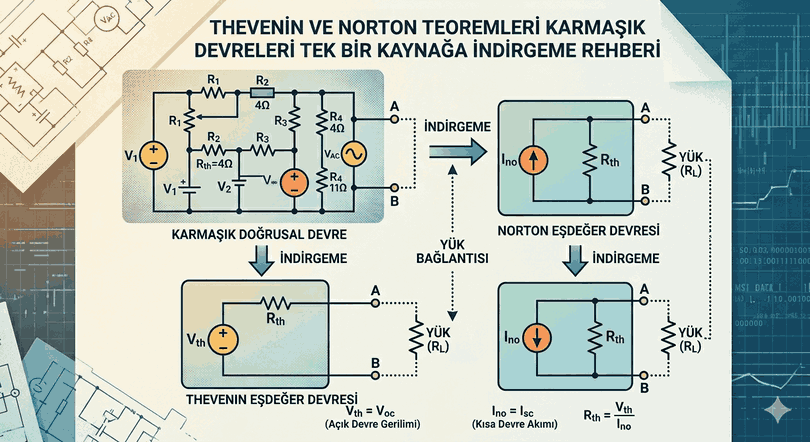
In advanced circuit analysis, this theorem is combined with Thevenin and Norton theorems to produce much faster and error-free results using equivalent models of certain parts of the circuit. Not neglecting the internal resistances of sources in precision calculations and checking the mathematical consistency of each step are the keys to a professional analysis.

#blog #electric #electronics #superposition-theorem #circuit-analysis #linear-systems #circuit-solution #kirchhoff-laws

Related Contents

Modern Rechargeable Battery Technologies and Electrochemical Performance Analysis

This blog post, which details modern battery technologies and the electrochemical operating principles of these systems, examines the technical specifications, performance metrics, and usage advantages of Li-ion, LiFePO4, NiMH, Ni-Cd, and lead-acid batteries from an engineering perspective.

blog electronics battery-technologies lithium-ion li-ion battery-performance lifepo4 nickel-metal-hydride rechargeable-batteries battery-management-systems ni-cd ni-mh energy-systems battery-analysis

Post-Exploitation Strategies and In-Depth Analysis in Internal Network Penetration Tests

This article analyzes post-exploitation techniques in internal network penetration tests, including privilege escalation methods, persistence mechanisms, and lateral movement processes within Active Directory with technical code examples. Professional tools such as Mimikatz, Impacket, and BloodHound are covered.

blog cyber-security network-security information-security cloud-security network privilege-escalation penetration-testing red-team post-exploitation active-directory lateral-movement intranet internal-network local-network

OWASP Top 10 Security Strategies in .NET 8 Projects

A critical guide for secure coding in .NET 8 projects! Discover how to protect your application using tools like EF Core, Data Protection API, and policy-based authorization against OWASP Top 10 threats with technical examples. Learn fundamental strategies for secure software architecture.

blog cyber-security dotnet owasp network-security information-security cloud-security

Modern Network Strategies with Zero Trust Architecture

Zero Trust architecture is a modern security strategy that dismantles the 'default trust' paradigm in today's hybrid world, where network boundaries have become increasingly blurred. This approach treats every user, device, and service as a potential risk factor—whether inside or outside the network—by subjecting access requests to continuous, contextual, and rigorous verification.

blog cyber-security zero-trust network-security information-security cloud-security

Veri Analizi Okulu: Data Science and Artificial Intelligence Training

Operating under the coordination of Yükseköğretim Kurumu (YÖK), the Veri Analizi Okulu (VAO) combines theoretical knowledge with practice through modules in Basic Statistics, Computational Social Sciences, Panel Data Analysis, Artificial Intelligence, Digital Humanities, and Psychometrics. Check out our blog post for both a high-quality education and your career.

blog veri-analizi-okulu vao basic-statistics computational-social-sciences panel-data-analysis artificial-intelligence ai-and-facilitating-tools ai ai-and-machine-learning digital-humanities psychometrics

Nur-o-link: Remote-Controlled Robotic Arm and Vehicle System

The Nur-o-link project is an innovative robotics study that combines remote-controllable robotic arm and autonomous vehicle features, highlighting the interaction between hardware and software.

blog robotic robotic-arm robotik iot embedded cplusplus arduino esp32 remote-control software-hardware rex-8in1-v2 electronic

Gungor-robot-car: ESP32 Camera-Controlled Robot Car

A robotic vehicle project capable of live video streaming via WiFi and remote control through a browser-based interface, powered by the ESP32-WROVER module.

blog robotics robotic iot embedded cplusplus arduino esp32 esp32-cam esp32-camera remote-control robotic-car electronic electronics software-hardware

Engineering Fundamentals and Mechanical Analysis of Flexible Structures in Soft Robotic Systems

A high-technical-depth blog post focusing on control algorithms and material mechanics, exploring the transformation of traditional rigid robotic systems through flexible elastomers and bio-mimetic approaches.

blog robotics soft-robotics mechatronics control-systems simulation engineering

Collective Intelligence and Dynamic Task Allocation in Swarm Robotic Systems

A technical blog post examining the technical foundations, algorithmic approaches, and software libraries for collective intelligence, dynamic task sharing, and distributed control mechanisms in swarm robotic systems.

blog robotics autonomous swarm-robotics multi-agent-systems task-allocation ros2 collective-decision-making distributed-systems swarm-intelligence intelligent-robots

The Evolution of Robotic Systems and Modern Migration Strategies to the ROS 2 Ecosystem

This blog post addresses the architectural changes in the transition process from ROS 1 to ROS 2, the technical advantages of the DDS-based communication layer, and system modernization strategies using modern software libraries in a technical language.

blog robotic robotics autonomous ros2 dds industrial-automation real-time-systems control-systems microservices

Agriculture 4.0 and Next-Generation Approaches in Autonomous Robotic Systems

A blog post covering navigation strategies for autonomous vehicles in the Agriculture 4.0 ecosystem, deep learning-based crop monitoring algorithms, and ROS 2-based software architectures.

blog robotics autonomous agriculture-4-0 path-planning crop-monitoring ros2 smart-farming precision-agriculture ai lidar image-processing sensor-fusion edge-computing

Topological Approaches in Data Science and Graph Theory-Based Network Analysis with Gephi

This technical blog post provides an in-depth analysis of how to visualize complex relationships in big data sets using graph theory and the Gephi software, accompanied by mathematical metrics and software libraries.

blog gephi network-analysis data-visualization graph-theory network-analysis python data-science centrality-metrics complex-systems

Deep Learning-Based Object Detection and Manipulation Techniques in Autonomous Robotic Systems

A technical review and software integration of modern robotic systems equipped with deep learning architectures, 6-DoF grasping strategies, and real-time object recognition algorithms.

blog robotics autonomous ai python pytorch ros2 yolo opencv autonomous-robots deep-learning machine-learning

Deep Dive into the Fundamental Building Blocks of Electronic Design: Engineering Foundations of Passive Component Selection

This blog post covers the non-ideal parasitic parameters, frequency-dependent behaviors, and modern engineering selection criteria for capacitors and inductors, which are critical in electronic circuit design, along with Python-based analysis methods.

blog electronics passive-components capacitor-selection inductor-parameters esr esl frequency-analysis circuit-simulation

Advanced Spatial Analysis and Data Science Integration in Modern Geographic Information Systems

A blog post covering data mining in the ArcGIS ecosystem, Python-based automation processes, and spatial statistics methods to transform raw location data into strategic decision support mechanisms.

blog arcgis spatial-analysis geographic-information-systems python arcpy mapping spatial-statistics data-science big-data

Mathematical Architecture of Complex Circuits and Nodal Analysis Method

Theoretical analysis of the nodal analysis method based on Kirchhoff's Current Law, the supernode concept, and modeling of circuit solutions with computational engineering approaches using the NumPy library.

blog electric electronic circuit-analysis kirchhoff-laws nodal-analysis numpy circuit-simulation circuit-theory supernode

Joule Heating and Advanced Thermal Management Strategies in Modern Electronics

A blog post covering the physical foundations of Joule heating, advanced PCB design techniques for optimizing thermal management in modern circuits, PID-based cooling algorithms, and embedded software control mechanisms.

blog electricity electronics joule joule-heating thermal-management heat-distribution power-electronics

Engineering Analysis and Selection Strategies for Resistor Parameters in Circuit Design

A technical blog post examining critical resistor parameters beyond Ohm's Law in real-world circuit designs, including parasitic effects and engineering calculations.

blog electrical electronics ohms-law circuit-analysis electronic-design resistor-selection engineering

Reduction Methods and Numerical Analysis Approaches in Linear Circuit Analysis

This article examines methods for simplifying complex electrical circuits using Thevenin and Norton theorems, mathematical analysis steps, and Python-based numerical analysis techniques from a detailed engineering perspective.

blog electric electrical-circuits circuit-analysis thevenin-theorem norton-theorem circuit-reduction linear-circuits

Professional Debugging Strategies and In-Depth Analysis Techniques in Embedded Systems Development

A technical article covering professional debugging processes in embedded systems under hardware constraints and real-time requirements, using critical methods such as JTAG/SWD analysis, memory management, and signal integrity.

blog electronics embedded-systems debugging troubleshooting jtag rtos microcontroller hardware

Communication Layers and Protocol Analysis in Modern Smart Home Ecosystems

An in-depth analysis of the technical architectures of Wi-Fi, BLE, and Zigbee protocols, mesh network structures, and software integration processes in smart home ecosystems.

blog iot zigbee wi-fi bluetooth bluetooth-ble communication-protocols electronics mesh-network

Power Management and Efficiency Strategies in Arduino Projects

A comprehensive technical article on reducing energy consumption to the microampere level in Arduino projects through hardware interventions, deep sleep modes, and the use of low-power regulators.

blog electronics arduino power-optimization embedded-systems deep-sleep battery-life avr

Raspberry Pi and Hardware Integration in Industrial Systems

A comprehensive article examining the use of Raspberry Pi in industrial automation, covering technical details from hardware isolation to RTOS kernel optimization and Modbus/MQTT communication protocols.

blog electronics raspberry-pi iiot iot industrial-automation mqtt rtos plc sensor-data-processing python

Architectural Decision Processes in IoT Projects: A Technical Analysis of ESP32 and ESP8266 Microcontrollers

A comprehensive guide providing an optimized selection strategy for IoT projects by technically analyzing the architectural differences, connectivity capabilities, and hardware features of ESP32 and ESP8266 microcontrollers.

blog iot esp32 esp8266 arduino free-rtos microcontroller electronics wi-fi bluetooth